Results by title
10 books match the query 'Humanitarian intervention'
Beyond International Intervention
Politics of Improvement in SerbiaKatarina Kušic
University of Michigan Press, 2025
By engaging with subjects, the book not only enhances our understanding of intervention, but also uncovers the limitations of the concept. Katarina Kušić argues that the concept limits what we can observe and theorize, and it prevents researchers from engaging with the people living in spaces of intervention as coeval political subjects. As an alternative, she proposes to foreground improvement over “intervention.” This reorientation enables researchers to trace hierarchies beyond the local/international dichotomy, expands fields of visibility beyond those prescribed by interventions themselves, and seriously considers the contradictions at the heart of liberalism.
Civil War, Civil Peace
Helen Yanacopulos
Ohio University Press, 2006
When a cease-fire is arranged, aid workers, military personnel, diplomats, and others pour in from the United States, Europe, and international agencies. Outside help is essential after a war, but too often, well-intentioned interveners do more harm than good. A half of civil wars have resumed after failed peace agreements.
Each war is different, and there can be no intervention handbook or best practices guide. Aimed at practitioners and policy makers, and essential reading for students of war, humanitarian intervention, peace building, and development, Civil War, Civil Peace provides a comprehensive examination of how interventions can be improved through a better understanding of the roots of war and of the grievances and interests that fueled the war.
Essays on Genocide and Humanitarian Intervention
Guenter Lewy
University of Utah Press, 2012
The essays in this book, written over a span of some twenty years but updated for this publication, discuss episodes of mass murder that are often considered instances of genocide: the large-scale killing of Armenians in Ottoman Turkey during World War I, the near-extinction of North America’s Indian population, the vicious persecution of the “Roma” or Gypsies under the Nazi regime. But in line with Article II of the Genocide Convention of 1948, Lewy stresses the crucial importance of looking closely at the intent of the perpetrators. In contrast to the Holocaust, the killers in the atrocities mentioned above did not seek to destroy an entire people, and so, these three large-scale killings do not deserve the label of genocide.
Lewy argues that affirming the distinctiveness of the Holocaust does not deny, downgrade, or trivialize the suffering of other people. The crimes against the Ottoman Armenians, the American Indians, and the Gypsies—even if they did not reach the threshold of genocide—involved horrendous suffering and a massive loss of life. The genocides of Cambodia and Rwanda that took place in the second half of the twentieth century remind us that man’s inhumanity to man can take many forms and is not the special prerogative of any particular group. The last essay of the collection deals with the complications of humanitarian intervention to prevent genocide. As the recent support of the Libyan rebels by NATO demonstrates, the issues raised here remain topical and controversial.
First Do No Harm
Humanitarian Intervention and the Destruction of YugoslaviaDavid N. Gibbs
Vanderbilt University Press, 2009
The book focuses on the 1991-99 breakup of Yugoslavia, which helped forge the idea that the United States and its allies could stage humanitarian interventions that would end ethnic strife. It is widely believed that NATO bombing campaigns in Bosnia and Kosovo played a vital role in stopping Serb-directed aggression, and thus resolving the conflict.
Gibbs challenges this view, offering an extended critique of Samantha Power's Pulitzer Prize-winning book, A Problem from Hell: America in the Age of Genocide. He shows that intervention contributed to the initial breakup of Yugoslavia, and then helped spread the violence and destruction. Gibbs also explains how the motives for U.S. intervention were rooted in its struggle for continued hegemony in Europe.
First Do No Harm argues for a new, noninterventionist model for U.S. foreign policy, one that deploys nonmilitary methods for addressing ethnic violence.

Fools' Crusade
Yugoslavia, NATO and Western DelusionsDiana Johnstone
Pluto Press, 2002
Thanks to massive deception and self-deception by media and politicians, even the anti-globalisation movement failed to grasp the implications of the aggressive military globalisation pursued by the United States, from Iraq to Afghanistan and beyond.
In this study, Diana Johnstone identifies the common geopolitical interests running through all these past, present and future military interventions. She argues persuasively that outside intervention creates rather than solves problems and cannot be justified.
Johnstone shows that the 'War in Kosovo' was in reality the model for future destruction of countries seen as potential threats to the hegemony of the 'International Community', led by the United States.
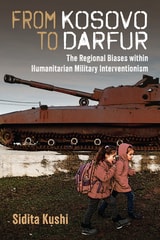
From Kosovo to Darfur
The Regional Biases within Humanitarian Military InterventionismSidita Kushi
University of Michigan Press, 2025
Using in-depth case studies and new data on all post–Cold War internal armed conflicts matched to third-party responses, From Kosovo to Darfur offers the first regionally sensitive analysis of humanitarian military intervention since the end of the Cold War. It shows that international military interventions in the context of acute humanitarian crises are driven by different pathways within the Western versus the non-Western world and fueled by elite perceptions of the crisis, making interventions closer to the geographic and cultural West most probable and most intense. As our international community becomes increasingly interdependent and aware of human suffering across borders, From Kosovo to Darfur points to new pathways of conflict trajectories and reveals vital implications for leaders, scholars, and nongovernmental actors advocating for or against international military intervention as a policy choice.
From Kosovo to Kabul and Beyond
Human Rights and International InterventionDavid Chandler
Pluto Press, 2006
Edward S. Herman
'Chandler deftly unpicks the hypocrisy and double standards behind our "ethical" bombing in the balkans and Asia.'
Independent
'Chandler's book is thorough and relentless in its critique of human rights consensus.'
Spiked
'David Chandler has emerged in recent years as one of Britain's foremost critics of the hypocrisy of human rights.'
The Spectator
This new and updated edition of David Chandler's acclaimed book takes a critical look at the way in which human rights issues have been brought to the fore in international affairs. The UN and Nato's new policy of interventionism--as shown in Iraq, Somalia, Bosnia, Kosovo and East Timor--has been hailed as part of a new 'ethical' approach to foreign policy. David Chandler offers a rigorous critique of this apparently benign shift in international relations to reveal the worrying political implications of a new human rights discourse. He asks why the West can now prioritise the rights of individuals over the traditional rights of state sovereignty, and why this shift has happened so quickly. Charting the development of a human rights-based foreign policy, he considers the theoretical problems of defining human rights and sets this within the changing framework of international law. Meticulous and compelling, From Kosovo to Kabul and Beyond offers a disturbing insight into the political implications of a human rights-led foreign policy, and the covert agenda that it conceals.
David Chandler is Professor of International Relations, Centre for the Study of Democracy, University of Westminster. He has written widely on democracy, human rights and international relations and is also the author of Bosnia: Faking Democracy After Dayton (Pluto Press, 1999/ 2000) and Constructing Global Civil Society: (2004), editor of Rethinking Human Rights: Critical Approaches to International Politics (2002) and Peace without Politics: Ten Years of State-Building in Bosnia (2005), and co-editor of Global Civil Society: Contested Futures (2005).
Human Rights at Risk
Global Governance, American Power, and the Future of DignitySalvador Santino F. Regilme Jr. and Irene Hadiprayitno
Rutgers University Press, 2022
Prelude to Genocide
Arusha, Rwanda, and the Failure of DiplomacyDavid Rawson
Ohio University Press, 2018
As the initial US observer, David Rawson participated in the 1993 Rwandan peace talks at Arusha, Tanzania. Later, he served as US ambassador to Rwanda during the last months of the doomed effort to make them hold. Despite the intervention of concerned states in establishing a peace process and the presence of an international mission, UNAMIR, the promise of the Arusha Peace Accords could not be realized. Instead, the downing of Rwandan president Habyarimana’s plane in April 1994 rekindled the civil war and opened the door to genocide.
In Prelude to Genocide, Rawson draws on declassified documents and his own experiences to seek out what went wrong. How did the course of political negotiations in Arusha and party wrangling in Kigali, Rwanda, bring to naught a concentrated international effort to establish peace? And what lessons are there for other international humanitarian interventions? The result is a commanding blend of diplomatic history and analysis that is a milestone read on the Rwandan crisis and on what happens when conflict resolution and diplomacy fall short.
Published in partnership with the ADST-DACOR Diplomats and Diplomacy Series.
Reluctant Interveners
America's Failed Responses to Genocide from Bosnia to DarfurEyal Mayroz
Rutgers University Press, 2020
Featured in the 2020 Association of University Presses Book, Jacket, and Journal Show
Why do we allow our governments to get away with “bystanding” to genocide? How can we, when alerted to the mass slaughter of innocents, still not take a stand? Reluctant Interveners provides the most comprehensive answers yet to these confronting questions, focusing on the complex relationships between the citizenry, the media, the political elites, and institutions in the most powerful nation in the world, the United States of America.
Eyal Mayroz offers a sobering account of the interactions between the governing and the governed, and the dynamics which transformed moral concerns for the lives of faraway “others” into cold political calculations. Exposed are the processes that turned the promise of “never again” to a recurring reality of ever again, the role of the office of the presidency in their advancement, and the resultant image of America as seen by the rest of the world. In a time of ubiquitous social media and populist revival, a greater role for the U.S. citizenry in decision-making on responses to genocide may be in the cards. The question is, in which directions will these trends take American foreign policy?