Results by title
32 books match the query 'Humanity'
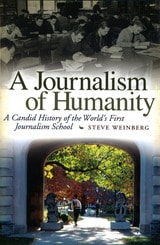
A Journalism of Humanity
A Candid History of the World's First Journalism SchoolSteve Weinberg
University of Missouri Press, 2008
It might seem unlikely that a midwestern university located far from national media centers would be home to the world’s first journalism school, but the University of Missouri holds that distinction. Now celebrating its centennial, the School of Journalism, founded by a newsman who lacked a college education, is regarded as one of the highest-rated in the world.
Steve Weinberg, an alumnus and investigative reporter who returned to teach at Missouri, now covers—and uncovers—the many-faceted history of its School of Journalism, from the days of Walter Williams through the Dean Mills era. A Journalism of Humanity balances the dynamics of the university that set the school’s course with the external forces that shaped journalism and society. True to journalism, it reveals the school’s flaws as well as its virtues.
Bringing his investigative expertise to bear, Weinberg tells the school’s complex story through thematic chapters. He draws on internal documents and correspondence to uncover the politics of the school from its founding to the present—the struggles over resources as well as the constant battle to balance scholarly ambitions with professional mission. In the course of his chronicle, he depicts an institution ahead of its time in professional education but often lagging in dealing with social issues such as race and gender.
Weinberg’s account embraces faculty and staff members, students and alumni, supporters and detractors, as it covers all professional sequences taught at the school. It captures the freewheeling debate that has been a hallmark of the school and includes the perspectives of women, blacks, and gays, who all too often were marginalized. It also incorporates a wealth of insider detail, from a typical day at the school during the Williams era to tales of the “Missouri Mafia.”
Key players, significant programs, legal and ethical battles—all are covered in a candid history that makes captivating reading for those associated with the school or for anyone interested in the development of journalism education. A Journalism of Humanity is a story as big as its subject that looks back on a trailblazing century and forward toward a continuing dedication to journalistic excellence.
Afrofuturisms
Ecology, Humanity, and Francophone Cultural ExpressionsIsaac Vincent Joslin
Ohio University Press, 2023
Art Without Borders
A Philosophical Exploration of Art and HumanityBen-Ami Scharfstein
University of Chicago Press, 2009
People all over the world make art and take pleasure in it, and they have done so for millennia. But acknowledging that art is a universal part of human experience leads us to some big questions: Why does it exist? Why do we enjoy it? And how do the world’s different art traditions relate to art and to each other?
Art Without Borders is an extraordinary exploration of those questions, a profound and personal meditation on the human hunger for art and a dazzling synthesis of the whole range of inquiry into its significance. Esteemed thinker Ben-Ami Scharfstein’s encyclopedic erudition is here brought to bear on the full breadth of the world of art. He draws on neuroscience and psychology to understand the way we both perceive and conceive of art, including its resistance to verbal exposition. Through examples of work by Indian, Chinese, European, African, and Australianartists, Art Without Borders probes the distinction between accepting a tradition and defying it through innovation, which leads to a consideration of the notion of artistic genius. Continuing in this comparative vein, Scharfstein examines the mutual influence of European and non-European artists. Then, through a comprehensive evaluation of the world’s major art cultures, he shows how all of these individual traditions are gradually, but haltingly, conjoining into a single current of universal art. Finally, he concludes by looking at the ways empathy and intuition can allow members of one culture to appreciate the art of another.
Lucid, learned, and incomparably rich in thought and detail, Art Without Borders is a monumental accomplishment, on par with the artistic achievements Scharfstein writes about so lovingly in its pages.
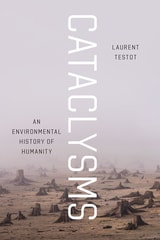
Cataclysms
An Environmental History of HumanityLaurent Testot
University of Chicago Press, 2020
Testot explores the interconnected histories of human evolution and planetary deterioration, arguing that our development from naked apes to Homo sapiens has entailed wide-scale environmental harm. Testot makes the case that humans have usually been catastrophic for the planet, “hyperpredators” responsible for mass extinctions, deforestation, global warming, ocean acidification, and unchecked pollution, as well as the slaughter of our own species. Organized chronologically around seven technological revolutions, Cataclysms unspools the intertwined saga of humanity and our environment, from our shy beginnings in Africa to today’s domination of the planet, revealing how we have blown past any limits along the way—whether by exploding our own population numbers, domesticating countless other species, or harnessing energy from fossils. Testot’s book, while sweeping, is light and approachable, telling the stories—sometimes rambunctious, sometimes appalling—of how a glorified monkey transformed its own environment beyond all recognition.
In order to begin reversing our environmental disaster, we must have a better understanding of our own past and the incalculable environmental costs incurred at every stage of human innovation. Cataclysms offers that understanding and the hope that we can now begin to reform our relationship to the Earth.
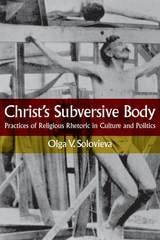
Christ's Subversive Body
Practices of Religious Rhetoric in Culture and PoliticsOlga V. Solovieva; Foreword by Haun Saussy
Northwestern University Press, 2018
Solovieva’s survey includes the iconoclastic polemics of Epiphanius at the moment of struggles for supremacy between the Roman state and the Christian church, the mystical theologico-political alchemy of an anonymous treatise circulated at the Council of Constance, Lavater’s counter-Enlightenment visions of the afterlife expressd through physiognomy, Dostoevsky’s refashioning of ethical communities, Pier Paolo Pasolini’s attempts to provoke the “scandal” of Jesus’s mission once more in the modern world, and the elaboration of a political theology subordinating democratic dissent to the higher unity of a corporately conceived “unitary executive” in early twenty-first-century America.
Solovieva presents her findings not as an entry into theological or Christological debates but rather as a study in comparative discourse analysis. She demonstrates how these uses of Christ’s body are triggered by moments of epistemological, political, and representational crisis in the history of Western civilization.
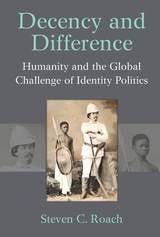
Decency and Difference
Humanity and the Global Challenge of Identity PoliticsSteven C. Roach
University of Michigan Press, 2019
Decency remains one of the most prevalent yet least understood terms in today’s political discourse. In evoking respect, kindness, courage, integrity, reason, and tolerance, it has long expressed an unquestioned duty and belief in promoting and protecting the dignity of all persons. Today this unquestioned belief is in crisis. Tribalism and identity politics have both hindered and threatened its moral stability and efficacy. Still, many continue to undertheorize its political character by isolating it from the effects of identity politics. Decency and Difference argues that decency is a primary source of the political tension that has long shaped the struggles for power, identity, and justice in the global arena. It distinguishes among basic, conservative, and liberal strands of decency to critically examine the many conflicting and competing applications of decency in global politics. Together these different strands reflect a long and uneven evolution from the British and American empires to a global network of justice. This powerful book exposes the gaps of decency and the disparate ways it is practiced, thus addressing the global challenge of configuring a diverse political ethic of decency.
Discourse on the State and Grandeurs of Jesus
The Ineffable Union of the Diety with HumanityPierre de Bérulle
Catholic University of America Press, 2023
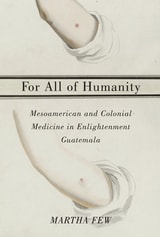
For All of Humanity
Mesoamerican and Colonial Medicine in Enlightenment GuatemalaMartha Few
University of Arizona Press, 2015
For All of Humanity examines the first public health campaigns in Guatemala, southern Mexico, and Central America in the eighteenth and early nineteenth centuries. Martha Few pays close attention to Indigenous Mesoamerican medical cultures, which not only influenced the shape and scope of those regional campaigns but also affected the broader New World medical cultures. The author reconstructs a rich and complex picture of the ways colonial doctors, surgeons, Indigenous healers, midwives, priests, government officials, and ordinary people engaged in efforts to prevent and control epidemic disease.
Few’s analysis weaves medical history and ethnohistory with social, cultural, and intellectual history. She uses prescriptive texts, medical correspondence, and legal documents to provide rich ethnographic descriptions of Mesoamerican medical cultures, their practitioners, and regional pharmacopeia that came into contact with colonial medicine, at times violently, during public health campaigns.
For the Good of Humanity
Ludwik Rajchman, Medical StatesmanMarta A. Balinska
Central European University Press, 1998
From the Enemy's Point of View
Humanity and Divinity in an Amazonian SocietyEduardo Viveiros de Castro
University of Chicago Press, 1992
Building upon ethnographic description and interpretation, Viveiros de Castro addresses the central aspect of the Arawete's concept of divinity—consumption—showing how its cannibalistic expression differs radically from traditional representations of other Amazonian societies. He situates the Araweté in contemporary anthropology as a people whose vision of the world is complex, tragic, and dynamic, and whose society commands our attention for its extraordinary openness to exteriority and transformation. For the Araweté the person is always in transition, an outlook expressed in the mythology of their gods, whose cannibalistic ways they imitate. From the Enemy's Point of View argues that current concepts of society as a discrete, bounded entity which maintains a difference between "interior" and "exterior" are wholly inappropriate in this and in many other Amazonian societies.
Game
Animals, Video Games, and HumanityTom Tyler
University of Minnesota Press, 2022
A playful reflection on animals and video games, and what each can teach us about the other
Video games conjure new worlds for those who play them, human or otherwise: they’ve been played by cats, orangutans, pigs, and penguins, and they let gamers experience life from the perspective of a pet dog, a predator or a prey animal, or even a pathogen. In Game, author Tom Tyler provides the first sustained consideration of video games and animals and demonstrates how thinking about animals and games together can prompt fresh thinking about both.
Game comprises thirteen short essays, each of which examines a particular video game, franchise, aspect of gameplay, or production in which animals are featured, allowing us to reflect on conventional understandings of humans, animals, and the relationships between them. Tyler contemplates the significance of animals who insert themselves into video games, as protagonists, opponents, and brute resources, but also as ciphers, subjects, and subversive guides to new ways of thinking. These animals encourage us to reconsider how we understand games, contesting established ideas about winning and losing, difficulty settings, accessibility, playing badly, virtuality, vitality and vulnerability, and much more.
Written in a playful style, Game draws from a dizzying array of sources, from children’s television, sitcoms, and regional newspapers to medieval fables, Shakespearean tragedy, and Edwardian comedy; from primatology, entomology, and hunting and fishing manuals to theological tracts and philosophical treatises. By examining video games through the lens of animals and animality, Tyler leads us to a greater humility regarding the nature and status of the human creature, and a greater sensitivity in dealings with other animals.
In the Name of Humanity
The Government of Threat and CareIlana Feldman and Miriam Ticktin, eds.
Duke University Press, 2010
The editors argue that ideas about humanity find concrete expression in the governing work that operationalizes those ideas to produce order, prosperity, and security. As a site of governance, humanity appears as both an object of care and a source of anxiety. Assertions that humanity is being threatened, whether by environmental catastrophe or political upheaval, provide a justification for the elaboration of new governing techniques. At the same time, humanity itself is identified as a threat (to nature, to nation, to global peace) which governance must contain. These apparently contradictory understandings of the relation of threat to the category of humanity coexist and remain in tension, helping to maintain the dynamic co-production of governance and humanity.
Contributors. Arun Agrawal, Joao Biehl , Didier Fassin, Allen Feldman, Ilana Feldman, Rebecca Hardin, S. Lochann Jain, Liisa Malkki, Adriana Petryna, Miriam Ticktin, Richard Ashby Wilson, Charles Zerner
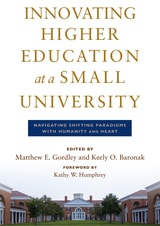
Innovating Higher Education at a Small University
Navigating Shifting Paradigms with Humanity and HeartMatthew E. Gordley
Rutgers University Press, 2027
Higher education is at a moment of real uncertainty. Colleges and universities are being asked to respond to changing student needs, financial pressure, and growing questions about value and purpose. Innovating Higher Education at a Small University offers a grounded and hopeful response to these challenges. Through a series of real, lived case studies, the book shows how one small, mission driven institution is rethinking how it teaches, partners, and serves its community. Spanning interdisciplinary work across teacher preparation, literacy, healthcare, and the arts, the chapters highlight what becomes possible when faculty and leaders are trusted to innovate with intention and care. Each chapter shares not only what was built, but also what was learned along the way, offering clear insights that others can adapt to their own contexts. Not a book about abstract trends or emerging technologies, it is grounded in program design, relationships, and project implementation. It is a book about people doing the work, and a reminder that meaningful change in higher education is already happening in places willing to lead with both humanity and purpose.

Jewish Universalisms
Mendelssohn, Cohen, and Humanity’s Highest GoodJeremy Fogel
Brandeis University Press, 2023
Any version of universalism relevant to a more attentive, pluralistic, and postcolonial outlook would balance the urgent current need for a universalistic perspective with the desire to maintain the richness of human diversity. The modern Jewish philosophers who sought to partake in the Enlightenment’s universalistic vision while maintaining their distinct identities as members of a religious minority within Europe offer insightful answers.
Jewish Universalisms analyzes how two major figures, Moses Mendelssohn and Hermann Cohen, dealt with the perceived tension between the universal values characteristic of the Enlightenment and aspects of Judaism often depicted as particularistic and parochial. Jeremy Fogel joins this lively debate in modern Jewish philosophy, offering a comparative examination of these thinkers and analyzing their worldviews from an innovative axiological perspective. Fogel writes that to gain a precise understanding of how Mendelssohn and Cohen argued for the concordance of Judaism and universalism, one must first seek out what they delineated as ultimately valuable. Then one can work out how that highest good, and the method of valuation it sustains, are universal.
John Stuart Mill and the Religion of Humanity
Linda C. Raeder
University of Missouri Press, 2002
Life, Emergent
The Social in the Afterlives of ViolenceYasmeen Arif
University of Minnesota Press, 2016
How does an inquiry into life as it lives (or dies) amid mass violence look like from the perspective of the “social”? Taking us from Sierra Leone to India to Lebanon, Life, Emergent challenges conventional understandings of biopolitics, weaving a politics of life through the lens of life, not death.
Arguing that the “letting die” element of biopolitics has been overemphasized, Yasmeen Arif zeros in on biopolitics’ other pole: “making live.” She does so by highlighting the various means and the forms of life configured in the aftermath—or afterlives—of violent events in contexts of law, justice, community, and identity. Her analysis of the social repercussions is both global and local in scope. Arif examines the convictions made in the Special Court of Sierra Leone, the first hybrid court of its nature under international criminal law. Next, she explores the making of a justice movement in the context of Hindu–Muslim violence in 2002 in the state of Gujarat, India. From there she revisits the Sikh carnage in Delhi of 1984. Finally, she explores a span of civil violence in Lebanon, and particularly, its effects on the city of Beirut.
This rigorously argued book brings together the various strands of life and the social that each chapter has disentangled—and in doing so it begins to frame a politics of, and in, life.

Model Machines
A History of the Asian as AutomatonLong T. Bui
Temple University Press, 2022
In the contemporary Western imagination, Asian people are frequently described as automatons, which disavows their humanity. In Model Machines, Long Bui investigates what he calls Asian roboticism or the ways Asians embody the machine and are given robotic characteristics.
Bui offers the first historical overview of the overlapping racialization of Asians and Asian Americans through their conflation with the robot-machine nexus. He puts forth the concept of the “model machine myth,” which holds specific queries about personhood, citizenship, labor, and rights in the transnational making of Asian/America.
The case studies in Model Machines chart the representation of Chinese laborers, Japanese soldiers, Asian sex workers, and other examples to show how Asians are reimagined to be model machines as a product of globalization, racism, and colonialism. Moreover, it offers examples of how artists and everyday people resisted that stereotype to consider different ways of being human. Starting from the early nineteenth century, the book ends in the present with the new millennium, where the resurgence of China presages the “rise of the machines” and all the doomsday scenarios this might spell for global humanity at large.

Not Your Average Zombie
Rehumanizing the Undead from Voodoo to Zombie WalksBy Chera Kee
University of Texas Press, 2017
The zombie apocalypse hasn’t happened—yet—but zombies are all over popular culture. From movies and TV shows to video games and zombie walks, the undead stalk through our collective fantasies. What is it about zombies that exerts such a powerful fascination? In Not Your Average Zombie, Chera Kee offers an innovative answer by looking at zombies that don’t conform to the stereotypes of mindless slaves or flesh-eating cannibals. Zombies who think, who speak, and who feel love can be sympathetic and even politically powerful, she asserts.
Kee analyzes zombies in popular culture from 1930s depictions of zombies in voodoo rituals to contemporary film and television, comic books, video games, and fan practices such as zombie walks. She discusses how the zombie has embodied our fears of losing the self through slavery and cannibalism and shows how “extra-ordinary” zombies defy that loss of free will by refusing to be dehumanized. By challenging their masters, falling in love, and leading rebellions, “extra-ordinary” zombies become figures of liberation and resistance. Kee also thoroughly investigates how representations of racial and gendered identities in zombie texts offer opportunities for living people to gain agency over their lives. Not Your Average Zombie thus deepens and broadens our understanding of how media producers and consumers take up and use these undead figures to make political interventions in the world of the living.
Our Planetary Mirror
Earth Science and the Reimagining of HumanityBoris Shoshitaishvili
University of Chicago Press, 2026
A philosophical analysis of three scientific visions of humanity: the noosphere, the Anthropocene, and Gaia theory.
How can we explain humanity’s unique relationship to the Earth? In Our Planetary Mirror, cultural theorist Boris Shoshitaishvili considers the three major forms of thought Earth scientists have posited in recent years: the noosphere (humans as a layer of thought and culture covering the Earth), the Anthropocene (humans as a geological force), and Gaia theory (humans as part of a superorganism comprising life on Earth).
To explore how these concepts extend beyond contemporary science, Shoshitaishvili traces the metaphors at the heart of each framework through their ancient predecessors, including Babylonian myth, Greek philosophy, Aztec metaphysics, and medieval European theology. Using this approach, Shoshitaishvili develops fresh responses to pressing global issues such as geoengineering, artificial intelligence, and the balance between cosmopolitanism and a world of intensified nationalism.
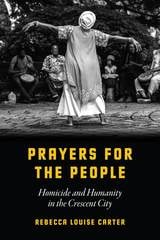
Prayers for the People
Homicide and Humanity in the Crescent CityRebecca Louise Carter
University of Chicago Press, 2019
Inspired by ministers and guided by grieving mothers who hold birthday parties for their deceased sons, Prayers for the People traces the emergence of a powerful new African American religious ideal at the intersection of urban life, death, and social and spiritual change. Carter frames this sensitive ethnography within the complex history of structural violence in America—from the legacies of slavery to free but unequal citizenship, from mass incarceration and overpolicing to social abandonment and the unequal distribution of goods and services. And yet Carter offers a vision of restorative kinship by which communities of faith work against the denial of Black personhood as well as the violent severing of social and familial bonds. A timely directive for human relations during a contentious time in America’s history, Prayers for the People is also a hopeful vision of what an inclusive, nonviolent, and just urban society could be.

Revelation Occurs via Signs
God's Self-Communication to Humanity in Its Semiotic ConstitutionVincent Birch
Catholic University of America Press, 2027
Revelations of Humanity
Anthropological Dimensions of Theological ControversiesRichard Schenk, OP
Catholic University of America Press, 2022
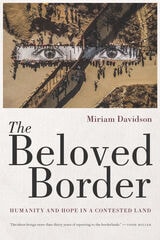
The Beloved Border
Humanity and Hope in a Contested LandMiriam Davidson
University of Arizona Press, 2021
The book draws on a variety of sources to explain how border issues intersect and how the current situation, while made worse under the Trump administration, is in fact the result of decades of prohibition, crackdowns, and wall building on the border. Davidson addresses subjects such as violence in Mexico, particularly against the press; cross-border gun smuggling and legal gun sales; the rise in migrant detentions, deportations, and deaths since the crackdown began; controversy over humanitarian aid in the desert; border patrol crimes and abuses; and the legal, ethical, and moral issues raised by increased police presence and militarization on the border. The book also looks at the environmental impact of wall building and construction of a planned copper mine near Tucson, especially on the jaguar and other endangered species.
Davidson shares the history of sanctuary and argues that this social movement and others that have originated on the border are vanguards of larger global movements against the mistreatment of migrant workers and refugees, police brutality, and other abuses of human and natural rights. She gives concrete examples of positive ways in which border people are promoting local culture and cross-border solidarity through health care, commerce, food, art, and music. While death and suffering continue to occur, The Beloved Border shows us how the U.S.-Mexico border could be, and in many ways already is, a model for peaceful coexistence worldwide.
The Christology of Erasmus
Christ, Humanity, and PeaceTerence J. Martin
Catholic University of America Press, 2024
The Drama of Humanity and Other Miscellaneous Papers, 1939-1985 (CW33)
Eric Voegelin, Edited & Intro by William Petropulos & Gilbert Weiss
University of Missouri Press, 2004

The Future of Humanity
From Global Civilization to Great CivilizationZhouying Jin
Intellect Books, 2022
This book seeks to underscore the importance of dealing with our planet’s common crises—climate change, species extinction, land and food shortages, water pollution, and many more global catastrophes. In the face of these calamities, this book calls for the transformation of human development model and civilization paradigm: Promote the transformation from industrial civilization to global Civilization and then strive to realize the great civilization.
The far-reaching effects of the COVID-19 pandemic have gone beyond the fields of health, deeply impacting economic, social, and geopolitical affairs worldwide. The still-unfolding health crisis has forced many to rethink the axioms of what they know as “civilization.” In this book, Zhouying Jin contends that if the human beings who share the earth cannot guide the direction of technological innovation to create a more advanced human civilization, then they are doomed to move toward self-destruction. The Future of Humanity calls on human beings to prepare for the future by altering their destructive relationship with nature and abandoning people-centered thinking to promote an awakening of all mankind.
The Future of Humanity
Global Civilization and China's RejuvenationZhouying Jin
Intellect Books, 2018
To navigate these many and complex topics, Jin combines the spiritual insights of ancient Chinese thinkers with a deep respect for the accomplishments and discoveries of modern Western science, exploring and explaining her distinct vision for a what a better, global future civilization could be.
The Philosophy of Hegel as a Doctrine of the Concreteness of God and Humanity
Volume One: The Doctrine of GodI. A. Il’in, Translated by Philip T. Grier
Northwestern University Press, 2010
This landmark two-volume translation from Russian of The Philosophy of Hegel as a Doctrine of the Concreteness of God and Humanity marks the first appearance in English of any of the works of Russian philosopher Ivan Aleksandrovich Il’in (Ilyin). Originally published in 1918, on the eve of the Russian civil war, Il'in's commentary on Hegel marked both an apogee of Russian Silver Age philosophy and a significant manifestation of the resurgence of interest in Hegel that began in the early twentieth century.
A. F. Losev accurately observed in the same year it appeared: “Neither the study of Hegel nor the study of contemporary Russian philosophical thought is any longer thinkable without this book of I. A. Il’in’s.” Some Hegel scholars may know this work through the abridged translation into German that Il’in produced himself in 1946. However, that edition omitted most of the original volume two. Noted Hegel scholar Philip T. Grier’s edition—with an introduction setting Il’in’s work in its proper historical, cultural, and philosophical contexts and annotation throughout—represents the first opportunity for non-Russian-speaking readers to acquaint themselves with the full scope of Il’in’s still provocative interpretation of Hegel.
Volume 1 is "The Doctrine of God." Volume 2 is "The Doctrine of Humanity."
The Philosophy of Hegel as a Doctrine of the Concreteness of God and Humanity
Volume Two: The Doctrine of HumanityI. A. Il’in, Translated by Philip T. Grier
Northwestern University Press, 2011
The publication of volume 2 of Philip T. Grier’s translation of The Philosophy of Hegel as a Doctrine of the Concreteness of God and Humanity completes the first appearance in English of any of the works of Russian philosopher I. A. Il’in (Ilyin).
Most of the contents of volume 2 will be unknown even to those who have read the 1946 German version prepared by Il’in, because in that version he omitted eight of the original ten chapters. These omitted chapters provide an extended reflection on the central categories of Hegel’s moral, legal, and political philosophies, as well as of the philosophy of history. The topics examined are, in order: freedom, humanity, will, right, morality, ethical life, personhood and its virtue, and the state. Contained within these chapters are some notably insightful expositions of core doctrines in Hegel’s philosophy.
Il’in’s colleague A. F. Losev accurately observed in the same year the text first appeared: “Neither the study of Hegel nor the study of contemporary Russian philosophical thought is any longer thinkable without this book of I. A. Il’in’s.”
The Religion of Humanity
The Illusion of Our TimesPierre Manent
St. Augustine's Press, 2022
The Religion of Humanity: The Illusion of Our Time is the first anthology in any language of the writings of the contemporary French political philosopher, Pierre Manent, on “the religion of Humanity.” The striking phrase comes from nineteenth-century French thinker, Auguste Comte (1798–1857). Comte coined the phrase and indeed created an atheistic religion of a self-adoring Humanity. In the aftermath of the Cold War, Manent observed victorious democracy interpreting itself in a similar framework. He took it upon himself to track this development, analyze it, and warn his fellow Europeans of its deleterious political, intellectual, moral, and spiritual effects. With conceptual precision and (most often) a sober tone, many contemporary sacred cows were gored. But in addition to cursing the humanitarian darkness, he also lit many candles of judicious political, philosophical, moral, and spiritual analysis. This anthology is thus almost unique in its subject matter, and certainly unique in its treatment of the subject. It is a rarity and gem: a first-rate work of political philosophy.
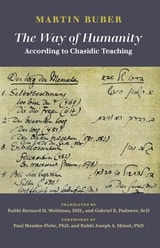
The Way of Humanity
According to Chasidic TeachingMartin Buber, translated by Rabbi Bernard H. Mehlman, DHL and GabrielE. Padawer, ScD
Central Conference of American Rabbis, 2023
Martin Buber (1878–1965) was one of the most influential Jewish thinkers of the twentieth century. A philosopher, seeker, and nurturer of dialogue, he responded to the complexities of his times by affirming the fullness of interpersonal encounter and the spiritual everyday. In 1947, Buber delivered lectures interpreting six traditional Chasidic stories to a German-speaking audience, published as The Way of Humanity. In the first new English translation in over half a century, Rabbi Bernard H. Mehlman, DHL, and Gabriel E. Padawer, ScD, z"l, bring the work to contemporary readers in a clear, accessible voice. The teachings within highlight the subversion and innovation of the early Chasidic masters of the eighteenth and nineteenth centuries, while providing meaningful spiritual guidance and insight for any seeker today. Scholarly forewords by Paul Mendes-Flohr, PhD, and Rabbi Joseph A. Skloot, PhD, as well as an introduction, epilogue, and notes from the translators, place Buber’s work in historical context. Timeless and enlightening, The Way of Humanity guides us to inner meaning and highlights our human wholeness.
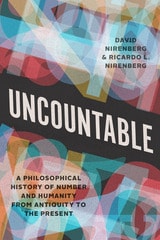
Uncountable
A Philosophical History of Number and Humanity from Antiquity to the PresentDavid Nirenberg and Ricardo L. Nirenberg
University of Chicago Press, 2021
Our knowledge of mathematics has structured much of what we think we know about ourselves as individuals and communities, shaping our psychologies, sociologies, and economies. In pursuit of a more predictable and more controllable cosmos, we have extended mathematical insights and methods to more and more aspects of the world. Today those powers are greater than ever, as computation is applied to virtually every aspect of human activity. Yet, in the process, are we losing sight of the human? When we apply mathematics so broadly, what do we gain and what do we lose, and at what risk to humanity?
These are the questions that David and Ricardo L. Nirenberg ask in Uncountable, a provocative account of how numerical relations became the cornerstone of human claims to knowledge, truth, and certainty. There is a limit to these number-based claims, they argue, which they set out to explore. The Nirenbergs, father and son, bring together their backgrounds in math, history, literature, religion, and philosophy, interweaving scientific experiments with readings of poems, setting crises in mathematics alongside world wars, and putting medieval Muslim and Buddhist philosophers in conversation with Einstein, Schrödinger, and other giants of modern physics. The result is a powerful lesson in what counts as knowledge and its deepest implications for how we live our lives.