Results by title
10 books match the query 'Humility'
Cultural Humility
David A. Hurley, Sarah R. Kostelecky, and Lori Townsend
American Library Association, 2022
Cultural humility is emerging as a preferred approach to diversity, equity, and inclusion (DEI) efforts within librarianship. At a time when library workers are critically examining their professional practices, cultural humility offers a potentially transformative framework of compassionate accountability; it asks us to recognize the limits to our knowledge, reckon with our ongoing fallibility, educate ourselves about the power imbalances in our organizations, and commit to making change. This Special Report introduces the concept and outlines its core tenets. As relevant to those currently studying librarianship as it is to long-time professionals, and applicable across multiple settings including archives and museums, from this book readers will
- learn why cultural humility offers an ideal approach for navigating the spontaneous interpersonal interactions in libraries, whether between patrons and staff or amongst staff members themselves;
- understand how it intersects with cultural competence models and critical race theory;
- see the ways in which cultural humility’s awareness of and commitment to challenging inequitable structures of power can act as a powerful catalyst for community engagement;
- come to recognize how a culturally humble approach supports DEI work by acknowledging the need for mindfulness in day-to-day interactions;
- reflect upon cultural humility’s limitations and the criticisms that some have leveled against it; and
- take away concrete tools for undertaking and continuing such work with patience and hope.
God, Science, and Humility
Ten Scientists Consider Humility TheologyRobert Hermann
Templeton Press, 2000
Editor Robert Herrmann has collected the opinions of ten scientists, all leaders in their fields, who have considered the relevance of their science to theology. The contributors bring a variety of religious experiences to the consideration of humility theology, a humble approach to our truth-seeking about God.
As a physicist, Russell Stannard provides an overview of humility theology in which truth is approached in an experimental, hypothetical mode, as is done in the sciences. Physicist and theologian Robert Russell focuses on the interaction between cosmology and theology. Charles Harper writes of the opportunity for a tremendous flowering of planetary science through a joint partnership between science and religion.
Owen Gingerich, historian of science, looks at the other side of humility theology—the possibility that we can actually arrive at unreasonable expectations— about the existence and nature of extraterrestrial intelligence. Francisco Ayala begins with the surprising contrast between the very brief period of human evolution and its remarkable and utterly unique end-product, homo sapiens. Psychologist David Myers points out that intuition can be a powerful faculty, but there are many limitations to this “inner knowing.”
Chemist Giuseppe Del Re writes an interesting view of the history of the development of chemistry as a discipline. Herbert Benson and Patricia Myers analyze the components of mind-body medicine that relate to the rubric of self-care, including relaxation procedures, nutrition, exercise, stress management, and faith. David and Susan Larson introduce the reader to a new field of medical science that focuses on the impact of spiritual values on patients' health. Fraser Watts looks at artificial intelligence research.
The discussion included in this book will significantly aid scholars and general readers in the search for greater understanding of the relationship between science and religion.
Contributors include Russell Stannard, Robert John Russell, Charles L. Harper Jr., Owen Gingerich, Francisco J. Ayala, David G. Myers, Giuseppe Del Re, Herbert Benson, Patricia Myers, David B. Larson, Susan S. Larson, and Fraser Watts.
Hopeful Visions, Practical Actions
Cultural Humility in Library WorkEdited by Sarah R. Kostelecky, Lori Townsend, and David A. Hurley
American Library Association, 2023
- how Indigenous adages can be tools for reflection and guidance in developing cultural humility;
- the experiences of two Black librarians who are using cultural humility to change the profession;
- new perspectives on core concepts of customer service;
- rethinking policies and practices in libraries both large and small;
- using cultural humility in approaching collection development and creating resource guides;
- what cultural humility can look like for a tribal librarian working in a tribal college library; and
- reflecting on cultural humility itself and where it is going.
Humility
The Quiet VirtueEverett L. Worthington
Templeton Press, 2007
Humility is a virtue that can be difficult to describe because of its paradoxical nature: claiming authority about humility and claiming that one is humble both suggest a lack of humility. In Humility, Everett L.Worthington Jr. seeks a way around this paradox by looking to people who are considered by others to be humble. He suggests people as examples: Jesus, Siddhartha, Gandhi, Mother Teresa, and Martin Luther King Jr. He looks, too, at people whom he admires. He examines the characteristics of humility they share, and, in doing so, formulates a working understanding of humility.
Science has made few attempts to measure humility, Worthington points out, but those few studies do give a different, but complementary, perspective on humility than the wisdom of the ages. Humility may not be a skill we can learn, but people can be inspired to be humble. "Great people—and ordinary people acting nobly—can inspire us," Worthington writes. "When we catch the spirit, we can transfer that spirit from ourselves to others." Quotations interspersed throughout the book reinforce the message that the unassuming virtue of humility transforms lives.
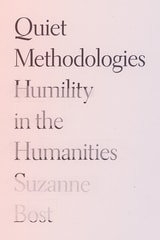
Quiet Methodologies
Humility in the HumanitiesSuzanne Bost
University of Minnesota Press, 2025
Reimagining humanities scholarship with humility and inclusive attention
How might foregrounding the writings of colonized peoples transform the ways we work in the humanities? In an era dominated by loud political rhetoric, Suzanne Bost advocates for quieter modes of scholarship: intellectual humility rather than ego, collaboration and conversation rather than singular argumentation, continual reflection and revision rather than defensiveness, and a willingness to believe in different ways of being and knowing rather than adhering to academic norms. With Quiet Methodologies, she demonstrates practical decolonial scholarship and proposes alternative approaches for fostering meaningful engagement.
Turning to feminist, queer, and decolonial writings from Gloria Anzaldúa, Alexis Pauline Gumbs, Audre Lorde, and many others, Bost reflects on what we do when we work with literature, culture, and ideas. She weaves together multiple voices, methods of writing, and culturally diverse epistemologies and uses creative devices such as collage, her own original poetry, revision, lists, images, and conversation to disengage academic thought and writing from colonial theories and archives that have passed as neutral. Eschewing conventional monograph formats, her work embraces a reciprocal and heterogeneous learning process with profound ethical implications.
Part of a movement of reimagining research and education through care, Quiet Methodologies is a powerful exploration of the possibilities of criticism during crises. It encourages readers to be visionary and pragmatic, challenging current conditions and offering alternative ideas for the future of the humanities.
Retail e-book files for this title are screen-reader friendly with images accompanied by short alt text and/or extended descriptions.
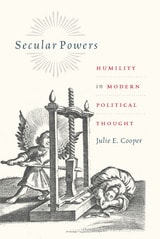
Secular Powers
Humility in Modern Political ThoughtJulie E. Cooper
University of Chicago Press, 2013
Contemporary understandings of secularism, Cooper contends, have been shaped by a limited understanding of it as a shift from vulnerability to power. But the works of the foundational thinkers of secularism tell a different story. Analyzing the writings of Hobbes, Spinoza, and Rousseau at the moment of secularity’s inception, she shows that all three understood that acknowledging one’s limitations was a condition of successful self-rule. And while all three invited humans to collectively build and sustain a political world, their invitations did not amount to self-deification. Cooper establishes that secular politics as originally conceived does not require a choice between power and vulnerability. Rather, it challenges us—today as then—to reconcile them both as essential components of our humanity.

Sir John Templeton
From Wall Street To HumilityRobert L. Hermann
Templeton Press, 1998
The biography of the "Wizard of Wall Street" who has dedicated his life to advancing the scientific study of spiritual realities has been revised and updated. Sir John Templeton was an inspiring and motivational force both through his personal example and through the foundation that bears his name and is dedicated to his mission.
This volume reviews the life of this man of vision, from his childhood in rural Tennessee, to his education at Yale and Oxford, to his legendary years on Wall Street, the birth of his children, and the development and growth of "humility theology science." Interwoven with the stories and facts are the roots of his faith and the values that he credits for his financial success and are the catalyst for his lifelong mission.
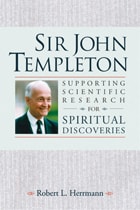
Sir John Templeton
Supporting Scientific Research For Spiritual DiscoveriesRobert Herrmann
Templeton Press, 2004
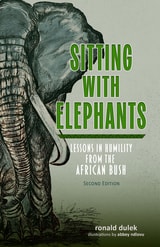
Sitting with Elephants
Lessons in Humility from the African Bush, Enhanced and Expanded Second EditionRonald Dulek, Illustrations by Abbey Ndlovu
University of Alabama Press, 2026
A professor of communication and strategy reveals deep lessons from life in the African bush.
Sitting with Elephants is a heartfelt memoir that follows a middle-aged American professor and his wife as they trade suburban life for a remote bush house in South Africa. What begins as a spontaneous decision becomes a life-changing experience—one shaped by lions at the backdoor, baboons in the rafters, and above all, a herd of elephants who frequent their yard like neighbors.
Told through a series of emails to their adult children and brought to life by vivid illustrations from Abbey Ndlovu, Ronald Dulek’s narrative explores the profound lessons nature teaches: patience, humility, and deep respect for the wild. As the couple learns to communicate with elephants and navigate the rhythms of bush life, they also reflect on the unexpected beauty of slowing down and embracing the unknown.
Blending lighthearted anecdotes with moments of quiet insight, Sitting with Elephants invites readers into a story of transformation—both personal and environmental. This second edition includes expanded content with new stories and reflections, offering a deeper look into the couple’s unforgettable time in the African bush.
The Way of Humility
St. Augustine's Theology of PreachingCharles J. Kim
Catholic University of America Press, 2023