Results by title
4 books match the query 'Humphrey, Caroline'
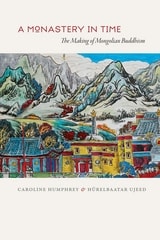
A Monastery in Time
The Making of Mongolian BuddhismCaroline Humphrey and Hurelbaatar Ujeed
University of Chicago Press, 2013
A Monastery in Time is the first book to describe the life of a Mongolian Buddhist monastery—the Mergen Monastery in Inner Mongolia—from inside its walls. From the Qing occupation of the eighteenth and nineteenth centuries through the Cultural Revolution, Caroline Humphrey and Hürelbaatar Ujeed tell a story of religious formation, suppression, and survival over a history that spans three centuries.
Often overlooked in Buddhist studies, Mongolian Buddhism is an impressively self-sustaining tradition whose founding lama, the Third Mergen Gegen, transformed Tibetan Buddhism into an authentic counterpart using the Mongolian language. Drawing on fifteen years of fieldwork, Humphrey and Ujeed show how lamas have struggled to keep Mergen Gegen’s vision alive through tremendous political upheaval, and how such upheaval has inextricably fastened politics to religion for many of today’s practicing monks. Exploring the various ways Mongolian Buddhists have attempted to link the past, present, and future, Humphrey and Ujeed offer a compelling study of the interplay between the individual and the state, tradition and history.
[more]
Marx Went Away--But Karl Stayed Behind
Caroline Humphrey
University of Michigan Press, 1999
When it appeared in 1983, Caroline Humphrey's Karl Marx Collective was the first detailed study of the Soviet collective farm system. Through careful ethnographic work on two collective farms operated in Buryat communities in Siberia, the author presented an absorbing--if dispiriting--account of the actual functioning of a planned economy at the local level.
Now this classic work is back in print in a revised edition that adds new material from the author's most recent research in the former Soviet Union. In two new chapters she documents what has happened to the two farms in the collapsing Russian economy. She finds that collective farms are still the dominant agricultural forms, not out of nostalgic sentiment or loyalty to the Soviet ideal, but from economic and political necessity.
Today the collectives are based on households and small groups coming together out of choice. There have been important resurgences in "traditional" thinking about kinship, genealogy, shamanism and mountain cults; and yet all of this is newly formed by its attempt to deal with post-Soviet realities.
Marx Went Away will appeal to students and scholars of anthropology, political science, economics, and sociology.
"The book should be on the shelf of every student of Soviet affairs." --Times Literary Supplement
Caroline Humphrey is Fellow of King's College and Lecturer in Social Anthropology, University of Cambridge.
[more]
Shamanism, History, and the State
Nicholas Thomas and Caroline Humphrey, Editors
University of Michigan Press, 1994
The literature on shamanism and related topics is extensive, but has in general been biased toward curing and trance; the political and historical significance of shamanic activities has been largely neglected. The contributors to Shamanism, History, and the State--distinguished anthropologists and historians from England, Australia, and France--show that shamanism is not static and stable, but always changing as a result of political dynamics and historical processes. Contributors are Tamsyn Barton, Sysan Bayly, Mary Beard, Maurice Bloch, Peter Gow, Roberte N. Hamayon, Stephen Hugh-Jones, Caroline Humphrey, and Nicholas Thomas. "The importance of this collection lies in the painstaking, many-sided ways in which it shows 'shamanism' to be a multifarious and continuously changing 'dialogue' or interaction with specific, local contexts. . . . Thus, rather than tackling the issue in principle, this collection tries to demonstrate through 'case studies' just how different 'shamanism' becomes if seen through a lens sensitive to history and the influence of institutions, such as the state, which seem far removed from it. I think the demonstrations add up to an impressive force." --Michael Taussig "This new, ably edited volume provides . . . chapters that are rich in historic detail and that provide insights into general cultural processes and social interactions." --Historian Nicholas Thomas is Queen Elizabeth II Research Fellow, Department of Prehistory and Anthropology, Australian National University, Canberra. He is the author of Out of Time: History and Evolution in Anthropological Discourse. Caroline Humphrey, author of Karl Marx Collective: Economy, Society and Religion in a Siberian Collective Farm, is Fellow of King's College and Lecturer in Social Anthropology, University of Cambridge.
[more]
The End of Nomadism?
Society, State, and the Environment in Inner AsiaCaroline Humphrey and David Sneath
Duke University Press, 1999
Those who herd in the vast grassland region of Inner Asia face a precarious situation as they struggle to respond to the momentous political and economic changes of recent years. In The End of Nomadism? Caroline Humphrey and David Sneath confront the romantic, ahistorical myth of the wandering nomad by revealing the complex lives and the significant impact on Asian culture of these modern “mobile pastoralists.” In their examination of the present and future of pastoralism, the authors recount the extensive and quite sudden social, political, environmental, and economic changes of recent years that have forced these peoples to respond and evolve in order to maintain their centuries-old way of life.
Using extensive and detailed case studies comparing pastoralism in Siberian Russia, Mongolia, and Northwest China, Humphrey and Sneath explore the different paths taken by nomads in these countries in reaction to a changing world. In examining how each culture is facing not only different prospects for sustainability but also different environmental problems, the authors come to the surprising conclusion that mobility can, in fact, be compatible with a modern and urbanized world. While placing emphasis on the social and cultural traditions of Inner Asia and their fate in the post-Socialist economies of the present, The End of Nomadism? investigates the changing nature of pastoralism by focusing on key areas under environmental threat and relating the ongoing problems to distinctive socioeconomic policies and practices in Russia and China. It also provides lively contemporary commentary on current economic dilemmas by revealing in telling detail, for instance, the struggle of one extended family to make a living.
This book will interest Central Asian, Russian, and Chinese specialists, as well as those studying the environment, anthropology, sociology, peasant studies, and ecology.
[more]