Results by title
3 books match the query 'Hungarians'
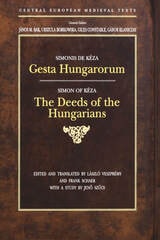
Gesta Hungarorum
The Deeds of the HungariansSimon Kézai
Central European University Press, 1999
Simon of Kéza was a court cleric of the Hungarian King, Ladislas IV (1272-1290). He travelled extensively in Italy, France and Germany and culled the epic and poetic material from a broad range of readings.Written between 1282-1285, the Gesta Hungarorum is an ingenious and imaginative historical fiction of prehistory, medieval history and contemporary social history. The author divides Hungarian history into two periods: Hunnish-Hungarian prehistory and Hungarian history, giving a division which persisted in Hungary up to the beginnings of modern historiography. Simon of Kéza provides a vivid retelling of the well known Attila stories, using such lively prose as - ".the battle lasted for 15 days on end, Csaba's army received such a crushing defeat that very few of the Huns or the sons of Attila survived, the river Danube from Sicambria as far as the city of Potentia was swollen with blood and for several days neither men nor animals could drink the water." The book is also significant because of the author's legal-theoretical framework of corporate self government and constitutional law, inspired by French and Italian sources and practice, which made this chronicle become an integral part of Hungarian historiography.
[more]
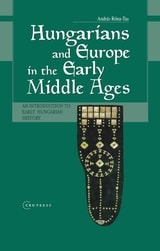
Hungarians and Europe in the Early Middle Ages
An Introduction to Early Hungarian HistoryAndrás Róna-Tas
Central European University Press, 1999
Lavishly illustrated, the book contains seventy five historical maps and colour plates which visualize the historical background of Hungary and introduces its early history to a broader readership. The early history of Hungarians is embedded into the history of Eurasia and special attention is given to the relationship of the Hungarians with the Khazars and the Bulghar-Turks. The first part deals with methods and sources which can be used for elucidating the ancient history of the Hungarians, relying on research into linguistics, archaeology, anthropology and natural history. The second part traces how the Hungarians came into the Carpathian Basin and answers such questions as: who are the Magyars, from where did they come and how did they conquer the land? It reconstructs and examines their early political and social structure, the economy, and religion, and compares the Hungarian medieval process with the ethnogenetic processes of the Germanic, Slavic and Turkic people.
[more]
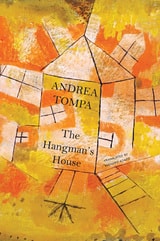
The Hangman's House
Andrea Tompa
Seagull Books, 2020
Set in the 1970s and ’80s, The Hangman’s House narrates the life and times of a Hungarian family in Romania. Those were extraordinary times of oppression, poverty and hopelessness, and Andrea Tompa’s latest novel depicts everyday life under the brutal communist dictatorship of Nicolae Ceaușescu, referred to by the narrator as an unnamed “one-eared hangman.” Ceaușescu is omnipresent throughout the story—in portraits in classrooms and schoolbooks, in the empty food stores, in TV programs, in obligatory Party demonstrations. Most insidiously, he is present in the dreams and nightmares of common people, who, in this cruel period of history, become cruel to one another, just like the dictator.
Our narrator, a teenage “Girl,” observes life through tangled, almost interminable sentences, trying to understand and process the many questions in her life: why her family is falling apart; why her mother has three jobs; why her father becomes an alcoholic; why her grandmother dreams of “Hungarian times”; and, most troubling, why there is persecution all around. Brutal though the times are, Girl’s narration is far from a mere indictment. It is suffused with love, tenderness and irony.
Written by a woman and featuring a young woman narrator, The Hangman's House focuses intently on how women play the principal roles in holding together the resilient fabric of society. Evocative of the celebrated wry humor that distinguishes the best of Hungarian literature, Tompa’s novel is a tour de force that will introduce a brilliant writer to English-language readers.
[more]