Results by title
18 books match the query 'Hunters'

23 Woodcock in 22 Years
Reflections on Hunting, the Night Sky, and Our Place in the UniverseJeff Wilkerson
University of Iowa Press, 2024
As Wilkerson’s thoughts soar to the stars that produced the chemical elements that form us and all the land and its creatures, simple reflections on going afield to harvest a woodcock for a special holiday meal ground him. What emerges is a love story about a bird, the land, and all of creation from atomic nuclei to the farthest reaches of the universe, and a reminder to acknowledge the gentle flow of time while cherishing the everyday existence around us.
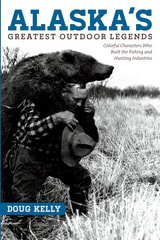
Alaska's Greatest Outdoor Legends
Colorful Characters Who Built the Fishing and Hunting IndustriesDoug Kelly
University of Alaska Press, 2016
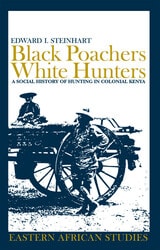
Black Poachers, White Hunters
A Social History of Hunting in Colonial KenyaEdward I. Steinhart
Ohio University Press, 2006
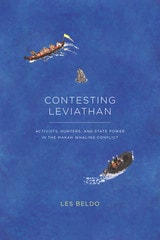
Contesting Leviathan
Activists, Hunters, and State Power in the Makah Whaling ConflictLes Beldo
University of Chicago Press, 2019
In Contesting Leviathan, anthropologist Les Beldo describes the complex judicial and political climate for whale conservation in the United States, and the limits of the current framework in which whales are treated as “large fish” managed by the National Marine Fisheries Service. Emphasizing the moral dimension of the conflict between the Makah, the US government, and antiwhaling activists, Beldo brings to light the lived ethics of human-animal interaction, as well as how different groups claim to speak for the whale—the only silent party in this conflict. A timely and sensitive study of a complicated issue, this book calls into question anthropological expectations regarding who benefits from the exercise of state power in environmental conflicts, especially where indigenous groups are involved. Vividly told and rigorously argued, Contesting Leviathan will appeal to anthropologists, scholars of indigenous culture, animal activists, and any reader interested in the place of animals in contemporary life.

Defending the Master Race
Conservation, Eugenics, and the Legacy of Madison GrantJonathan Spiro
University Press of New England, 2008
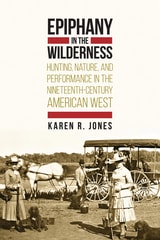
Epiphany in the Wilderness
Hunting, Nature, and Performance in the Nineteenth-Century American WestKaren R. Jones
University Press of Colorado, 2016
Whether fulfilling subsistence needs or featured in stories of grand adventure, hunting loomed large in the material and the imagined landscape of the nineteenth-century West. Epiphany in the Wilderness explores the social, political, economic, and environmental dynamics of hunting on the frontier in three “acts,” using performance as a trail guide and focusing on the production of a “cultural ecology of the chase” in literature, art, photography, and taxidermy.
Using the metaphor of the theater, Jones argues that the West was a crucial stage that framed the performance of the American character as an independent, resourceful, resilient, and rugged individual. The leading actor was the all-conquering masculine hunter hero, the sharpshooting man of the wilderness who tamed and claimed the West with each provident step. Women were also a significant part of the story, treading the game trails as plucky adventurers and resilient homesteaders and acting out their exploits in autobiographical accounts and stage shows.
Epiphany in the Wilderness informs various academic debates surrounding the frontier period, including the construction of nature as a site of personal challenge, gun culture, gender adaptations and the crafting of the masculine wilderness hero figure, wildlife management and consumption, memorializing and trophy-taking, and the juxtaposition of a closing frontier with an emerging conservation movement.
The University Press of Colorado gratefully acknowledges the generous support of the Charles Redd Center for Western Studies at Brigham Young University toward the publication of this book.

Escaping into Nature
The Making of a Sportsman-Conservationist and Environmental HistorianJohn F. Reiger
Oregon State University Press, 2013
In Escaping into Nature, prominent wildlife conservationist and environmental historian John Reiger shares his story of an angler and hunter who found a cause and a calling and combined them for his life’s work.
John Reiger’s outdoor adventures as a young man primed him for the teachings of the great sportsmen-conservationists of the past, particularly George Bird Grinnell, Theodore Roosevelt, and Aldo Leopold. Inspired by these conservation giants, Reiger left the security of a tenured professorship to serve as executive director of the Connecticut Audubon Society where he, sometimes controversially, put his ideals into practice. Later, he resumed his academic career to illuminate the lives of early wildlife conservationists, visionaries who continue to inspire us to care deeply about the future of the natural world.
Abused psychologically within his family in his early years, Reiger found solace in nature. Though he first entered the outdoors as an escape from his unpleasant circumstances, he soon found the study and pursuit of insects, fishes, and birds to be exciting ends in themselves. He came to believe that it was only by participating in the life and death of other creatures that one could learn to truly value the natural world, be a part of it, and be inspired to work for its conservation.
John Reiger’s autobiography is also the story of his own developing fascination with America’s past, especially as it relates to human interaction with the natural world; his desire to share that passion with others; and his experiences on the road to becoming a nationally recognized scholar. The twists and turns of that journey, and his accounts of the people—and of the wild creatures—who helped him along the way, will appeal to history enthusiasts and nature lovers alike.
Farmers, Hunters, and Colonists
Interaction Between the Southwest and the Southern PlainsEdited by Katherine A. Spielmann
University of Arizona Press, 1991
Contributors:
Timothy G. Baugh
Judith A. Habicht-Mauche
Frances Levine
Christopher Lintz
David H. Snow
John D. Speth
Katherine A. Spielmann
David R. Wilcox

George Magoon and the Down East Game War
History, Folklore, and the LawEdward D. Ives
University of Illinois Press, 1988
moose and deer poacher in Maine, was the hero of scores of funny stories of
how he outwitted game wardens. Preserving these oral histories, Edward Ives
documents Magoon's life and explores his significance as a folk hero within
the context of the conservation movement, the cult of the sportsman, and Maine's
increasingly restrictive game laws.
"A rich and subtle book, an
important work by a major scholar. . . . It is a major contribution to folklore
studies, and to history and American studies as well."
-- Journal of American Folklore
Gordon MacQuarrie
The Story of an Old Duck HunterKeith Crowley
Wisconsin Historical Society Press, 2003
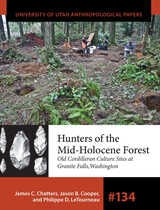
Hunters of the Mid-Holocene Forest
Old Cordilleran Culture Sites at Granite Falls, WashingtonJames C. Chatters, Jason B. Cooper, and Philippe D. LeTourneau
University of Utah Press, 2020
This volume examines an almost purely lithic record known in the Puget Sound region as the Olcott Complex. Only loosely described off and on since the early 1960s by a series of researchers, none of whom used the same analytical approach, the Olcott record has never been systematically analyzed until now. As a result, this book fills in enormous gaps in our knowledge regarding the age, mode of subsistence, and adaptive strategy of the Olcott Complex. Chatters and colleagues describe the intensive excavation of three Olcott sites that were threatened by highway construction. The book concludes by pulling those findings together to place the Olcott Complex into its proper place in regional prehistory. An exemplary model of how to conduct archaeological research, the volume demonstrates how important research issues can be addressed in a cultural resource management context.
Extensive appendices available online.
Hunters of the Northern Forest
Designs for Survival among the Alaskan KutchinRichard K. Nelson
University of Chicago Press, 1986

Mortal Stakes
Hunters and Hunting in Contemporary AmericaJan E. Dizard
University of Massachusetts Press, 2003
Each autumn, millions of men and increasing numbers of women don camouflage or blaze orange outfits and go afield in pursuit of game. For much of American history, there was no need to explain why they did this. Hunting was simply another aspect of the annual cycle of planting, breeding, and harvesting. But modern hunting began separating from its agrarian roots well over a century ago, and although it has retained its connection to the metaphor of the harvest, the self-perceptions and motives of hunters today are no longer transparent, especially to nonhunters. Indeed, hunting—and those who hunt—have become targets of a vocal and growing array of critics.
In Mortal Stakes, Jan E. Dizard examines the place of hunting in contemporary America. Drawing on detailed interviews with hunters as well as opinion surveys and demographic statistics, he analyzes the meanings these men and women attach to hunting and situates this traditional activity in its current setting. He looks at who hunts, how they compare socially and politically with nonhunters, and how they see themselves and are seen by others.
With fewer and fewer Americans closely linked to the land, hunting seems less ordinary and less necessary. As the gulf between hunters and nonhunters widens, hunters have begun to think of themselves as a minority group which, like other minorities, suffers from prejudice and stereotyping. As a result, Dizard argues, hunting is fast becoming one more front in an expanding “culture war” over what it means to be an American.
So Great Was the Slaughter
Market Hunters, Sportsmen, and Wildlife Conservation in ArkansasBuckley T. Foster
University of Alabama Press, 2025
Winner of the 2026 J.G. Ragsdale Book Award
So Great Was the Slaughter reveals the untold story of Arkansas conservation pioneers who saved the state’s game and fish populations. As Arkansas entered the twentieth century, the national demand for meat combined with the ability to ship millions of animals to hungry cities like New Orleans, Memphis, and Chicago had driven many species, including bison and passenger pigeons, to extinction in Arkansas. Many others, including deer, bear, turkey, quail, and fish, were in danger of disappearing.
In response, an unlikely coalition of Arkansas sportsmen, hunters, and conservationists created a vision for conservation legislation, game laws, and the establishment of fish hatcheries and wildlife refuges. With support from influential outsiders like E. A. McIlhenny and the United States Biological Survey, they waged a long battle against entrenched political and commercial interests.
Buckley Foster’s meticulous research reveals how these pioneers fought to save the state’s wildlife resources from destruction and laid the foundations for sustainable, modern wildlife management in Arkansas. So Great Was the Slaughter will fascinate hunters, conservationists, historians, and those interested in the history of wildlife conservation and conflicts between market hunters and sportsmen in the United States and the American South.
The Hunters or the Hunted?
An Introduction to African Cave TaphonomyC. K. Brain
University of Chicago Press, 1981
The Jumanos
Hunters and Traders of the South PlainsBy Nancy Parrott Hickerson
University of Texas Press, 1994
In the late sixteenth century, Spanish explorers described encounters with North American people they called "Jumanos." Although widespread contact with Jumanos is evident in accounts of exploration and colonization in New Mexico, Texas, and adjacent regions, their scattered distribution and scant documentation have led to long-standing disagreements: was "Jumano" simply a generic name loosely applied to a number of tribes, or were they an authentic, vanished people?
In the first full-length study of the Jumanos, anthropologist Nancy Hickerson proposes that they were indeed a distinctive tribe, their wide travel pattern linked over well-established itineraries. Drawing on extensive primary sources, Hickerson also explores their crucial role as traders in a network extending from the Rio Grande to the Caddoan tribes' confederacies of East Texas and Oklahoma.
Hickerson further concludes that the Jumanos eventually became agents for the Spanish colonies, drafted as mercenary fighters and intelligence-gatherers. Her findings reinterpret the cultural history of the South Plains region, bridging numerous gaps in the area's comprehensive history and in the chronicle of these elusive people.

The Last of the Market Hunters
Dale Hamm with David Bakke
Southern Illinois University Press, 1996
Duck hunting has changed greatly since the days of unlimited duck kills, as the limit of fifty ducks a day established in 1902 has fallen to the present three. A legitimate hunter now, Dale Hamm learned the art of market hunting—taking waterfowl out of season and selling them to restaurants—from his father during the l920s. During the l930s and l940s, he kept his family alive by market hunting. At the peak of his career, Hamm poached every private hunting club along the Illinois River from Havana to Beardstown.
After market hunting died out, Hamm became a legendary and almost respected—albeit controversial—character on the Illinois backwaters. He was eventually invited to hunt on the same clubs from which he had once been chased at the point of a shotgun. He hunted with judges, sheriffs, and the head of undercover operations for the Illinois Department of Conservation, all of whom knew of his reputation. He passed on to these hunting partners a lifetime of outdoor knowledge gained from slogging through mud, falling through ice, hunting ducks at three o’clock in the morning, dodging game wardens, and running the world’s only floating tavern.
"I always said if anyone ever cut open one of us Hamms, all they’d find was duck or fish," Hamm once said of his family. Now in his eighties, Hamm still carries a pellet from a shotgun in his chin to remind him of a shotgun blast that ricocheted off the water and into his face. Bakke notes that it is appropriate that a man who spent his life with a shotgun in his hands should carry a bit of buckshot wherever he goes.
Everyone who ever met Dale Hamm has a story about him. His own story is that of a one-of-a-kind character who, in his later years, used his considerable outdoor savvy to conserve the natural resources he once savaged. "His time and kind are gone," Bakke notes, "and there will never be another like him."
This book will be of interest to anyone who has ever been hunting—or who enjoys reading about colorful people and times that exist no more.
The Narrative of Lucy Ann Lobdell
A Woman's Case for EqualityLisa Macchia Ohliger
Westholme Publishing, 2024
Lucy Ann Lobdell’s (1829–1912) extraordinary life was shaped by personal strife and the hardships of survival in upstate New York. Struggling with an abusive, alcoholic husband, a young child, ailing parents, and financial strain, Lucy did what was necessary to support her family. In a rural world defined by hunting, farming, and lumbering, she dressed, labored, and lived in a traditional masculine manner. Her prowess as a rifle shot and fiddle player were known locally, but because of her unconventional, androgynous lifestyle, she became a target of public gossip and ridicule. Educated and eloquent, Lucy penned and published, Lucy Ann Lobdell, the Female Hunter of Delaware and Sullivan Counties, N.Y., in 1855. The narrative provides a unique look at the persecution of a woman whose only “offense” was disregard for contemporary societal norms.
After her husband was killed during the Civil War, she received a widow’s pension. Ostracized and eventually hospitalized in 1880—gender laws of the time imprisoned indigent men, but sent women to mental hospitals—she underwent torturous experimental treatment until she confessed to a self-serving doctor that she was “a man in all that the name implies.” Whether Lucy was a lesbian, cross dresser, or transgender, we don’t know from the historical record, but as Lisa Macchia Ohliger demonstrates in The Narrative of Lucy Ann Lobdell: A Woman’s Case for Equality, Lucy did embody the nascent women’s rights movement. At the same time, and not far from where Lucy lived and went to school, Amelia Bloomer was advocating the right for women to wear pants and was publishing the feminist newspaper, The Lily, while Susan B. Anthony was pushing for land rights and equal pay for women. All of these issues are found in Lucy’s autobiographical account, fully reproduced in this volume. Lucy’s life is an illustration of the historical significance and destructive power of gender in society, and her narrative bears painful witness to the clash between taboo and survival.