Results by title
4 books match the query 'Hush'
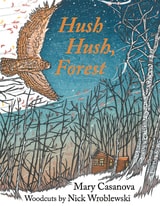
Hush Hush, Forest
Mary Casanova
University of Minnesota Press, 2018
Lyrical words and elegant woodcuts capture the quiet beauty of the forest as day fades to night and autumn gives way to the North Woods winter
While we are tucked in, snug in warm blankets as we listen to bedtime stories, the woods around us whisper another tale. As the golden leaves waft through the lengthening shadows, the loon sings one last lullaby, the whirring hummingbird takes one last sip, the industrious beaver saws one last branch for her lodge. Here, in enchanting words and woodcuts, is the magic of night falling and winter approaching in the North Woods. Hush Hush, Forest peers through twilight’s window at the raccoon preening, the doe and fawn bedding down, the last bat of the season flitting away. The owl surveys, the rabbit scurries, the bear hunkers, readying her den.
Marking the rhythm between the falling leaf and the falling snowflake, picturing the rituals of creatures big and small as they prepare for the long winter’s sleep, this charming book captures a time of surpassing wonder for readers of all ages—and bids everyone in the hushed forest a peaceful good night.
Hush
Media and Sonic Self-ControlMack Hagood
Duke University Press, 2019
In Hush to Harbor
Black Sanctuary from Slavery to Trump's AmericaLa-Toya L. Scott
Rutgers University Press, 2026
Black communities in America have a long history of constructing sanctuaries amid oppression, from the secret hush harbors of slavery to the digital refuges created in response to the resurgence of white supremacist violence in the Trump era. These havens have offered places to grieve and to gather, to imagine freedom when the world denied it, and to practice care and resistance in the face of constant danger. They remind us that even in the darkest moments, Black people have made space to grieve, rest, heal, strategize, and imagine new futures.
In Hush to Harbor traces this enduring sanctuary-making through both historical memory and contemporary expression from the legacy of Freedmen’s Towns and Green Books for Motorists in the Jim Crow era as testaments to Black mobility and mutual protection to present-day digital activism and grassroots organizing that reimagine safety in the public sphere.
Blending literary criticism, cultural history, and ethnography, Scott demonstrates that sanctuary is not merely a place of retreat but a political and spiritual practice that calls forth a collective act of making space when none is offered. In Hush to Harbor offers not just a chronicle of survival but a blueprint for sustaining Black refuge in a time of urgent need, redefining what it means to be safe in a nation that has never guaranteed safety for Black life.
Unlearning the Hush
Oral Histories of Black Female Educators in Mississippi in the Civil Rights EraMarlee S. Bunch Foreword by Christopher M. Span
University of Illinois Press, 2025