Results by title
5 books match the query 'Hussain, Sawad'
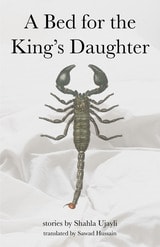
A Bed for the King's Daughter
Stories by Shahla Ujayli; translated by Sawad Hussain
University of Texas Press, 2020
A groundbreaking collection of experimental short fiction by award-winning Syrian author and Booker International Prize for Arabic Fiction nominee Shahla Ujayli, A Bed for the King’s Daughter uses surrealism and irony to examine such themes as women’s agency, the decline of collective life and imagination under modernity, and the effects of social and political corruption on daily life. In “The Memoir of Cinderella’s Shoes,” Cinderella uses her famous glass slipper as a weapon in order to take justice into her own hands. In “Tell Me About Surrealism,” an art history professor’s writing assignment reveals the slipperiness of storytelling, and in “Merry Christmas,” the realities of apartheid interfere with one family’s celebration. Through twenty-two short stories, Ujayli animates—with brevity and inventiveness—themes relevant to both the particularities of life in the Arab world and life outside it.
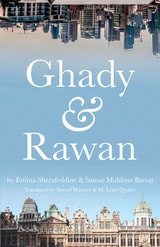
Ghady & Rawan
By Fatima Sharafeddine and Samar Mahfouz Barraj, translated by M. Lynx Qualey and Sawad Hussain
University of Texas Press, 2019
Ghady and Rawan is a heartfelt and timely novel by the award-winning author Fatima Sharafeddine (The Servant, Cappuccino) and Samar Mahfouz Barraj. The novel follows the close-knit friendship of two Lebanese teenagers, Ghady, who lives with his family in Belgium, and Rawan, who lives in Lebanon. Ghady’s family travels every summer to Beirut, where Ghady gets to spend all his time with Rawan and their other friends, enjoying their freedom from school. During the rest of the year, he and Rawan keep in touch by email. Through this correspondence, we learn about the daily ups and downs of their lives in Brussels and Beirut, including Ghady’s homesickness and his struggles with racism at school, as well as Rawan’s changing relationship to her family. The novel offers a glimpse into the lives of Lebanese adolescents while exploring a range of topics relevant to young people everywhere: bullying, parental conflicts, racism, belonging and identity, and peer pressure. Through the connection between the two main characters, Sharafeddine and Mahfouz Barraj show how the love and support of a good friend can help you through difficulties as well as sweeten life’s triumphs and good times.
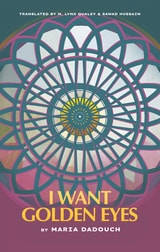
I Want Golden Eyes
Maria Dadouch; translated by M. Lynx Qualey and Sawad Hussain
University of Texas Press, 2025
A girl must save herself and her family after discovering her society's secrets in this sci-fi novel in translation.
I Want Golden Eyes is set on the Comoros Islands at the end of this century in a futuristic city called Quartzia, the home of a genetically privileged minority called the Golden Eyes. The rest of the population, the Limiteds, live in a cavity called the Hive beneath the city. Dalia is a sixteen-year-old girl who lives in the Hive but works with her family in Quartzia at Professor Adam’s house, where she cleans, her sister grows organic food in the garden, and her deaf father works as the cook.
Because books are forbidden in the Hive, Dalia secretly borrows math texts from the professor’s library and smuggles them to read in the Hive. When Professor Adam, who is famous for engineering embryos with enhanced genes, discovers Dalia’s crime, he enslaves her for two years in his library. Dalia seeks to flee the city with her family after overhearing the professor being ordered to design genetic traits for the president’s expected baby and realizes that Golden Eyes are not privileged by nature’s selection, as she was led to believe, but by authority and money.
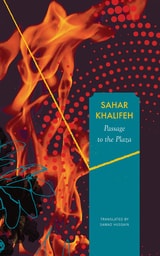
Passage to the Plaza
Sahar Khalifeh
Seagull Books, 2020
In the furnace of conflict at the heart of the 1987 Intifada, notions of freedom, love, respectability, nationhood, the rights of women, and Palestinian identity—both among the reluctant residents of the house and the inhabitants of the quarter at large—will be melted and re-forged. Vividly recounted through the eyes of its female protagonists, Passage to the Plaza is a groundbreaking story that shatters the myth of a uniform gendered experience of conflict.
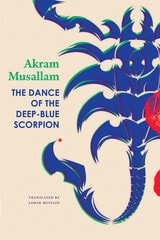
The Dance of the Deep-Blue Scorpion
Akram Musallam
Seagull Books, 2021
On a plastic chair in a parking lot in Ramallah sits a young man writing a novel, reflecting on his life: working in a dance club on the Israeli side of the border, scratching his father’s amputated leg, dreaming nightly of a haunting scorpion, witnessing the powerful aura of his mountain-lodging aunt. His work in progress is a meditation on absence, loss, and emptiness. He poses deep questions: What does it mean to exist? How can you confirm the existence of a place, a person, a limb? How do we engage with what is no longer there? Absurd at times, raw at others, The Dance of the Deep-Blue Scorpion explores Palestinian identity through Akram Musallam’s extended metaphors in the hope of transcending the loss of territory and erasure of history.