Results by title
2 books match the query 'Hutcheon, Linda'
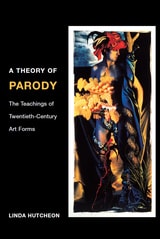
A Theory of Parody
The Teachings of Twentieth-Century Art FormsLinda Hutcheon
University of Illinois Press, 1985
In this major study of a flexible and multifaceted mode of expression, Linda Hutcheon looks at works of modern literature, visual art, music, film, theater, and architecture to arrive at a comprehensive assessment of what parody is and what it does.
Hutcheon identifies parody as one of the major forms of modern self-reflexivity, one that marks the intersection of invention and critique and offers an important mode of coming to terms with the texts and discourses of the past. Looking at works as diverse as Tom Stoppard's Rosenkrantz and Guildenstern Are Dead, Brian de Palma's Dressed to Kill, Woody Allen's Zelig, Karlheinz Stockhausen's Hymnen, James Joyce's Ulysses, and Magritte's This Is Not a Pipe, Hutcheon discusses the remarkable range of intent in modern parody while distinguishing it from pastiche, burlesque, travesty, and satire. She shows how parody, through ironic playing with multiple conventions, combines creative expression with critical commentary. Its productive-creative approach to tradition results in a modern recoding that establishes difference at the heart of similarity.
In a new introduction, Hutcheon discusses why parody continues to fascinate her and why it is commonly viewed as suspect-–for being either too ideologically shifty or too much of a threat to the ownership of intellectual and creative property.
[more]
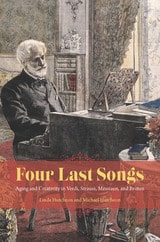
Four Last Songs
Aging and Creativity in Verdi, Strauss, Messiaen, and BrittenLinda Hutcheon and Michael Hutcheon
University of Chicago Press, 2015
Aging and creativity can seem a particularly fraught relationship for artists, who often face age-related difficulties as their audience’s expectations are at a peak. In Four Last Songs, Linda and Michael Hutcheon explore this issue via the late works of some of the world’s greatest composers.
Giuseppe Verdi (1813–1901), Richard Strauss (1864–1949), Olivier Messiaen (1908–92), and Benjamin Britten (1913–76) all wrote operas late in life, pieces that reveal unique responses to the challenges of growing older. Verdi’s Falstaff, his only comedic success, combated Richard Wagner’s influence by introducing young Italian composers to a new model of national music. Strauss, on the other hand, struggling with personal and political problems in Nazi Germany, composed the self-reflexive Capriccio, a “life review” of opera and his own legacy. Though it exhausted him physically and emotionally, Messiaen at the age of seventy-five finished his only opera, Saint François d’Assise, which marked the pinnacle of his career. Britten, meanwhile, suffering from heart problems, refused surgery until he had completed his masterpiece, Death in Venice. For all four composers, age, far from sapping their creative power, provided impetus for some of their best accomplishments.
With its deft treatment of these composers’ final years and works, Four Last Songs provides a valuable look at the challenges—and opportunities—that present themselves as artists grow older.
[more]