Results by title
14 books match the query 'Hymns'
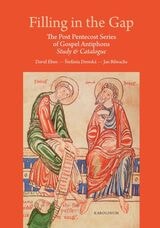
Filling in the Gap
The Post Pentecost Series of Gospel AntiphonesDavid Eben, Štefánia Hanusa Demská, and Jan Bilwachs
Karolinum Press, 2025
Provides insight into the world of the Carolingian monks and clerics who created the Liturgy of the Hours.
Filling in the Gap recounts the creative process behind a specific part of the Gregorian Office repertoire that has not been addressed so far. By linking historical and liturgical evidence with musical analysis, the study opens new avenues for grouping manuscripts and interpreting their interrelationships. The catalogue of melodies included in this volume contains transcriptions of the post-Pentecost antiphon repertoire from twenty-four manuscripts across Western Europe.

Hymns / Inni
Giuseppe Verdi
University of Chicago Press, 2007
This newest volume in The Works of Giuseppe Verdi series comprises his only two surviving secular choral works: Inno popolare, or Hymn of the People, for unaccompanied male chorus, and Inno delle nazioni, or Hymn of the Nations, for tenor solo, chorus, and orchestra.
Verdi wrote the brief Inno popolare in 1848 at the behest of the Italian philosopher and patriot Giuseppe Mazzini, intending that it become an anthem for Italy at a time when the country had just driven away its Austrian overlords. He wrote no more independent patriotic pieces until he was asked in 1861 to represent his country with a patriotic composition at a musical jubilee during London’s International Exhibition of 1862. The resulting piece was Inno delle nazioni, the critical edition of which is based on Verdi’s autograph score, preserved at the British Library. Other important sources include the composer's musical sketches, recently discovered in the Verdi family villa, and the performing parts Toscanini used for a BBC broadcast in 1943.
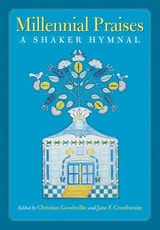
Millennial Praises
A Shaker HymnalChristian Goodwillie
University of Massachusetts Press, 2009
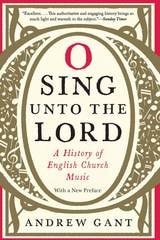
O Sing unto the Lord
A History of English Church MusicAndrew Gant
University of Chicago Press, 2017
The ornate complexity of pre-Reformation Catholic liturgies revealed the exclusive nature of this form of worship. By contrast, simple English psalms, set to well-known folk songs, summed up the aims of the Reformation with its music for everyone. The Enlightenment brought hymns, the Methodists and Victorians a new delight in the beauty and emotion of worship. Today, church music mirrors our multifaceted worldview, embracing the sounds of pop and jazz along with the more traditional music of choir and organ. And reflecting its truly global reach, the influence of English church music can be found in everything from masses sung in Korean to American Sacred Harp singing.
From medieval chorales to “Amazing Grace,” West Gallery music to Christmas carols, English church music has broken through the boundaries of time, place, and denomination to remain familiar and cherished everywhere. Expansive and sure to appeal to all music lovers, O Sing unto the Lord is the biography of a tradition, a book about people, and a celebration of one of the most important sides to our cultural heritage.

Reading Akkadian Prayers and Hymns
An IntroductionAlan Lenzi
SBL Press, 2011
A thorough text for students of ancient Mesopotamian religion and the Hebrew Bible
Alan Lenzi places Akkadian prayers and hymns within both a religious studies perspective and a Mesopotamian studies perspective. Complete with vocabulary glosses, grammatical notes, literary commentary, and comparative suggestions to biblical material, this book provides a crucial tool for accessing ancient texts related to our understanding of the Hebrew Bible.
Features:
- Background essays
- Discussion of classes of Mesopotamian prayers and their comparative use in biblical studies
- Akkadian text, transliteration, translation, and commentary
- Notes on vocabulary and grammar
Alan Lenziis Associate Professor of Hebrew Bible and Ancient Near East at University of the Pacific. He is the author of Secrecy and the Gods: Secret Knowledge in Ancient Mesopotamia and Biblical Israel (Neo-Assyrian Text Corpus Project).
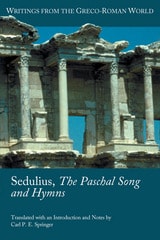
Sedulius, The Paschal Song and Hymns
Carl P. Springer
SBL Press, 2013
Sing Them Over Again to Me
Hymns and Hymnbooks in AmericaEdited by Mark A. Noll and Edith L. Blumhofer
University of Alabama Press, 2006
Hymns and hymnbooks as American historical and cultural icons.
This work is a study of the importance of Protestant hymns in defining America and American religion. It explores the underappreciated influence of hymns in shaping many spheres of personal and corporate life as well as the value of hymns for studying religious life. Distinguishing features of this volume are studies of the most popular hymns (“Amazing Grace,” “O, For a Thousand Tongues to Sing,” “All Hail the Power of Jesus’ Name”), with attention to the ability of such hymns to reveal, as they are altered and adapted, shifts in American popular religion. The book also focuses attention on the role hymns play in changing attitudes about race, class, gender, economic life, politics, and society.
Singing the Lord's Song in a Strange Land
Hymnody in the History of North American ProtestantismEdith L. Blumhofer
University of Alabama Press, 2008
Music and song are important parts of worship, and hymns have long played a central role in Protestant cultural history. This book explores the ways in which Protestants have used and continue to use hymns to clarify their identity and define their relationship with America and to Christianity. Representing seven groups—Baptists, Presbyterians, Lutherans, Mennonites, Holiness, Hispanics, and Evangelicals—the nine essays reveal how hymns have helped immigrants to establish new identities, contributed to the body of worship resources, and sustained ethnic identity.
Individual essays address the music of the Old-Fashioned Revival Hour, America’s longest running and most successful independent radio program; singing among Swedish evangelicals in America; the German hymn tradition as transformed by Mennonite immigrants; the ways hymnody reinforces themes of the Wesleyan holiness movement; the history of Mercer’s Cluster (1810), a southern hymnal that gave voice to slaves, women, and native Americans; and the Presbyterian hymnal tradition in Canada formed by Scottish immigrants.
Spencer Kimball's Record Collection
Essays on Mormon MusicMichael Hicks
Signature Books, 2020
The Hymns on Faith
Jeffrey T. St. Ephrem the Syrian
Catholic University of America Press, 2015

The Lucca Choirbook
Lucca, Archivio di Stato, MS 238; Lucca, Archivio Arcivescovile, MS 97; Pisa, Archivo Arcivescovile, Biblioteca Maffi, Cartella 11/IIIEdited and with an Introduction and Inventory by Reinhard Strohm
University of Chicago Press, 2009
More than forty years ago in the state archives of Lucca, Italy, musicologist Reinhard Strohm noticed that bindings on some of the books were unusual: they consisted of the pages of a centuries-old music manuscript. In the following years, Strohm worked with the archivists to remove these leaves and reassemble as much as possible of the original manuscript, a major cultural recovery now known as The Lucca Choirbook.
The recovered volume comprises what remains of a gigantic cathedral codex commissioned in Bruges around 1463 and containing English, Franco-Flemish, and Italian sacred music of the fifteenth century—including works by the celebrated composers Guillaume Du Fay and Henricus Isaac.
This facsimile of the choirbook includes all the known leaves, ordered according to their proper placement in the original codex. In the introduction, Strohm tells the fascinating story of this choirbook, identifying its early users and reconstructing its travel from Bruges to Lucca.
The Makers of the Sacred Harp
David Warren Steel with Richard H. Hulan
University of Illinois Press, 2010
The Proper of Time
Advent, Christmas, Lent, and Easter, Volume 1Andrew Wadsworth
Catholic University of America Press, 2024
We Shall Not Be Moved/No nos moveran
Biography of a Song of StruggleDavid Spener
Temple University Press, 2016
The activist anthem “We Shall Not Be Moved” expresses resolve in the face of adversity; it helps members of social movements persevere in their struggles to build a better world. The exact origins of the song are unknown, but it appears to have begun as a Protestant revival song sung by rural whites and African slaves in the southeastern United States in the early nineteenth century. The song was subsequently adopted by U.S. labor and civil rights activists, students and workers opposing the Franco dictatorship in Spain, and by Chilean supporters of that country’s socialist government in the early 1970s.
In his fascinating biography, We Shall Not Be Moved, David Spener details the history and the role the song has played in each of the movements in which it has been sung. He analyzes its dissemination, function, and meaning through a number of different sociological and anthropological lenses to explore how songs can serve as an invaluable resource to participants in movements for social change.