Results by title
10 books match the query 'Iberian Peninsula'
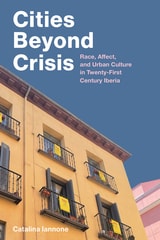
Cities Beyond Crisis
Race, Affect, and Urban Culture in Twenty-First-Century IberiaCatalina Iannone
Vanderbilt University Press, 2025
In Cities Beyond Crisis, Catalina Iannone studies the rapid evolution of Iberian urban centers in the years following the 2008 financial crisis, identifying how this event catalyzed a protracted period of unraveling and reorganization in the region. Arguing that the affects and effects of the crisis are best understood when embedded within local environments, Cities Beyond Crisis focuses on how textual, visual, and spatial interventions both drove and contested change in two racially diverse, historically marginalized neighborhoods in the capital cities of Spain and Portugal—Madrid’s Lavapiés and Lisbon’s Mouraria. Through a critical examination of the narratives shaping public perception of these spaces, whether promoting their development and consumption or challenging market-oriented trends, Iannone demonstrates how the stories that stakeholders across the ideological spectrum told about these districts illuminate enduring attachments and aspirations in each nation’s relationship to race. By approaching the study of space as a contested and contingent social product, this book takes an interdisciplinary approach, drawing from both humanistic and social science theories and practices to show how cultural production shapes and is shaped by the built environment.
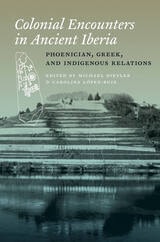
Colonial Encounters in Ancient Iberia
Phoenician, Greek, and Indigenous RelationsEdited by Michael Dietler and Carolina López-Ruiz
University of Chicago Press, 2009
During the first millennium BCE, complex encounters of Phoenician and Greek colonists with natives of the Iberian Peninsula transformed the region and influenced the entire history of the Mediterranean.
One of the first books on these encounters to appear in English, this volume brings together a multinational group of contributors to explore ancient Iberia’s colonies and indigenous societies, as well as the comparative study of colonialism. These scholars—from a range of disciplines including classics, history, anthropology, and archaeology—address such topics as trade and consumption, changing urban landscapes, cultural transformations, and the ways in which these issues played out in the Greek and Phoenician imaginations. Situating ancient Iberia within Mediterranean colonial history and establishing a theoretical framework for approaching encounters between colonists and natives, these studies exemplify the new intellectual vistas opened by the engagement of colonial studies with Iberian history.
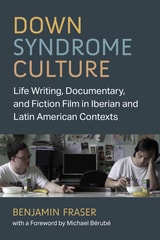
Down Syndrome Culture
Life Writing, Documentary, and Fiction Film in Iberian and Latin American ContextsBenjamin Fraser
University of Michigan Press, 2024
Down Syndrome Culture also pushes the traditionally Anglophone borders of disability studies by examining examples in Spanish, Catalan, and Portuguese-language texts, and incorporating the work of thinkers in Iberian and Latin American studies. Through a close analysis of life writing, documentaries, and fiction films, the book emphasizes the central role of people with Down syndrome in contemporary cultural production. Chapters discuss the autobiography of Andy Trias Trueta, the social actors of the documentary Los niños [The Grown-Ups] (2016), dancers from Danza Mobile, and a variety of fiction films, challenging ableist understandings of disability in nuanced ways. Ultimately, this book reveals the lives, cultural work, and representations of people with trisomy 21 in an international context.

Ethics of Life
Contemporary Iberian DebatesKatarzyna Beilin
Vanderbilt University Press, 2016
• What are the different rhetorical strategies employed by writers, artists, filmmakers, and activists to react to the degradation of life and climate change?
• How are urban movements using environmental issues to resist corporate privatization of the commons?
• What is the shape of Spanish debates on reproductive rights and biotechnology?
• What is the symbolic significance of the bullfighting debate and other human/animal issues in today's political turmoil in Spain?
Hispanic Issues Series
Nicholas Spadaccini, Editor-in-Chief
Hispanic Issues Online
hispanicissues.umn.edu/online_main.html
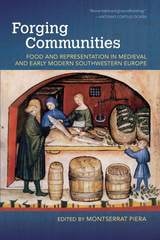
Forging Communities
Food and Representation in Medieval and Early Modern Southwestern EuropeMontserrat Piera
University of Arkansas Press, 2018
This interdisciplinary study of food in medieval and early modern communities connects threads of history conventionally examined separately or in isolation. The intersection of foodstuffs with politics, religion, economics, and culture enhances our understanding of historical developments and cultural continuities through the centuries, giving insight that today, as much as in the past, we are what we eat and what we eat is never devoid of meaning.
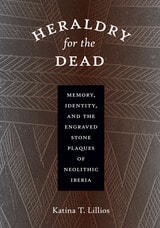
Heraldry for the Dead
Memory, Identity, and the Engraved Stone Plaques of Neolithic IberiaBy Katina T. Lillios
University of Texas Press, 2008
In the late 1800s, archaeologists began discovering engraved stone plaques in Neolithic (3500-2500 BC) graves in southern Portugal and Spain. About the size of one's palm, usually made of slate, and incised with geometric or, more rarely, zoomorphic and anthropomorphic designs, these plaques have mystified generations of researchers. What do their symbols signify? How were the plaques produced? Were they worn during an individual's lifetime, or only made at the time of their death? Why, indeed, were the plaques made at all?
Employing an eclectic range of theoretical and methodological lenses, Katina Lillios surveys all that is currently known about the Iberian engraved stone plaques and advances her own carefully considered hypotheses about their manufacture and meanings. After analyzing data on the plaques' workmanship and distribution, she builds a convincing case that the majority of the Iberian plaques were genealogical records of the dead that served as durable markers of regional and local group identities. Such records, she argues, would have contributed toward legitimating and perpetuating an ideology of inherited social difference in the Iberian Late Neolithic.
Imagining Iberia in English and Castilian Medieval Romance
Emily Houlik-Ritchey
University of Michigan Press, 2023
In and Of the Mediterranean
Medieval and Early Modern Iberian StudiesMichelle M. Hamilton
Vanderbilt University Press, 2014
Music and the Making of Portugal and Spain
Nationalism and Identity Politics in the Iberian PeninsulaEdited by Matthew Machin-Autenrieth, Salwa el-Shawan Castelo-Branco, and Samuel Llano
University of Illinois Press, 2023
What does music in Portugal and Spain reveal about the relationship between national and regional identity building? How do various actors use music to advance nationalism? How have state and international heritage regimes contributed to nationalist and regionalist projects? In this collection, contributors explore these and other essential questions from a range of interdisciplinary vantage points. The essays pay particular attention to the role played by the state in deciding what music represents Portuguese or Spanish identity. Case studies examine many aspects of the issue, including local recording networks, so-called national style in popular music, and music’s role in both political protest and heritage regimes. Topics include the ways the Salazar and Franco regimes adapted music to align with their ideological agendas; the twenty-first-century impact of UNESCO’s Intangible Cultural Heritage program on some of Portugal and Spain's expressive practices; and the tensions that arise between institutions and community in creating and recreating meanings and identity around music.
Contributors: Ricardo Andrade, Vera Marques Alves, Salwa El-Shawan Castelo-Branco, Cristina Sánchez-Carretero, José Hugo Pires Castro, Paulo Ferreira de Castro, Fernán del Val, Héctor Fouce, Diego García-Peinazo, Leonor Losa, Josep Martí, Eva Moreda Rodríguez, Pedro Russo Moreira, Cristina Cruces Roldán, and Igor Contreras Zubillaga
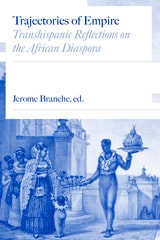
Trajectories of Empire
Transhispanic Reflections on the African DiasporaJerome C. Branche
Vanderbilt University Press, 2022
The book’s chapters explore what Blackness means in the so-called racial democracies of Brazil and Cuba today. Among the historical narratives and themes it covers are the role of medical science in the objectification and nullification of Black female personhood during slavery in nineteenth-century Brazil; the protocols of portraiture in the colonial period that, in including enslaved individuals, pictorially highlight and freeze their supposed inferiority vis-à-vis their owners; and those aspects of discourse that promote colonial capture and oppression in terms of evangelization and the saving of souls, or simply create the discursive template as early as the fifteenth century, for their continued alienation and marginalization across generations.
Trajectories of Empire’s contributions come from the fields of literary criticism, visual culture, history, anthropology, popular culture (rap), and cultural studies. As the product of an interdisciplinary collective, this book will be of interest to scholars in Iberian or Hispanic studies, Africana studies, postcolonial studies, and transatlantic studies, as well as the general public.