Results by title
4 books match the query 'Ida B . Wells'
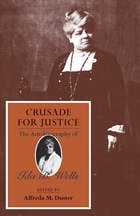
Crusade for Justice
The Autobiography of Ida B. WellsIda B. Wells
University of Chicago Press, 1970
"No student of black history should overlook Crusade for Justice."—William M. Tuttle, Jr., Journal of American History
"Besides being the story of an incredibly courageous and outspoken black woman in the face of innumerable odds, the book is a valuable contribution to the social history of the United States and to the literature of the women's movement as well."—Elizabeth Kolmer, American Quarterly
"[Wells was] a sophisticated fighter whose prose was as thorough as her intellect."—Walter Goodman, New York Times
"An illuminating narrative of a zealous, race-conscious, civic- and church-minded black woman reformer, whose life story is a significant chapter in the history of Negro-White relations."—Thelma D. Perry, Negro History Bulletin
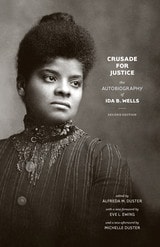
Crusade for Justice
The Autobiography of Ida B. Wells, Second EditionIda B. Wells
University of Chicago Press, 2020
Ida B. Wells is an American icon of truth telling. Born to slaves, she was a pioneer of investigative journalism, a crusader against lynching, and a tireless advocate for suffrage, both for women and for African Americans. She co-founded the NAACP, started the Alpha Suffrage Club in Chicago, and was a leader in the early civil rights movement, working alongside W. E. B. Du Bois, Madam C. J. Walker, Mary Church Terrell, Frederick Douglass, and Susan B. Anthony.
This engaging memoir, originally published 1970, relates Wells’s private life as a mother as well as her public activities as a teacher, lecturer, and journalist in her fight for equality and justice. This updated edition includes a new foreword by Eve L. Ewing, new images, and a new afterword by Ida B. Wells’s great-granddaughter, Michelle Duster.
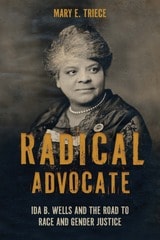
Radical Advocate
Ida B. Wells and the Road to Race and Gender JusticeMary E. Triece
University of Alabama Press, 2025
Pinpoints the persuasive strategies that typified Wells’s efforts to shape broader cultural conversations concerning the causes of racial, social, and gender inequity
Born into the brutal reality of slavery, Ida B. Wells rose to become an audacious journalist, teacher, and activist for racial and gender justice. In Radical Advocate, Mary E. Triece examines the rhetorical strategies employed by Wells to challenge deeply rooted systems of oppression, strategies that remain powerful and relevant today.
Triece introduces the concept of “radical embodied advocacy” to give an account of Wells’s unique position as a Black woman whose personal encounters with white violence were palpable, experienced physically and mentally. White men lynched Wells’s friends and threatened her own life, forcing her into exile after destroying the very press on which she wrote and edited. From this perspective, Wells understood lynching as linked to white economic and political control. Through a close analysis of Wells’s speeches, writings, and journalism, Triece reveals how Wells pioneered a form of “intersectional journalism” that centered the voices of those marginalized by race, gender, and class.
By examining Wells’s work through the lens of philosophy, rhetoric, and Black feminism, Triece underscores the epistemic challenges faced by marginalized advocates and the importance of their perspectives in shaping social change. Radical Advocate ultimately positions Wells as a prophetic figure whose insights into the systemic nature of racism remain profoundly relevant in today’s world.
Staging Migrations toward an American West
From Ida B. Wells to Rhodessa JonesMarta Effinger-Crichlow
University Press of Colorado, 2014
Four case studies consider how the featured women—activist Ida B. Wells, singer Sissieretta "Black Patti” Jones, World War II black female defense-industry workers, and performance artist Rhodessa Jones—imagined and experienced the American West geographically and symbolically at different historical moments. Dissecting the varied ways they used migration to survive in the world from the viewpoint of theater and performance theory, Effinger-Crichlow reconceptualizes the migration histories of black women in nineteenth- and twentieth-century America.
This interdisciplinary study expands the understanding of the African American struggle for unconstrained movement and full citizenship in the United States and will interest students and scholars of American and African American history, women and gender studies, theater, and performance theory.