Results by title
7 books match the query 'Identity (Psychology) in motion pictures'
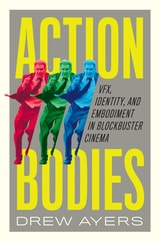
Action Bodies
VFX, Identity, and Embodiment in Blockbuster CinemaDrew Ayers
University of Texas Press, 2026
Exploring how digital visual effects have changed the representations of the body and identity in action films.
When Harrison Ford appeared digitally de-aged in Indiana Jones and the Dial of Destiny, audiences witnessed more than a technical feat; they saw how visual effects are reshaping what bodies can be on screen. In Action Bodies, Drew Ayers examines how the contemporary action genre redefines embodiment across human, superhuman, animal, and machine forms. Ayers argues that action films are a crucial site for understanding how popular media both reflect and shape cultural debates about identity, citizenship, disability, and ethics in the era of big data and algorithmic culture.
Through case studies including Top Gun: Maverick, The Woman King, The Fast & the Furious franchise, and Avatar: The Way of Water, Ayers explores how VFX-altered bodies carry ideological weight. While the action genre has long leaned conservative in its politics of identity, its digitally mediated bodies also generate unexpected opportunities: glimpses of more inclusive and flexible modes of embodiment. As artificial intelligence and synthetic imagery continue to transform film production, Action Bodies demonstrates why careful attention to action cinema is essential for understanding how contemporary culture imagines and engineers the future of the body.

Border Cinema
Reimagining Identity through AestheticsEdited by Monica Hanna and Rebecca A. Sheehan
Rutgers University Press, 2019

First Person Jewish
Alisa S. Lebow
University of Minnesota Press, 2008
Documentaries have increasingly used the first person, with a number of prominent filmmakers finding critical and commercial success with this intimate approach. Jewish filmmakers have particularly thrived in this genre, using it to explore disparate definitions of the self in relation to the larger groups of family and community.
In First Person Jewish, Alisa S. Lebow examines more than a dozen films from Jewish artists to reveal how the postmodern impulse to turn the lens inward intersects provocatively (and at times unwittingly) with historical tropes and stereotypes of the Jew. Focusing her efforts on Jewish filmmakers working on the margins, Lebow analyzes the work of Jonathan Caouette, Chantal Akerman, and Alan Berliner, among others, also including a discussion of her own first person film Treyf (1998), made with Cynthia Madansky. The filmmakers in this study, Lebow argues, are confronting a desire to both define and reimagine contemporary Jewishness.
Using a multidisciplinary approach to first person films, Lebow shows how this form of self-expression is challenging both autobiography and documentary and, in the process, changing the art of cinema and recording the cultural shifts of our time.
Alisa S. Lebow is a filmmaker and lecturer in film and TV studies at Brunel University.

Hollywood at the Intersection of Race and Identity
Delia Malia Caparoso Konzett
Rutgers University Press, 2020

Israeli Cinema
Identities in MotionEdited by Miri Talmon and Yaron Peleg
University of Texas Press, 2011
With top billing at many film forums around the world, as well as a string of prestigious prizes, including consecutive nominations for the Best Foreign Film Oscar, Israeli films have become one of the most visible and promising cinemas in the first decade of the twenty-first century, an intriguing and vibrant site for the representation of Israeli realities. Yet two decades have passed since the last wide-ranging scholarly overview of Israeli cinema, creating a need for a new, state-of-the-art analysis of this exciting cinematic oeuvre.
The first anthology of its kind in English, Israeli Cinema: Identities in Motion presents a collection of specially commissioned articles in which leading Israeli film scholars examine Israeli cinema as a prism that refracts collective Israeli identities through the medium and art of motion pictures. The contributors address several broad themes: the nation imagined on film; war, conflict, and trauma; gender, sexuality, and ethnicity; religion and Judaism; discourses of place in the age of globalism; filming the Palestinian Other; and new cinematic discourses. The authors' illuminating readings of Israeli films reveal that Israeli cinema offers rare visual and narrative insights into the complex national, social, and multicultural Israeli universe, transcending the partial and superficial images of this culture in world media.

Personal Demons
Possession Narratives of Late LiberalismGrace Lavery
Duke University Press, 2026
Where Social Identities Converge
Latin American and Latinx Youth on ScreenTraci Roberts-Camps
Vanderbilt University Press, 2024