Results by title
2 books match the query 'Identity Papers'

Identity Papers
Contested Nationhood in Twentieth-Century FranceSteven Ungar and Tom Conley, Editors
University of Minnesota Press, 1996
Identity Papers was first published in 1996. Minnesota Archive Editions uses digital technology to make long-unavailable books once again accessible, and are published unaltered from the original University of Minnesota Press editions.
What does citizenship mean? What is the process of "naturalization" one goes through in becoming a citizen, and what is its connection to assimilation? How do the issues of identity raised by this process manifest themselves in culture? These questions, and the way they arise in contemporary France, are the focus of this diverse collection.
The essays in this volume range in subject from fiction and essay to architecture and film. Among the topics discussed are the 1937 Exposition Universelle; films dealing with Vichy France; François Truffaut's Histoire d'Adèle H.; the war of Algerian independence; and nation building under François Mitterrand.
Contributors: Anne Donadey, Elizabeth Ezra, Richard J. Golsan, Lynn A. Higgins, T. Jefferson Kline, Panivong Norindr, Shanny Peer, Rosemarie Scullion, David H. Slavin, Philip H. Solomon; Florianne Wild, .
Steven Ungar is professor of cinema and comparative literature at the University of Iowa and author of Scandal and Aftereffect: Blanchot and France since 1930 (Minnesota, 1995). Tom Conley is professor of French at Harvard University.
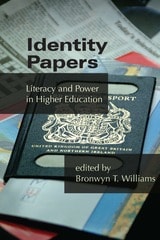
Identity Papers
Literacy and Power in Higher Educationedited by Bronwyn T. Williams
Utah State University Press, 2006
How do definitions of literacy in the academy, and the pedagogies that reinforce such definitions, influence and shape our identities as teachers, scholars, and students? The contributors gathered here reflect on those moments when the dominant cultural and institutional definitions of our identities conflict with our other identities, shaped by class, race, gender, sexual orientation, location, or other cultural factors.
These writers explore the struggle, identify the sources of conflict, and discuss how they respond personally to such tensions in their scholarship, teaching, and administration. They also illustrate how writing helps them and their students compose alternative identities that may allow the connection of professional identities with internal desires and senses of self. They emphasize how identity comes into play in education and literacy and how institutional and cultural power is reinforced in the pedagogies and values of the writing classroom and writing profession.