Results by title
3 books match the query 'Ideology and literature'
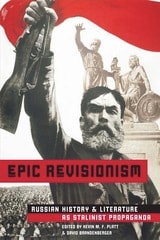
Epic Revisionism
Russian History and Literature as Stalinist PropagandaEdited by Kevin M. F. Platt and David Brandenberger
University of Wisconsin Press, 2006
Focusing on a number of historical and literary personalities who were regarded with disdain in the aftermath of the 1917 revolution—figures such as Peter the Great, Ivan the Terrible, Alexander Pushkin, Leo Tolstoy, and Mikhail Lermontov—Epic Revisionism tells the fascinating story of these individuals’ return to canonical status during the darkest days of the Stalin era.
An inherently interdisciplinary project, Epic Revisionism features pieces on literary and cultural history, film, opera, and theater. This volume pairs scholarly essays with selections drawn from Stalin-era primary sources—newspaper articles, unpublished archival documents, short stories—to provide students and specialists with the richest possible understanding of this understudied phenomenon in modern Russian history.“These scholars shed a great deal of light not only on Stalinist culture but on the politics of cultural production under the Soviet system.”—David L. Hoffmann, Slavic Review
[more]
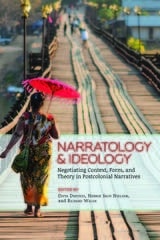
Narratology and Ideology
Negotiating Context, Form, and Theory in Postcolonial NarrativesDivya Dwivedi
The Ohio State University Press, 2018
Narratology and Ideology: Negotiating Context, Form, and Theory in Postcolonial Narratives, edited by Divya Dwivedi, Henrik Skov Nielsen, and Richard Walsh, brings together many of the most prominent figures in the interface between narratology and postcolonial criticism. While narrative theory has for some time recognized the importance of context in the analysis of fiction, this recognition has not quickly translated into substantial work in fields like postcolonialism, where situated questions of value and ideology have been brought to the fore. Postcolonial criticism, on the other hand, has often neglected the formal qualities of fiction in preference for ideological thematic interpretations, precisely because of the suspect legacy of formalism. The volume, then, stages a meeting between these two fields, negotiating both narratological and postcolonialist concerns by addressing specific features of narrative form and technique in the ideological analysis of key postcolonial texts.
The thirteen essays in Narratology and Ideology offer compelling readings of individual novels, with a focus upon South Asian literature, that provide a cumulative case study on the value of postcolonial narratology. The essays show not only how narrative theory can be productively applied in service of postcolonial criticism but also how such attention to postcolonial fictions can challenge and refine our theoretical understanding of narrative.
The thirteen essays in Narratology and Ideology offer compelling readings of individual novels, with a focus upon South Asian literature, that provide a cumulative case study on the value of postcolonial narratology. The essays show not only how narrative theory can be productively applied in service of postcolonial criticism but also how such attention to postcolonial fictions can challenge and refine our theoretical understanding of narrative.
[more]
The Rhetoric of Fictionality
Narrative Theory and the Idea of FictionRichard Walsh
The Ohio State University Press, 2007
Narrative theory has always been centrally concerned with fiction, yet it has tended to treat fictions as if they were merely the framed or disowned equivalents of nonfictional narratives. A rhetorical perspective upon fictionality, however, sees it as a direct way of meaning and a distinct kind of communicative gesture. The Rhetoric of Fictionality: Narrative Theory and the Idea of Fiction by Richard Walsh argues the merit of such a perspective and demonstrates its radical implications for narrative theory.
A new conception of fictionality as a distinctive rhetorical resource, somewhat like the master-trope of fictional narrative, cuts across many of the core theoretical issues in the field. The model, set out in chapter one, is subsequently tested and elaborated in relation to currently prevalent assumptions about narrativity and mimesis; narrative structure; the narrator and transmission; voice and mediacy; narrative media and cognition; and creativity, reception, and involvement. Throughout, the theoretical analysis seeks to vindicate readers’ intuitions about fiction without merely restating them: the result is a forceful challenge to many of narrative theory’s orthodoxies.
The rhetorical model of fictionality advanced in this book offers up new areas of inquiry into the purchase of fictiveness itself upon questions of narrative interpretation. It urges a fundamental reconception of the apparatus of narrative theory by theorizing the conditions of significance that make fictions conceivable and worthwhile.
[more]