Results by title
5 books match the query 'Idioms'
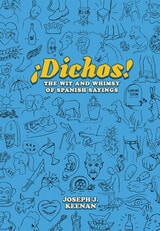
Dichos! The Wit and Whimsy of Spanish Sayings
By Joseph J. Keenan
University of Texas Press, 2019
One of the most challenging—and entertaining—aspects of learning another language is the idiom. Those quirky phrases, steeped in metaphor and colorful cultural references, enliven conversation and make your cross-cultural communication familiar, fun, and meaningful. ¡Dichos! (Sayings) brings us a vibrant compendium of both age-old and brand-new expressions from across Latin America, compiled by the language enthusiast whose Breaking Out of Beginner’s Spanish transformed thousands of readers’ interactions with the Spanish language.
¡Dichos! is divided into thematic sections covering topics ranging from games and relaxation to politics, macho men, and Mondays. Spanish speakers can also use the book to identify the spot-on/best slangy English equivalent for a Spanish-language idiom. Packed with gems like La barba me huele a tigre, y yo mismo me tengo miedo (My beard smells of tiger, and I’m even afraid of myself) and Para todo mal, mezcal; para todo bien, también (For everything bad, mezcal; for everything good, likewise), this book is the ultimate tool for taking your language skills to the next level as you navigate nuance with humor and linguistic agility.
Dichos! The Wit and Whimsy of Spanish Sayings
By Joseph J. Keenan
University of Texas Press, 2019
One of the most challenging—and entertaining—aspects of learning another language is the idiom. Those quirky phrases, steeped in metaphor and colorful cultural references, enliven conversation and make your cross-cultural communication familiar, fun, and meaningful. ¡Dichos! (Sayings) brings us a vibrant compendium of both age-old and brand-new expressions from across Latin America, compiled by the language enthusiast whose Breaking Out of Beginner’s Spanish transformed thousands of readers’ interactions with the Spanish language.
¡Dichos! is divided into thematic sections covering topics ranging from games and relaxation to politics, macho men, and Mondays. Spanish speakers can also use the book to identify the spot-on/best slangy English equivalent for a Spanish-language idiom. Packed with gems like La barba me huele a tigre, y yo mismo me tengo miedo (My beard smells of tiger, and I’m even afraid of myself) and Para todo mal, mezcal; para todo bien, también (For everything bad, mezcal; for everything good, likewise), this book is the ultimate tool for taking your language skills to the next level as you navigate nuance with humor and linguistic agility.
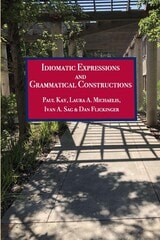
Idiomatic Expressions and Grammatical Constructions
Paul Kay, Laura A. Michaelis, Ivan A. Sag, and Dan Flickinger
CSLI, 2025
Any theory of idioms should be part and parcel of a general theory of grammar, adding as little machinery to one's overall grammatical approach as possible in describing both the syntactic and semantic idiosyncrasies and regularities of this large class of linguistic expressions. This volume presents several lexicalist analyses of idioms within the framework of Sign-Based Construction Grammar, reflecting three guiding principles: many but not all idioms are syntactically and semantically compositional, dividing into distinct classes; idioms are analyzable in terms of a suitably rich lexicon and a set of constructions (lexical and syntactic rules) with corresponding meaning representations; and idiomaticity is a gradient phenomenon, exhibiting wide variation in degree of syntactic flexibility and meaning.
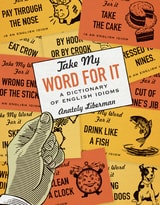
Take My Word for It
A Dictionary of English IdiomsAnatoly Liberman
University of Minnesota Press, 2022
Three centuries of English idioms—their unusual origins and unexpected interpretations
To pay through the nose. Raining cats and dogs. By hook or by crook. Curry favor. Drink like a fish. Eat crow. We hear such phrases every day, but this book is the first truly all-encompassing etymological guide to both their meanings and origins. Spanning more than three centuries, Take My Word for It is a fascinating, one-of-a-kind window into the surprisingly short history of idioms in English. Widely known for his studies of word origins, Anatoly Liberman explains more than one thousand idioms, both popular and obscure, occurring in both American and British standard English and including many regional expressions.
The origins, and even the precise meaning, of most idioms are often obscure and lost in history. Based on a critical analysis of countless conjectures, with exact, in-depth references (rare in the literature on the subject), Take My Word for It provides not only a large corpus of idiomatic phrases but also a vast bibliography. Detailed indexes and a thesaurus make the content accessible at a glance, and Liberman’s introduction and conclusion add historical dimensions. The result of decades of research by a leading authority, this book is both instructive and absorbing for scholars and general readers, who won’t find another resource as comparable in scope or based on data even remotely as exhaustive.
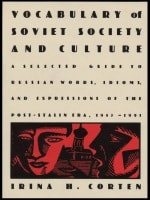
Vocabulary of Soviet Society and Culture
A Selected Guide to Russian Words, Idioms, and Expressions of the Post-Stalin Era, 1953–1991Irina H. Corten
Duke University Press, 1992
The entries are listed alphabetically in English transliteration followed by the Cyrillic, although readers familiar with Russian may prefer to use the Cyrillic alphabet listing included in this volume. In each entry, the author provides a succinct but full explanation of the term and, whenever possible, cross-references to other entries, authentic examples of its use, and samples of relevant Soviet jokes. A reader may approach the lexicon either sequentially or with the aid of a subject thesaurus that divides the material into specific topics. A listing of complementary sources of reference appears in a useful bibliography.
With this fascinating lexicon of "Sovietisms," Corten provides an invaluable and easily accessible medium for those general readers and scholars of the Russian language and Soviet culture interested in understanding contemporary Soviet life.
Selected entries from the Vocabulary of Soviet Society and Culture
Anekdótchik (anekdótchitsa) (cyrillic spelling) (n.)
1: A person who tells jokes (anekdoty); 2: coll. since the late Stalin era, a person arrested and given a prison sentence for the telling of political jokes. The phenomenon indicates the important role of the political joke in Soviet culture and, specifically, in the dissident movement. See iazychnik; sident.
The following jokes were popular during the Brezhnev era:
1. "Comrade Brezhnev, what is your hobby?"
"Collecting jokes about myself."
"And how many have you collected so far?"
"Two and a half labor camps."
2. Question: What is a marked-down joke?
Answer: A joke which, under Stalin, got you ten years in a labor camp, and now gets you only five.
egoístiki (cyrillic) (n.; pl.). Lit., little egotists; coll. since the 1970s referring to headsets worn by music lovers, especially teenage fans of rock music. The idea is that, by wearing headsets, one shuts out the world and becomes indifferent to everything except oneself.
zhrál'nia (cyrillic) (n.). Der. zhrat', to gorge, devour (vulg.); coll. since the 1970s denoting an eating establishment with inexpensive and often bad-tasting food. In the late 1980s, the term also has been applied to new fast-food restaurants which have been built in Soviet cities by Western concerns, for example, McDonald's. See amerikanka; stekliashka; stoiachka.