Results by title
4 books match the query 'Idiot'
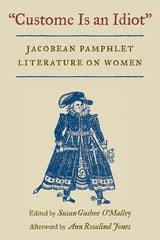
Custome Is an Idiot
JACOBEAN PAMPHLET LITERATURE ON WOMENEdited by Susan Gushee O'Malley
University of Illinois Press, 2004
Containing the complete and annotated texts of six pamphlets written between 1609 and 1620, "Custome Is an Idiot" makes an invaluable contribution to the scholarship on early modern British cultural history, specifically on competing opinions about the role of women in society.
During the early seventeenth century a fierce debate raged in British intellectual society regarding the role of women, how much is ordained by God, and how much is merely custom. The pamphlets that circulated at the time reveal a great deal about the terms of the debate, and these six constitute a significant body of primary literature, allowing the contending voices to be heard anew.
Included here are two pamphlets about gossips by Samuel Rowlands, William Heale's treatise against wife-beating, Christopher Newstead's argument for the superiority of women, and Hic Mulier and Haec Vir, two pamphlets that address the theme of cross-dressing. Introductions by Susan Gushee O'Malley place each pamphlet in a wider context, and detailed annotations shed light on the individual texts.
[more]
Dostoevsky's "The Idiot"
A Critical CompanionLiza Knapp
Northwestern University Press, 1998
This book, part of the acclaimed AATSEEL Critical Companions series, is designed to guide readers through Dostoevsky's most mysterious and confusing work. It begins with introductory essays looking at where, when, and how The Idiot was written and at the novel's major characters. Other essays guide the reader through the author's plans and notebooks; use contemporary feminist criticism to shed light on how this novel explores alternatives to traditional roles; examine the ways in which the novel reflects Dostoevsky's concern with apocalypse, modernity, and time; and address the ways the novel's hero, Prince Myshkin, can be compared to Christ. A final section offers a rich collection of primary sources, including Dostoevsky's letters concerning The Idiot, and an annotated bibliography.
[more]
Dostoevsky's Idiot
Dialogue and the Spiritually Good LifeBruce A. French
Northwestern University Press, 2001
Prince Myshkin is one of Dostoevsky's most perplexing creations. In this study, Bruce A. French presents a provocative interpretation of the religious dimension of Myshkin's goodness from a Bakhtinian perspective.
In three chapters, French takes up in turn the narrator and narrative points of view, the author’s use of inserted narratives, and three modes of interaction French calls Monologue, Dialogue, and Dialogical Living.
In three chapters, French takes up in turn the narrator and narrative points of view, the author’s use of inserted narratives, and three modes of interaction French calls Monologue, Dialogue, and Dialogical Living.
[more]
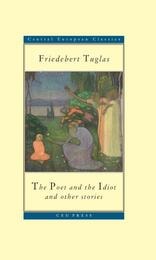
The Poet and the Idiot
Friedebert Tuglas
Central European University Press, 2007
Estonian literature in its written form is little more than a century old. As Estonia was part of the Russian Empire, then of the Soviet Union, it is something of a miracle that the powerful presence of the Baltic Germans, the periods of Russification, and other more subtle forms of cultural pressure, have not eradicated Estonian as a serious literary language. One of the central figures to credit for this was Friedebert Tuglas. The nine stories, and the essay, featured here were written during the World War One, or in the first years of Estonian independence in the early 1920s. They reflect the troubled spirit of the times, but exhibit the influence of a wide selection of writers, ranging from O. Wilde and M. Gorky, to F. Nietzsche and Edgar Allan Poe. The subject matter of Tuglas' stories represented here ranges from a starving prisoner, via a luckless pharmacist's hallucinations from childhood, a wandering soldier who encounters weird spirits, to a young man sitting in a park, accosted by a devilish lunatic who wants to introduce a new brand of devil worship to the world.
[more]