Results by title
3 books match the query 'Ifa'
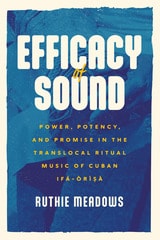
Efficacy of Sound
Power, Potency, and Promise in the Translocal Ritual Music of Cuban Ifá-ÒrìsàRuthie Meadows
University of Chicago Press, 2023
Hailing from Cuba, Nigeria, and various sites across Latin America and the Caribbean, Ifá missionary-practitioners are transforming the landscape of Ifá divination and deity (òrìṣà/oricha) worship through transatlantic travel and reconnection. In Cuba, where Ifá and Santería emerged as an interrelated, Yorùbá-inspired ritual complex, worshippers are driven to “African traditionalism” by its promise of efficacy: they find Yorùbá approaches more powerful, potent, and efficacious.
In the first book-length study on music and Ifá, Ruthie Meadows draws on extensive, multisited fieldwork in Cuba and Yorùbáland, Nigeria, to examine the controversial “Nigerian-style” ritual movement in Cuban Ifá divination. Meadows uses feminist and queer of color theory along with critical studies of Africanity to excavate the relation between utility and affect within translocal ritual music circulations. Meadows traces how translocal Ifá priestesses (ìyánífá), female batá drummers (bataleras), and priests (babaláwo) harness Yorùbá-centric approaches to ritual music and sound to heighten efficacy, achieve desired ritual outcomes, and reshape the conditions of their lives. Within a contentious religious landscape marked by the idiosyncrasies of revolutionary state policy, Nigerian-style Ifá-Òrìṣà is leveraged to transform femininity and masculinity, state religious policy, and transatlantic ritual authority on the island.
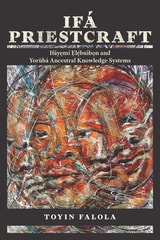
Ifá Priestcraft
Ifáyemí Elébuìbon and Yorùbá Ancestral Knowledge SystemsToyin Falola
University of Wisconsin Press, 2026
Born in 1947, Ifáyẹmí Ọ̀ṣúndàgbonù Ẹlẹ́buìbọn descends from a long line of Yorùbá healers, philosophers, and priests. A fervent disciple of Ifá from age four, Ẹlẹ́buìbọn grew to become both a living moral exemplar and an internationally recognized face of his religion. The first scholarly work to connect the biography of a devout Ifá practitioner to broader intellectual conversations around pluriversalism and Indigenous knowledge systems, Ifá Priestcraft analyzes the complexities of Yorùbá philosophy and religion and their lasting cultural impact in Nigeria and throughout the diaspora. Toyin Falola, a world-renowned scholar of African studies, employs a phenomenological approach that recognizes and solidifies the voice of the “guru” as an organic and authentic source of knowledge. The result is a wholly original and uniquely interdisciplinary study of Yorùbá spirituality and an extraordinary contribution to the field of ancestral studies.
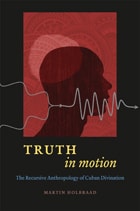
Truth in Motion
The Recursive Anthropology of Cuban DivinationMartin Holbraad
University of Chicago Press, 2012