Results by title
8 books match the query 'Illusions'

Entertaining the Third Reich
Illusions of Wholeness in Nazi CinemaLinda Schulte-Sasse
Duke University Press, 1996
Drawing on theoretical work, particularly that of Lacan and Zizek, Schulte-Sasse shows how films such as Jew Süsss and The Great King construct fantasies of social harmony, often through distorted versions of familiar stories from eighteenth-century German literature, history, and philosophy. Schulte-Sasse observes, for example, that Nazi films, with their valorization of bourgeois culture and use of familiar narrative models, display a curious affinity with the world of Enlightenment culture that the politics of National Socialism would seem to contradict.
Schulte-Sasse argues that film served National Socialism less because of its ideological homogeneity than because of the appeal and familiarity of its underlying literary paradigms and because the medium itself guarantees a pleasurable illusion of wholeness. Entertaining the Third Reich will be of interest to a wide range of scholars, including those engaged in the study of cinema, popular culture, Nazism and Nazi art, the workings of fascist culture, and the history of modern ideology.
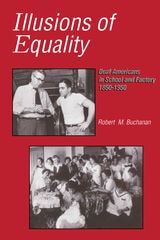
Illusions of Equality
Deaf Americans in School and Factory, 1850-1950Robert M. Buchanan
Gallaudet University Press, 1999
The working lives of Deaf Americans from the mid-1850s to the post-World War II era depended upon strategies created by Deaf community leaders to win and keep jobs through periods of low national employment as well as high. Deaf people typically sought to de-emphasize their identity as sign language users to be better integrated into the workforce. But in his absorbing new book Illusions of Equality, Robert Buchanan shows that events during the next century would thwart these efforts.
The residential schools for deaf students established in the 19th century favored a bilingual approach to education that stressed the use of American Sign Language while also recognizing the value of learning English. But the success of this system was disrupted by the rise of oralism, with its commitment to teaching deaf children speech and its ban of sign language. Buchanan depicts the subsequent ramifications in sobering terms: most deaf students left school with limited educations and abilities that qualified them for only marginal jobs. He also describes the insistence of the male hierarchy in the Deaf community on defending the tactics of individual responsibility through the end of World War II, a policy that continually failed to earn job security for Deaf workers. Illusions of Equality is an original, edifying work that will be appreciated by scholars and students for years to come.
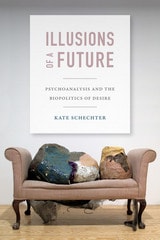
Illusions of a Future
Psychoanalysis and the Biopolitics of DesireKate Schechter
Duke University Press, 2014
In the process, Schechter shows how deeply imbricated the analyst-patient relationship is in this effort. Since the mid-twentieth century, the "real" relationship between analyst and patient is no longer the unremarked background of analysis but its very site. Psychoanalysts seek to validate the centrality of this relationship with theory and, through codified "standards," to claim it as a privileged technique. It has become the means by which psychoanalysts, in seeking to protect their disciplinary autonomy, have unwittingly bound themselves to a neoliberal discourse of regulation.
Lies, Passions, and Illusions
The Democratic Imagination in the Twentieth CenturyFrançois Furet
University of Chicago Press, 2014
This conversation would be, sadly, Furet’s last—he died while Ricoeur was completing his edits. Ricoeur did not want to publish his half without Furet’s approval, so what remains is Furet’s alone, an astonishingly cohesive meditation on the political passions of the twentieth century. With strokes at once broad and incisive, he examines the many different trajectories that nations of the West have followed over the past hundred years. It is a dialogue with history as it happened but also as a form of thought. It is a dialogue with his critics, with himself, and with those major thinkers—from Tocqueville to Hannah Arendt—whose ideas have shaped our understanding of the tragic dramas and upheavals of the modern era. It is a testament to the crucial role of the historian, a reflection on how history is made and lived, and how the imagination is a catalyst for political change. Whether new to Furet or deeply familiar with his work, readers will find thought-provoking assessments on every page, a deeply moving look back at one of the most tumultuous periods of history and how we might learn and look forward from it.
Novel Ecologies
Nature Remade and the Illusions of TechAllison Carruth
University of Chicago Press, 2025
Allison Carruth’s Novel Ecologies shows how the tech industry has taken up the wilderness mythologies that shaped one strain of American environmentalism over the last century. Calling this twenty-first-century environmental imagination Nature Remade, Carruth describes a distinctly West Coast framework that is at once nostalgic and futuristic. Through three case studies (synthetic wildlife, the digital cloud, and space colonization), the book shows Nature Remade to be a quasi-religious belief in venture capitalism and big tech. This paradigm thus imagines a future in which species, ecosystems, and entire planets are re-generated and re-created through engineering.
Novel Ecologies challenges the conviction that climate change and other environmental crises must be met with ever larger-scale forms of technological intervention. Against the new worlds conjured by Google, Meta, Open AI, Amazon, SpaceX, and a host of lesser-known start-ups, Carruth marshals writers and artists who imagine provisionally hopeful environmental futures while refusing to forget the histories that have made the world what it is. On this track of the book, Carruth discusses the works of Octavia Butler, Becky Chambers, Jennifer Egan, Ruth Ozeki, Craig Santos Perez, Tracy K. Smith, Jeff VanderMeer, Saya Woolfalk, and many more. Their novels, poems, installation artworks, and expressive media offer a speculative world built on livable communities rather than engineered lifeforms.
The Illusions of Doctor Faustino
Juan Valera
Catholic University of America Press, 2008
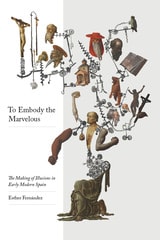
To Embody the Marvelous
The Making of Illusions in Early Modern SpainEsther Fernández
Vanderbilt University Press, 2021
Winner of the Nancy Staub Award, UNIMA-USA (Union Internationale de la Marionnette), 2023
In its exploration of puppetry and animation as the performative media of choice for mastering the art of illusion, To Embody the Marvelous engages with early modern notions of wonder in religious, artistic, and social contexts.
From jointed, wood-carved figures of Christ, saintly marionettes that performed hagiographical dramas, experimental puppets and automata in Cervantes' Don Quixote, and the mechanical sets around which playwright Calderón de la Barca devised secular magic shows to deconstruct superstitions, these historical and fictional artifacts reenvisioned religious, artistic, and social notions that led early modern society to critically wrestle with enchantment and disenchantment.
The use of animated performance objects in Spanish theatrical contexts during the sixteenth and seventeenth centuries became one of the most effective pedagogical means to engage with civil society. Regardless of social strata, readers and spectators alike were caught up in a paradigm shift wherein belief systems were increasingly governed by reason—even though the discursive primacy of supernatural doxa and Christian wonder remained firmly entrenched. Thanks to their potential for motion, religious and profane puppets, automata, and mechanical stage props deployed a rationalized sense of wonder that illustrates the relationship between faith and reason, reevaluates the boundaries of fiction in art and entertainment cultures, acknowledges the rise of science and technology, and questions normative authority.
To Embody the Marvelous
The Making of Illusions in Early Modern SpainEsther Fernández
Vanderbilt University Press, 2022
Winner of the Nancy Staub Award, UNIMA-USA (Union Internationale de la Marionnette), 2023
In its exploration of puppetry and animation as the performative media of choice for mastering the art of illusion, To Embody the Marvelous engages with early modern notions of wonder in religious, artistic, and social contexts.
From jointed, wood-carved figures of Christ, saintly marionettes that performed hagiographical dramas, experimental puppets and automata in Cervantes' Don Quixote, and the mechanical sets around which playwright Calderón de la Barca devised secular magic shows to deconstruct superstitions, these historical and fictional artifacts reenvisioned religious, artistic, and social notions that led early modern society to critically wrestle with enchantment and disenchantment.
The use of animated performance objects in Spanish theatrical contexts during the sixteenth and seventeenth centuries became one of the most effective pedagogical means to engage with civil society. Regardless of social strata, readers and spectators alike were caught up in a paradigm shift wherein belief systems were increasingly governed by reason—even though the discursive primacy of supernatural doxa and Christian wonder remained firmly entrenched. Thanks to their potential for motion, religious and profane puppets, automata, and mechanical stage props deployed a rationalized sense of wonder that illustrates the relationship between faith and reason, reevaluates the boundaries of fiction in art and entertainment cultures, acknowledges the rise of science and technology, and questions normative authority.