Results by title
3 books match the query 'Imagery (Psychology)'

Hunt the Devil
A Demonology of US War CultureRobert L. Ivie and Oscar Giner
University of Alabama Press, 2015
Meticulously researched, documented, and argued, Hunt the Devil opens with contemporary images of the US’s global war on terror in the aftermath of 9/11. In five chapters devoted to the demonization of evildoers, witches, Indians, dictators, and Reds by American writers, in presidential rhetoric, and in popular culture, Ivie and Giner show how the use of demonization in the war on terror is only the most recent manifestation of a process that has recurred throughout American history.
In a sixth chapter, the authors introduce the archetype of the Trickster. Though not opposed to the Devil per se, the Trickster’s democratic impulses have often provided a corrective antidote to the corrosive and distorting effects of demonization. Invoking the framework of Carl Jung’s shadow aspect, Hunt the Devil offers the Trickster as a figure who can break the cycle of demonization and war.
The role of the mythic Devil in the American psyche has profound implications, not just for American diplomacy and the use of American arms in the world, but for the possibility of domestic peace within an increasingly diverse society. Hunt the Devil provides much of interest to readers and scholars in the fields of war, rhetorical studies, American Studies, US political culture, Jungian psychology, and mythography.

Imagination and Invention
Gilbert Simondon
University of Minnesota Press, 2023
A radical rethinking of the theory and the experience of mental images
Here, in English translation for the first time, is Gilbert Simondon’s fundamental reconception of the mental image and the theory of imagination and invention. Drawing on a vast range of mid-twentieth-century theoretical resources—from experimental psychology, cybernetics, and ethology to the phenomenological reflections of Sartre and Merleau-Ponty—Imagination and Invention provides a comprehensive account of the mental image and adds a vital new dimension to the theory of psychical individuation in Simondon’s earlier, highly influential work.
Simondon traces the development of the mental image through four phases: first a bundle of motor anticipations, the image becomes a cognitive system that mediates the organism’s relation to its milieu, then a symbolic and abstract integration of motor and affective experience to, finally, invention, a solution to a problem of life that requires the externalization of the mental image and the creation of a technical object. An image cannot be understood from the perspective of one phase alone, he argues, but only within the trajectory of its progressive metamorphosis.
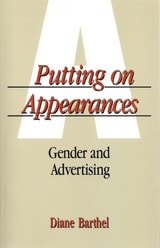
Putting On Appearances
Gender and AdvertisingDiane Barthel
Temple University Press, 1989
In this lively critical analysis, Diane Barthel reveals the previously overlooked and underestimated depth of cultural meaning behind contemporary American advertising. Focusing mainly on ads for beauty products directed at women, she demonstrates how stereotypical gender identities are emphasized and how advertising itself creates a gendered relationship with the consumer. She explores psychological, sociological, and cultural messages in advertising to show how Putting on Appearances is anything but a purely personal matter, and how the social realities in which we are forced to live are conditioned by the personal appearances we choose to create.
Most advertisements are not sexually obvious, but rely instead on sexual story-telling in which seduction, deception, and passion are portrayed as acceptable means for achieving selfhood. Advertisements that proclaim, "Now is the time to paint your knees" speak with one form of authority: those that present the voice of the all-knowing scientist or the nurturing mother rely on others. Celebrities figure as professional beauties and wise older sisters, sharing their secrets with the consumer. "The Gentle Treatment Great Model Search Made Me a Star. Now it’s your turn."
Inseparable from the clothes we wear and the products we use are our ideas and fantasies about our bodies. Beauty products present beauty rituals as transcendent occasions, and diet products call up religious imagery of guilt and salvation. The body itself is to be anxiously manipulated and systematically worked over until the consumer "turns her body into...an advertisement for herself, a complicated sign to be read and admired."
In the series Women in the Political Economy, edited by Ronnie J. Steinberg.