Results by title
6 books match the query 'Imaginary'

Control of the Imaginary
Reason and Imagination in Modern TimesLuiz Costa LimaTranslated by Ronald W. SousaIntroduction by Ronald W. SousaAfterword by Jochen Schulte-Sasse
University of Minnesota Press, 1989
Control of the Imaginary was first published in 1989. Minnesota Archive Editions uses digital technology to make long-unavailable books once again accessible, and are published unaltered from the original University of Minnesota Press editions.
In Control of the Imaginary Luiz Costa Lima explains how the distinction between truth and fiction emerged at the beginning of modern times and why, upon its emergence, fiction fell under suspicion. Costa Lima not only describes the continuous relationship between Western notions of reason and subjectivity over a broad time-frame—the Renaissance to the first decade of the twentieth century—but he uses this occasion to reexamine the literary traditions of France, Italy, Spain, Portugal, England, and Germany. The book reconstructs the dominant frames in the European tradition between the Middle Ages and the nineteenth century from the perspective of a Latin American who sees the culture of his native Brazil haunted by unresolved questions from the Northern Hemisphere. Costa Lima manages to synthesize positions from philosophy, anthropology, sociology, psychology, linguistics, and history without separating the theoretical discussion from his historical reconstructions.
The first chapter situates the problem and grounds the emergent distinction between truth and fiction in a very close analysis of one of the first European historians, Fernao Lopes, who sets the tone for the condemnation of fiction in the name of the truth of history and the potential for individual interpretation. Costa Lima pursues these notions through the aesthetic debates of the seventeenth and eighteenth centuries to the writings of the French historian Michelet. He also devotes an illuminating chapter to the invention of the strictures imposed on fiction.
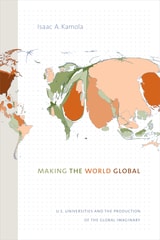
Making the World Global
U.S. Universities and the Production of the Global ImaginaryIsaac A. Kamola
Duke University Press, 2019
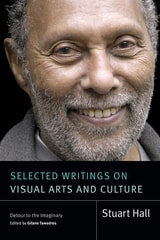
Selected Writings on Visual Arts and Culture
Detour to the ImaginaryStuart Hall. Edited by Gilane Tawadros
Duke University Press, 2024
The Imaginary and Its Worlds
American Studies after the Transnational TurnEdited by Laura Bieger, Ramón Saldívar, and Johannes Voelz
Dartmouth College Press, 2013
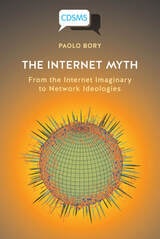
The Internet Myth
From the Internet Imaginary to Network IdeologiesPaolo Bory
University of Westminster Press, 2020
‘The Internet is broken and Paolo Bory knows how we got here. In a powerful book based on original research, Bory carefully documents the myths, imaginaries, and ideologies that shaped the material and cultural history of the Internet. As important as this book is to understand our shattered digital world, it is essential for those who would fix it.’ — Vincent Mosco, author of The Smart City in a Digital World
The Internet Myth retraces and challenges the myth laying at the foundations of the network ideologies – the idea that networks, by themselves, are the main agents of social, economic, political and cultural change. By comparing and integrating different sources related to network histories, this book emphasizes how a dominant narrative has extensively contributed to the construction of the Internet myth while other visions of the networked society have been erased from the collective imaginary. The book decodes, analyzes and challenges the foundations of the network ideologies looking at how networks have been imagined, designed and promoted during the crucial phase of the 1990s.
Three case studies are scrutinized so as to reveal the complexity of network imaginaries in this decade: the birth of the Web and the mythopoesis of its inventor; and the histories of two Italian networking projects, the infrastructural plan Socrate and the civic network Iperbole, the first to give free Internet access to citizens.
The Internet Myth thereby provides a compelling and hidden sociohistorical narrative in order to challenge one of the most powerful myths of our time.
This title has been published with the financial assistance of the Fondazione Hilda e Felice Vitali, Lugano, Switzerland.
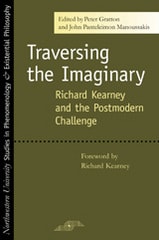
Traversing the Imaginary
Richard Kearney and the Postmodern ChallengeEdited by Peter Gratton and John Panteleimon Manoussakis; Foreword by Richard Kearney
Northwestern University Press, 2007
The book opens with Kearney's own "prelude" in which he traces his intellectual itinerary as it traverses the three imaginaries explored in the volume: the dialogical, the political, and the narrative. The interviews that follow the first section allow readers to listen in on conversations between Kearney and some of the most interesting and respected thinkers of our time—Noam Chomsky, Charles Taylor, Jacques Derrida, Paul Ricouer, and Martha Nussbaum—as they reveal new and unexpected aspects of their thought on stories and mourning, ethics and narrative, terror and religion, intellectuals and ideology. The next section, on the political imaginary, looks at Kearney's distinctive contribution to the political situation in Ireland and in Europe more generally; and in the last, on narrative, writers including David Wood, Terry Eagleton, and Mark Dooley focus on Kearney's novels as instances of narrative theory put into literary practice. Concluding with Kearney's postscript, an essay on "Traversals and Epiphanies in Joyce and Proust," the volume comes full circle, encompassing the full extent of Richard Kearney's engagement and offerings as a philosopher,