Results by title
3 books match the query 'Immanence'
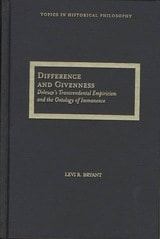
Difference and Givenness
Deleuze's Transcendental Empiricism and the Ontology of ImmanenceLevi R Bryant
Northwestern University Press, 2008
From one end of his philosophical work to the other, Gilles Deleuze consistently described his position as a transcendental empiricism. But just what is transcendental about Deleuze’s transcendental empiricism? And how does his position fit with the traditional empiricism articulated by Hume? In Difference and Givenness, Levi Bryant addresses these long-neglected questions so critical to an understanding of Deleuze’s thinking. Through a close examination of Deleuze’s independent work--focusing especially on Difference and Repetition--as well as his engagement with thinkers such as Kant, Maïmon, Bergson, and Simondon, Bryant sets out to unearth Deleuze’s transcendental empiricism and to show how it differs from transcendental idealism, absolute idealism, and traditional empiricism.
What emerges from these efforts is a metaphysics that strives to articulate the conditions for real existence, capable of accounting for the individual itself without falling into conceptual or essentialist abstraction. In Bryant’s analysis, Deleuze’s metaphysics articulates an account of being as process or creative individuation based on difference, as well as a challenging critique--and explanation--of essentialist substance ontologies. A clear and powerful discussion of how Deleuze’s project relates to two of the most influential strains in the history of philosophy, this book will prove essential to anyone seeking to understand Deleuze’s thought and its specific contribution to metaphysics and epistemology.

Immanence and Transcendance
The Theater of Jean Rotrou (1609–1650)Robert J. Nelson
The Ohio State University Press, 1900

The Immanence of a Crisis
Gregg Lambert
University of Minnesota Press, 2027
A radical reconsideration of what crisis means in an age of continual global upheavals
The very notion of crisis in the wake of the Covid-19 pandemic, widespread social unrest, economic instability, and worsening climate change seems almost mundane. Combining rigorous philosophical analysis with literary expressionism, The Immanence of a Crisis rethinks the idea of calamity to explore how human beings collectively resist and adapt to the external conditions imposed on them.
Challenging the conventional pathological standpoint that views crises as singular episodes, each with a locatable and decisive cause, The Immanence of a Crisis frames its subject as a multiplicity of overlapping events that are shaped by both natural and artificial forces. Drawing on a diverse range of thinkers such as Jean-Baptiste Lamarck, Alfred North Whitehead, Gilles Deleuze, and Michel Foucault, Gregg Lambert offers timely philosophical reflections on how to contend with the many existential challenges we face in a rapidly changing world.
Concluding what the author calls a “four-part trilogy” on Foucault’s concept of biopolitics, this work demonstrates how modern governance seeks to justify its power by embedding populations in a state of perpetual emergency. By refusing the idea of a return to normal, The Immanence of a Crisis instead theorizes how we might redeem the present moment and develop new forms of resilience amidst what is now a permanent and pervasive condition of crisis.
Retail e-book files for this title are screen-reader friendly.