Results by title
3 books match the query 'Immigration Law'
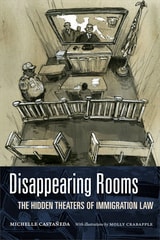
Disappearing Rooms
The Hidden Theaters of Immigration LawMichelle Castañeda
Duke University Press, 2023
In Disappearing Rooms Michelle Castañeda lays bare the criminalization of race enacted every day in US immigration courts and detention centers. She uses a performance studies perspective to show how the theatrical concept of mise-en-scène offers new insights about immigration law and the absurdist dynamics of carceral space. Castañeda draws upon her experiences in immigration trials as an interpreter and courtroom companion to analyze the scenography—lighting, staging, framing, gesture, speech, and choreography—of specific rooms within the immigration enforcement system. Castañeda’s ethnographies of proceedings in a “removal” office in New York City, a detention center courtroom in Texas, and an asylum office in the Northeast reveal the depersonalizing violence enacted in immigration law through its embodied, ritualistic, and affective components. She shows how the creative practices of detained and disappeared people living under acute duress imagine the abolition of detention and borders. Featuring original illustrations by artist-journalist Molly Crabapple, Disappearing Rooms shines a light into otherwise hidden spaces of law within the contemporary deportation regime.
Duke University of Press Scholars of Color First Book Award Recipient
Duke University of Press Scholars of Color First Book Award Recipient
[more]
Immigration Law and the U.S.–Mexico Border
¿Sí se puede?Kevin R. Johnson and Bernard Trujillo
University of Arizona Press, 2011
Americans from radically different political persuasions agree on the need to “fix” the “broken” US immigration laws to address serious deficiencies and improve border enforcement. In Immigration Law and the US–Mexico Border, Kevin Johnson and Bernard Trujillo focus on what for many is at the core of the entire immigration debate in modern America: immigration from Mexico.
In clear, reasonable prose, Johnson and Trujillo explore the long history of discrimination against US citizens of Mexican ancestry in the United States and the current movement against “illegal aliens”—persons depicted as not deserving fair treatment by US law. The authors argue that the United States has a special relationship with Mexico by virtue of sharing a 2,000-mile border and a “land-grab of epic proportions” when the United States “acquired” nearly two-thirds of Mexican territory between 1836 and 1853.
The authors explain US immigration law and policy in its many aspects—including the migration of labor, the place of state and local regulation over immigration, and the contributions of Mexican immigrants to the US economy. Their objective is to help thinking citizens on both sides of the border to sort through an issue with a long, emotional history that will undoubtedly continue to inflame politics until cooler, and better-informed, heads can prevail. The authors conclude by outlining possibilities for the future, sketching a possible movement to promote social justice. Great for use by students of immigration law, border studies, and Latino studies, this book will also be of interest to anyone wondering about the general state of immigration law as it pertains to our most troublesome border.
[more]
The Violence of Protection
Policing, Immigration Law, and Asian American WomenLee Ann S. Wang
Duke University Press, 2026
Celebrated as a feminist victory upon its passage as part of the Clinton Crime Bill, the Violence Against Women Act (VAWA) is a landmark piece of legislation that provides protections for survivors of gender and sexual violence. However, as Lee Ann S. Wang shows in The Violence of Protection, VAWA primarily funds law enforcement efforts to rescue women, and in doing so, creates conditions of racial violence against survivors from communities who are already policed, surveilled, and face immigration enforcement. Through ethnographic fieldwork with legal and social advocates serving Asian American survivors of gender and sexual violence in the San Francisco Bay Area, Wang shows how these advocates grapple with laws which require survivors to cooperate with policing in order to receive protection. Engaging in methodologies of feminist refusal, theories of racial assemblage, and abolition feminisms, The Violence of Protection theorizes the victim as a legal subject and exposes the racial violence enacted when State-provided legal safeguards are leveraged to expand punishment against survivors, their communities, and others.
[more]