Results by title
15 books match the query 'Imperial'
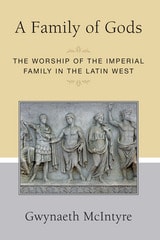
A Family of Gods
The Worship of the Imperial Family in the Latin WestGwynaeth McIntyre
University of Michigan Press, 2016
Roman politics and religion were inherently linked as the Romans attempted to explain the world and their place within it. As Roman territory expanded and power became consolidated into the hands of one man, people throughout the empire sought to define their relationship with the emperor by granting honors to him. This collection of practices has been labeled “emperor worship” or “ruler cult,” but this tells only half the story: imperial family members also became an important part of this construction of power and almost half of the individuals deified in Rome were wives, sisters, children, and other family members of the emperor.
In A Family of Gods, Gwynaeth McIntyre expands current “ruler cult” discussions by including other deified individuals, and by looking at how communities in the period 44 BCE to 337 CE sought to connect themselves with the imperial power structure through establishing priesthoods and cult practices. This work focuses on the priests dedicated to the worship of the imperial family in order to contextualize their role in how imperial power was perceived in the provincial communities and the ways in which communities chose to employ religious practices. Special emphasis is given to the provinces in Gaul, Spain, and North Africa.
This book draws on epigraphic evidence but incorporates literary, numismatic, and archaeological evidence where applicable. It will be of interest to scholars of Roman imperial cult as well as Roman imperialism, and religious and political history.

Brave new world
Imperial and democratic nation-building in Britain between the warsVolume editor Laura Beers and Geraint Thomas
University of London Press, 2012
Diary of General Patrick Gordon of Auchleuchries 1635-1699
Volume 1: 1635-1659Dmitry Fedosov and Patrick Gordon
Aberdeen University Press, 2009
Diary of General Patrick Gordon of Auchleuchries 1635-1699
Volume 2: 1659-1667Dmitry Fedosov and Patrick Gordon
Aberdeen University Press, 2009
Diary of General Patrick Gordon of Auchleuchries 1635-1699
Volume 3: 1677-1678Dmitry Fedosov and Patrick Gordon
Aberdeen University Press, 2012
Diary of General Patrick Gordon of Auchleuchries 1635-1699
Volume 4: 1684-1689Dmitry Fedosov and Patrick Gordon
Aberdeen University Press, 2013
Diary of General Patrick Gordon of Auchleuchries 1635-1699
Volume 5: 1690-1695Dmitry Fedosov and Patrick Gordon
Aberdeen University Press, 2014
Diary of General Patrick Gordon of Auchleuchries 1635-1699
Volume 6: 1696-1699Dmitry Fedosov and Patrick Gordon
Aberdeen University Press, 2016
Gogol's Afterlife
The Evolution of a Classic in Imperial and Soviet RussiaCaryl Emerson
Northwestern University Press, 2002
Part I charts the historical and cultural currents that shaped Gogol's reputation, devoting particular attention to the models of authorship Gogol himself devised in response to his changing audience and developing authorial mission. Part II takes a panoramic view of the social milieu in which Gogol's status evolved. Finally, Part III examines the place of the classics in Soviet culture, with a focus on Gogol's role in the cultural revolution and his peculiar relationship with state power under Stalinism.
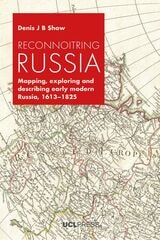
Reconnoitring Russia
Mapping, Exploring and Describing Early Modern Russia, 1613–1825Denis J. B. Shaw
University College London, 2024
Focusing on geographical practices—such as exploring, observing, describing, and mapping—Reconnoitring Russia explains how Russia’s rulers and public came to understand the expanse of their territory. It adopts a broad chronological framework and compares the Russian experience to the concurrent realities of other European countries between 1613, the emergence of the Romanov dynasty, and 1825, the conclusion of Alexander I’s reign.
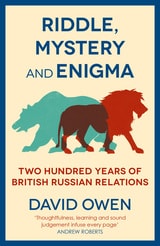
Riddle, Mystery, and Enigma
Two Hundred Years of British–Russian RelationsDavid Owen
Haus Publishing, 2022
With Riddle, Mystery, and Enigma, statesman and author David Owen tells the story of Britain’s relationship with Russia, which has been surprisingly underexplored. Through his characteristic insight and expertise, he depicts a relationship governed by principle as often as by suspicion, expediency, and necessity.
When the two nations formed a pragmatic alliance and fought together at the Battle of Navarino in Greece in 1827, it was overwhelmingly the work of the British prime minister, George Canning. His death brought about a drastic shift that would see the countries fighting on opposite sides in the Crimean War and jostling for power during the Great Game. It was not until the Russian Revolution of 1917 that another statesman had a defining impact on relations between Britain and Russia: Winston Churchill, who opposed Bolshevism yet never stopped advocating for diplomatic and military engagement with Russia. In the Second World War, he recognized early on the necessity of allying with the Soviets against the menace of Nazi Germany. Bringing us into the twenty-first century, Owen chronicles how both countries have responded to their geopolitical decline. Drawing on both imperial and Soviet history, he explains the unique nature of Putin’s autocracy and addresses Britain’s return to “blue water” diplomacy. Newly revised, this paperback edition features extended chapters on Putin’s Russia and the future of British–Russian relations after the Russo-Ukrainian War.

Russia’s Black Genius
A Sourcebook on the African Heritage of Alexander PushkinEdited by Emily Wang and Korey Garibaldi
Amherst College Press, 2027
Russia’s Black Genius: A Sourcebook on the African Heritage of Alexander Pushkin brings together primary sources related to the racialization of Russian poet Alexander Pushkin and his Afro-Russian great-grandfather, the military engineer and general Abram Petrovich Gannibal. While Pushkin is a canonical figure and renowned to this day as Russia’s national poet, his African heritage is often overlooked or poorly understood; meanwhile Gannibal, despite his compelling life story, has become a relatively obscure figure outside of Russia. Yet over the course of the nineteenth and twentieth centuries, it was common to find discussions of Pushkin’s Black and multiracial ancestry in books and periodicals on both sides of the Atlantic. Building on the work of a small but influential cohort of scholars and intellectuals who have illuminated the racial dimensions of Pushkin’s legacy, this volume makes primary and source materials available, often for the first time, to readers who are not fluent in the Russian language. Ranging from US criticism and English translations of Russian, German, and French texts to numerous accounts of Pushkin’s life and works penned by Black Americans, the texts in this sourcebook expand and complicate the historical reception of Pushkin in Europe and the United States. Through translation and interdisciplinary dialogue, Russia’s Black Genius brings one of Russia’s—and the world’s— foremost poets into conversation with a broader swath of global readers.
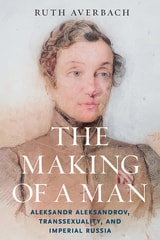
The Making of a Man
Aleksandr Aleksandrov, Transsexuality, and Imperial RussiaRuth Averbach
University of Wisconsin Press, 2026
Aleksandr Aleksandrov was an author and soldier in service of the Russian tsar, active in the Prussian theater of the War of the Fourth Coalition (1806–7) and in the Napoleonic Wars. In scholarship, he is better known by his birth name, Nadezhda Andreevna Durova, and often referred to with the female pronouns bestowed upon him at birth. In this first book-length study of Aleksandrov, Ruth Averbach argues that we should understand this celebrated figure of Imperial Russia, whose sex was legally changed by Tsar Aleksandr I, simply as a man, one whose masculinity was intimately connected to the imperialist cause and Russian nationalism.
For the majority of his life, Aleksandrov lived, wrote, and fought as a man and was recognized as such by most of his contemporaries. This contradicts the dominant position in especially Western feminist scholarship, which understands “Durova” either as a woman so patriotic that she dressed as a man to fight Russia’s wars or as a woman so frustrated by gender restrictions that she dramatically sought to cast them aside. Averbach instead asserts that we should take Aleksandrov at his word and accept his transition as genuine. Doing so allows for fresh interpretations of both his autobiographical writings and his works of fiction, interpretations that Averbach deftly shows have salience not just for a single man’s life but also for how we understand masculinity, imperialism, and nationalism in nineteenth-century Russia more broadly.
The Ukrainian Question
Russian Empire and Nationalism in the 19th CenturyAlexei Miller
Central European University Press, 2003
To Kill a Spy
Everyday Nationalism and Political Violence in Fin-de-Siecle EuropeZachary Mazur
Central European University Press, 2026
How does an ordinary, working-class man transform into a political executioner? And how does a society reach the tipping point where premeditated murder is celebrated as a civic duty?
This gripping historical investigation unravels the environment and conditions of radicalization in fin-de-siècle Europe. Societal shifts, mass political movements, the popular press and espionage paranoia all contributed to a fearful community, wary of outsiders and ready to do anything to defend itself.