Results by title
2 books match the query 'Imperial Britain'
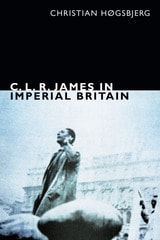
C. L. R. James in Imperial Britain
Christian Høgsbjerg
Duke University Press, 2014
C. L. R. James in Imperial Britain chronicles the life and work of the Trinidadian intellectual and writer C. L. R. James during his first extended stay in Britain, from 1932 to 1938. It reveals the radicalizing effect of this critical period on James's intellectual and political trajectory. During this time, James turned from liberal humanism to revolutionary socialism. Rejecting the "imperial Britishness" he had absorbed growing up in a crown colony in the British West Indies, he became a leading anticolonial activist and Pan-Africanist thinker. Christian Høgsbjerg reconstructs the circumstances and milieus in which James wrote works including his magisterial study The Black Jacobins. First published in 1938, James's examination of the dynamics of anticolonial revolution in Haiti continues to influence scholarship on Atlantic slavery and abolition. Høgsbjerg contends that during the Depression C. L. R. James advanced public understanding of the African diaspora and emerged as one of the most significant and creative revolutionary Marxists in Britain.
[more]
Twisted Words
Torture and Liberalism in Imperial BritainKatherine Judith Anderson
The Ohio State University Press, 2022
Twisted Words: Torture and Liberalism in Imperial Britain examines torture across the fiction, periodicals, and government documents of the British Empire in the latter half of the nineteenth century. Placing acts of torture and words about torture in relation to changing definitions of citizenship and human rights, Katherine Judith Anderson argues that torture—as a technique of state terrorism—evolved in relation to nineteenth-century liberalism, combining the traditional definition of exceptional acts of cruelty with systemic, banal, or everyday violence. Analyzing canonical novels by George Eliot, Anthony Trollope, and George Meredith alongside an impressive array of lesser-known fiction through the lenses of critical terrorism studies and political, legal, and phenomenological theory, Anderson rethinks torture as a mode of reclaiming an embodied citizenship and demonstrates how the Victorians ushered in our modern definition of torture. Furthermore, she argues that torture is foundational to Western modernity, since liberalism was, and continues to be, dependent on state-sanctioned––and at times state-sponsored—torture, establishing parallels between Victorian liberal thought and contemporary (neo)imperialism and global politics.
[more]