Results by title

2 books match the query 'Imperial Entanglements'
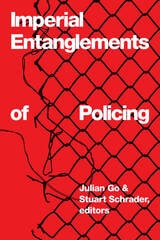
cover of Imperial Entanglements of Policing

Imperial Entanglements of Policing

Julian Go and Stuart Schrader

Duke University Press, 2026
In recent years, people across the world have protested the violence of policing and its intrusion into everyday lives, and the close timing of these global movements is no coincidence. As Imperial Entanglements of Policing shows, a central reason for the remarkable similarities of policing around the globe is empire. Across the entire sweep of modern policing, there have been strong, mutual connections among police forces via tactics, training, technology, and ideology. Contributors investigate these imperial entanglements in diverse sites around the world, from cities like New York, Santiago, and Johannesburg to countries like the Philippines, Algeria, United Kingdom, and Iraq. Together, they examine a range of policing practices and tactics, such as the impact of American, German, and United Nations policing consultants being employed across the world and the influence of technology and ideology on these encounters. They highlight the ways imperial power was and continues to be perpetrated through police power, how it has evolved in service of imperial goals, and its connection with sites of imperial control.
[more]
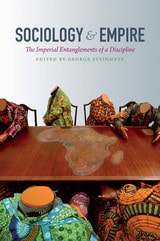
cover of Sociology and Empire: The Imperial Entanglements of a Discipline

Sociology and Empire

The Imperial Entanglements of a Discipline

George Steinmetz, ed.

Duke University Press, 2013

The revelation that the U.S. Department of Defense had hired anthropologists for its Human Terrain System project—assisting its operations in Afghanistan and Iraq—caused an uproar that has obscured the participation of sociologists in similar Pentagon-funded projects. As the contributors to Sociology and Empire show, such affiliations are not new. Sociologists have been active as advisers, theorists, and analysts of Western imperialism for more than a century.

The collection has a threefold agenda: to trace an intellectual history of sociology as it pertains to empire; to offer empirical studies based around colonies and empires, both past and present; and to provide a theoretical basis for future sociological analyses that may take empire more fully into account. In the 1940s, the British Colonial Office began employing sociologists in its African colonies. In Nazi Germany, sociologists played a leading role in organizing the occupation of Eastern Europe. In the United States, sociology contributed to modernization theory, which served as an informal blueprint for the postwar American empire. This comprehensive anthology critiques sociology's disciplinary engagement with colonialism in varied settings while also highlighting the lasting contributions that sociologists have made to the theory and history of imperialism.

Contributors. Albert Bergesen, Ou-Byung Chae, Andy Clarno, Raewyn Connell, Ilya Gerasimov, Julian Go, Daniel Goh, Chandan Gowda, Krishan Kumar, Fuyuki Kurasawa, Michael Mann, Marina Mogilner, Besnik Pula, Anne Raffin, Emmanuelle Saada, Marco Santoro, Kim Scheppele, George Steinmetz, Alexander Semyonov, Andrew Zimmerman

[more]