Results by title
13 books match the query 'Imprints'
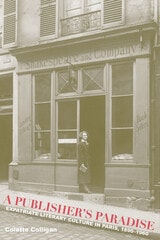
A Publisher's Paradise
Expatriate Literary Culture in Paris, 1890-1960Colette Colligan
University of Massachusetts Press, 2014
From 1890 to 1960, some of Anglo-America's most heated cultural contests over books, sex, and censorship were staged not at home, but abroad in the City of Light. Paris, with its extraordinary liberties of expression, became a special place for interrogating the margins of sexual culture and literary censorship, and a wide variety of English language “dirty books” circulated through loose expatriate publishing and distribution networks.
A Publisher's Paradise explores the political and literary dynamics that gave rise to this expatriate cultural flourishing, which included everything from Victorian pornography to the most daring and controversial modernist classics. Colette Colligan tracks the British and French politicians and diplomats who policed Paris editions of banned books and uncovers offshore networks of publishers, booksellers, authors, and readers. She looks closely at the stories the “dirty books” told about this publishing haven and the smut peddlers and literary giants it brought together in transnational cultural formations. The book profiles an eclectic group of expatriates living and publishing in Paris, from relatively obscure figures such as Charles Carrington, whose list included both The Picture of Dorian Gray and the pornographic novel Randiana, to bookshop owner Sylvia Beach, famous for publishing James Joyce's Ulysses in 1922.
A Publisher's Paradise is a compelling exploration of the little-known history of foreign pornography in Paris and the central role it played in turning the city into a modernist outpost for literary and sexual vanguardism, a reputation that still lingers today in our cultural myths of midnight in Paris.

Asylum, Prison, and Poorhouse
The Writings and Reform Work of Dorothea Dix in IllinoisDavid L. Lightner
Southern Illinois University Press, 1999
This illustrated collection of annotated newspaper articles and memorials by Dorothea Dix provides a forum for the great mid-nineteenth-century humanitarian and reformer to speak for herself.
Dorothea Lynde Dix (1802–87) was perhaps the most famous and admired woman in America for much of the nineteenth century. Beginning in the early 1840s, she launched a personal crusade to persuade the various states to provide humane care and effective treatment for the mentally ill by funding specialized hospitals for that purpose. The appalling conditions endured by most mentally ill inmates in prisons, jails, and poorhouses led her to take an active interest also in prison reform and in efforts to ameliorate poverty.
In 1846–47 Dix brought her crusade to Illinois. She presented two lengthy memorials to the legislature, the first describing conditions at the state penitentiary at Alton and the second discussing the sufferings of the insane and urging the establishment of a state hospital for their care. She also wrote a series of newspaper articles detailing conditions in the jails and poorhouses of many Illinois communities.
These long-forgotten documents, which appear in unabridged form in this book, contain a wealth of information on the living conditions of some of the most unfortunate inhabitants of Illinois. In his preface, David L. Lightner describes some of the vivid images that emerge from Dorothea Dix's descriptions of social conditions in Illinois a century and a half ago: "A helpless maniac confined throughout the bitter cold of winter to a dark and filthy pit. Prison inmates chained in hallways and cellars because no more men can be squeezed into the dank and airless cells. Aged paupers auctioned off by county officers to whoever will maintain them at the lowest cost."
Lightner provides an introduction to every document, placing each memorial and newspaper article in its proper social and historical context. He also furnishes detailed notes, making these documents readily accessible to readers a century and a half later. In his final chapter, Lightner assesses both the immediate and the continuing impact of Dix's work.

English in Print from Caxton to Shakespeare to Milton
Valerie Hotchkiss and Fred C. Robinson
University of Illinois Press, 2007

Imprints on Native Lands
The Miskito-Moravian Settlement Landscape in HondurasBenjamin F. Tillman
University of Arizona Press, 2011
Much like the Spanish and English attempts before them, German colonizing efforts in the region never completely took hold. Still, as Benjamin Tillman shows, for the region’s indigenous inhabitants, the Miskito people, the arrival of the Moravian missionaries marked the beginning of an important cultural interface.
Imprints on Native Lands documents Moravian contributions to the Miskito settlement landscape in sixty four villages of eastern Honduras through field observations of material culture, interviews with village residents, and research in primary sources in the Moravian Church archives. Tillman employs the resulting data to map a hierarchy of Moravian centers, illustrating spatially varying degrees of Moravian influence on the Miskito settlement landscape.
Tillman reinforces Miskito claims to ancestral lands by identifying and mapping their created ethnic landscape, as well as supporting earlier efforts at land-use mapping in the region. This book has broad implications, providing a methodology that will be of help to those with an interest in geography, anthropology, or Latin American studies, and to anyone interested in documenting and strengthening indigenous land claims.

Imprints, Voiceprints, and Footprints of Memory
Werner H. Kelber
SBL Press, 2013

Imprints
The Pokagon Band of Potawatomi Indians and the City of ChicagoJohn N. Low
Michigan State University Press, 2016
Imprints: The Pokagon Band of Potawatomi Indians and the City of Chicago examines the ways some Pokagon Potawatomi tribal members have maintained a distinct Native identity, their rejection of assimilation into the mainstream, and their desire for inclusion in the larger contemporary society without forfeiting their “Indianness.” Mindful that contact is never a one-way street, Low also examines the ways in which experiences in Chicago have influenced the Pokagon Potawatomi. Imprints continues the recent scholarship on the urban Indian experience before as well as after World War II.

John Fuller and the Sycamore Press
A Bibliographic HistoryRyan Roberts
Bodleian Library Publishing, 2010

Managing Readers
Printed Marginalia in English Renaissance BooksWilliam W. E. Slights
University of Michigan Press, 2001
The recent revolution in the protocols of reading brought on by computer technology has forced questions about the nature of book-based knowledge in our global culture. Managing Readers traces changes in the protocols of annotation and directed reading--from medieval religious manuscripts and Renaissance handbooks for explorers, rhetoricians, and politicians to the elegant clear-text editions of the Enlightenment and the hypertexts of our own time. Developing such concepts as textual authority, generic difference, and reader-response, Slights demonstrates that printed marginalia were used to confirm the authority of the text and to undermine it, to supplement "dark" passages, and to colonize strategic hermeneutic spaces. The book contains twenty-two illustrations of pages from rare-book archives that make immediately clear how distinctive the management of the reading experience was during the first century-and-a-half of printing in England.
William W. E. Slights is Professor of English, University of Saskatchewan. He is also author of Ben Jonson and the Art of Secrecy.
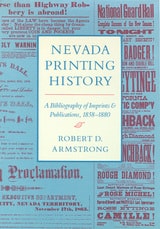
Nevada Printing History
A Bibliography Of Imprints And Publications, 1858-1880Robert D. Armstrong
University of Nevada Press, 1981
A detailed look at Nevada's printing history from 1858 through 1880. Includes proclamations, pamphlets, menus, government publications, church programs, and more. For Nevada historians, bibliographers, book collectors, and people who are interested in the printed records produced in Nevada toward the end of the nineteenth century.
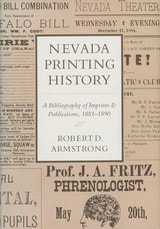
Nevada Printing History
A Bibliography Of Imprints And Publications, 1881-1890Robert D. Armstrong
University of Nevada Press, 1991
A detailed look at Nevada's printing history from 1881 through 1890. With over 1400 entries describing books, pamphlets, broadsides, state and local documents, fraternal and church publications, and a variety of other printed matter, this intriguing compilation serves as the companion volume to Armstrong's Nevada Printing History, 1858-1880. Armstrong includes annual summaries of events affecting the printing trade in Nevada as well as the locations and kinds of printing technology in use. This second volume also documents the planning and erection of a state printing office. Of particular interest are the summaries of individual publications that provide the reader with a picture of social, economic, and political viewpoints of the period. The author's research led him to more than 125 public institutions over a period of nearly twenty years. Historians, bibliographers, students of printing history and practice, collectors of Western Americana, antiquarian booksellers, and librarians will find this book to be an invaluable guide to Nevada's printing, its printers, and its history.
Publishing Women
Salons, the Presses, and the Counter-Reformation in Sixteenth-Century ItalyDiana Robin
University of Chicago Press, 2007
Even the most comprehensive Renaissance histories have neglected the vibrant groups of women writers that emerged in cities across Italy during the mid-1500s—and the thriving network of printers, publishers, and agents that specialized in producing and selling their books. In Publishing Women, Diana Robin finally brings to life this story of women’s cultural and intellectual leadership in early modern Italy, illuminating the factors behind—and the significance of—their sudden dominance.
Focusing on the collective publication process, Robin portrays communities in Naples, Venice, Rome, Siena, and Florence, where women engaged in activities that ranged from establishing literary salons to promoting religious reform. Her innovative cultural history considers the significant roles these women played in tandem with men, rather than separated from them. In doing so, it collapses the borders between women’s history, Renaissance and Reformation studies, and book history to evoke a historical moment that catapulted women’s writings and women-sponsored books into the public sphere for the first time anywhere in Europe.

The Contact Image
Casts, Imprints, and Other Traces in ArtJohanna Malt
University of Minnesota Press, 2026
A new conceptual tool for understanding the history of art
From ancient cave paintings to contemporary sculpture, forms of indexical trace are vital to the human practice of artmaking. Through this wide-ranging exploration, Johanna Malt shows how casts, molds, and imprints (“contact images”) offer a paradigm for thinking about our relationship to objects and their surfaces as sites of meaning. Engaging and complicating philosophical dualities of absence and presence, art and non-art, original and copy, Malt introduces the contact image as an important new concept for the study of Western art.
Close reading examples from 30,000 years of art history, Malt cuts across eras and media to unite diverse forms of artistic production created through instances of contact with “the objects of the world.” From holy relics to Napoleon’s death mask to life casts of the human body by artists such as Duane Hanson and Janine Antoni, as well as conceptual and performance work by Jasper Johns and Yves Klein, The Contact Image traces themes of selfhood, time, negation, and vestige in these tactile encounters.
Revisiting fundamental questions about representation, perception, and aesthetics, The Contact Image is a sophisticated provocation for a theory of art built on the tension and oscillations that emerge when we explore how artworks embody opposites.
Retail e-book files for this title are screen-reader friendly with images accompanied by short alt text and/or extended descriptions.
The Correspondence of Johann Amerbach
Early Printing in its Social ContextSelected, Translated, Edited, and with Commentary by Barbara C. Halporn
University of Michigan Press, 2000
Between 1478 and 1513 Amerbach published more than a hundred substantial works. He is best known for his monumental editions of the works of early church fathers. Crucial to his success was the information network he kept through correspondence with scholars, teachers, printers, booksellers, library curators, and other members of the literate community. The letters reveal how books were made, by whom, and for whom. The Correspondence of Johann Amerbach allows us to see the tensions in the new alliance between commerce and the republic of letters. Filling out the scene more fully, letters between the Amerbach children and their parents tell of the daily life, expectations, and aspirations of an intellectual bourgeois family at the end of the fifteenth century.
Barbara C. Halporn is Head of the Collection Development Department, Widener Library, Harvard University.