Results by title
6 books match the query 'Indian Ocean'
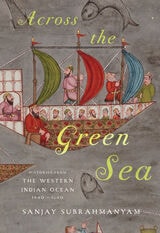
Across the Green Sea
Histories from the Western Indian Ocean, 1440-1640Sanjay Subrahmanyam
University of Texas Press, 2024
A history of two centuries of interactions among the areas bordering the western Indian Ocean, including India, Iran, and Africa.
Beginning in the mid-fifteenth century, the regions bordering the western Indian Ocean—“the green sea,” as it was known to Arabic speakers—had increasing contact through commerce, including a slave trade, and underwent cultural exchange and transformation. Using a variety of texts and documents in multiple Asian and European languages, Across the Green Sea looks at the history of the ocean from a variety of shifting viewpoints: western India; the Red Sea and Mecca; the Persian Gulf; East Africa; and Kerala.
Sanjay Subrahmanyam sets the scene for this region starting with the withdrawal of China's Ming Dynasty and explores how the western Indian Ocean was transformed by the growth and increasing prominence of the Ottoman Empire and the continued spread of Islam into East Africa. He examines how several cities, including Mecca and the vital Indian port of Surat, grew and changed during these centuries, when various powers interacted until famines and other disturbances upended the region in the seventeenth century. Rather than proposing an artificial model of a dominant center and its dominated peripheries, Across the Green Sea demonstrates the complexity of a truly dynamic and polycentric system through the use of connected histories, a method pioneered by Subrahmanyam himself.
Black Undertow
Hugo ka Canham
Duke University Press, 2026
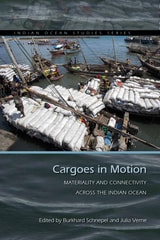
Cargoes in Motion
Materiality and Connectivity across the Indian OceanBurkhard Schnepel
Ohio University Press, 2022
An innovative collection of essays that foregrounds specific cargoes as a means to understand connectivity and mobility across the Indian Ocean world.
Scholars have long appreciated the centrality of trade and commerce in understanding the connectivity and mobility that underpin human experience in the Indian Ocean region. But studies of merchant and commercial activities have paid little attention to the role that cargoes have played in connecting the disparate parts of this vast oceanic world. Drawing from the work of anthropologists, geographers, and historians, Cargoes in Motion tells the story of how material objects have informed and continue to shape processes of exchange across the Indian Ocean.
By following selected cargoes through both space and time, this book makes an important and innovative contribution to Indian Ocean studies. The multidisciplinary approach deepens our understanding of the nature and dynamics of the Indian Ocean world by showing how transoceanic connectivity has been driven not only by economic, social, cultural, and political factors but also by the materiality of the objects themselves.
Essays by:
- Edward A. Alpers
- Fahad Ahmad Bishara
- Eva-Maria Knoll
- Karl-Heinz Kohl
- Lisa Jenny Krieg
- Pedro Machado
- Rupert Neuhöfer
- Mareike Pampus
- Hannah Pilgrim
- Burkhard Schnepel
- Hanne Schönig
- Tansen Sen
- Steven Serels
- Julia Verne
- Kunbing Xiao
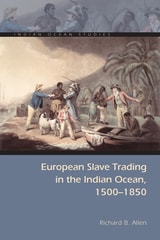
European Slave Trading in the Indian Ocean, 1500–1850
Richard B. Allen
Ohio University Press, 2015
Between 1500 and 1850, European traders shipped hundreds of thousands of African, Indian, Malagasy, and Southeast Asian slaves to ports throughout the Indian Ocean world. The activities of the British, Dutch, French, and Portuguese traders who operated in the Indian Ocean demonstrate that European slave trading was not confined largely to the Atlantic but must now be viewed as a truly global phenomenon. European slave trading and abolitionism in the Indian Ocean also led to the development of an increasingly integrated movement of slave, convict, and indentured labor during the late eighteenth and early nineteenth centuries, the consequences of which resonated well into the twentieth century.
Richard B. Allen’s magisterial work dramatically expands our understanding of the movement of free and forced labor around the world. Drawing upon extensive archival research and a thorough command of published scholarship, Allen challenges the modern tendency to view the Indian and Atlantic oceans as self-contained units of historical analysis and the attendant failure to understand the ways in which the Indian Ocean and Atlantic worlds have interacted with one another. In so doing, he offers tantalizing new insights into the origins and dynamics of global labor migration in the modern world.
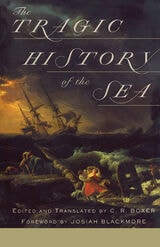
Tragic History Of The Sea
C.R. Boxer
University of Minnesota Press, 2001
Compelling stories of shipwreck, adventure, and death on the high seas, now back in print.
The sixteenth and seventeenth centuries were a time of great colonial expansion, marked by a mercantile frenzy of ships carrying merchants, aristocrats, missionaries, sailors, Inquisitors, botanists, and statesmen pursuing the spoils of empire. Among the narratives that chronicled these voyages, those of the Portuguese are unequaled. C. R. Boxer’s fascinating translations of famous Portuguese shipwreck stories detail the disasters and terrors plaguing the perilous sea trading route between Portugal and India.
In the tradition of Homer, Virgil, Shakespeare, Defoe, and Poe, these dramatic stories of shipwreck—and those who lived to tell about it—represent existence and survival pushed to the limits. They describe disastrous turns of fate and miraculous rescues, heroism and cowardice, and offer the exhilaration and sheer emotive appeal of a tale of adventure well told. Often circulated in pamphlet form, these stories recounting the dangers and terrors of storm-tossed ocean voyages and the fate of castaways in distant lands were a popular genre, rife with compelling and often gory details. This first ever paperback edition includes a new translation of the tragic tale of Captain Manuel de Sousa Sepúlveda, shipwrecked with his family on the sands of Africa in 1552, the previous English versions of which have long been unavailable. Vividly descriptive and engrossing, these tales of selfishness, cruelty, despair, pirates, mayhem, and harrowing storms will captivate readers.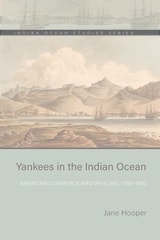
Yankees in the Indian Ocean
American Commerce and Whaling, 1786–1860Jane Hooper
Ohio University Press, 2022
The history of US imperialism remains incomplete without this consideration of long-overlooked nineteenth-century American commercial and whaling ventures in the Indian Ocean.
Yankees in the Indian Ocean shows how nineteenth-century American merchant and whaler activity in the Indian Ocean shaped the imperial future of the United States, influenced the region’s commerce, encouraged illegal slaving, and contributed to environmental degradation. For a brief time, Americans outnumbered other Western visitors to Mauritius, Madagascar, Zanzibar, and the East African littoral. In a relentless search for commodities and provisions, American whaleships landed at islands throughout the ocean and stripped them of resources. Yet Americans failed to develop a permanent foothold in the region and operated instead from a position of weakness relative to other major colonizing powers, thus discouraging the development of American imperial holdings there.
The history of American concerns in the Indian Ocean world remains largely unwritten. Scholars who focus on the region have mostly ignored American involvement, despite arguments for the ocean’s importance in powering global connections during the late eighteenth and early nineteenth centuries. Historians of the United States likewise have failed to examine the western Indian Ocean because of a preoccupation with US interests in Asia and the Pacific. Failing to understand the scale of American trade in the Indian Ocean has led to a fixation on European commercial strength to the exclusion of other maritime networks. Instead, this book reveals how the people of Madagascar and East Africa helped the United States briefly dominate commerce and whaling.
This book investigates how and why Americans were drawn to the western Indian Ocean years before the United States established a formal overseas empire in the late nineteenth century. Ship logs, sailor journals, and travel narratives reveal how American men transformed foreign land- and seascapes into knowable spaces that confirmed American conceptions of people and natural resources; these sources also provide insight into the complex social and ecological worlds of the Indian Ocean during this critical time.