Results by title
6 books match the query 'Indicators'
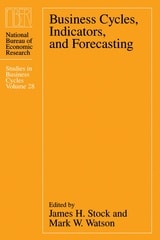
Business Cycles, Indicators, and Forecasting
Edited by James H. Stock and Mark W. Watson
University of Chicago Press, 1993
The inability of forecasters to predict accurately the 1990-1991 recession emphasizes the need for better ways for charting the course of the economy. In this volume, leading economists examine forecasting techniques developed over the past ten years, compare their performance to traditional econometric models, and discuss new methods for forecasting and time series analysis.
[more]

Indicators of Change in the American Family
Abbott Lamoyne Ferriss
Russell Sage Foundation, 1970
Provides a selection of existing and new measures of family change. The statistical time series are presented and organized around the topics of marriage, marital status, households, fertility, divorce, dependency, work and income, and poverty. The series selected for inclusion were chosen because of an apparent or assumed significant change which they displayed. They are illustrated by graphs and accompanied by a brief commentary. The statistical series are numbered in an appendix, and sources of the data are cited at the foot of the page of commentary.
[more]
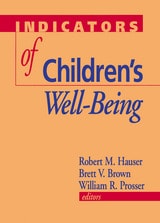
Indicators of Children's Well-Being
Robert M. Hauser
Russell Sage Foundation, 1997
The search for reliable information on the well-being of America's young is vital to designing programs to improve their lives. Yet social scientists are concerned that many measurements of children's physical and emotional health are inadequate, misleading, or outdated, leaving policymakers ill-informed. Indicators of Children's Well-Being is an ambitious inquiry into current efforts to monitor children from the prenatal period through adolescence. Working with the most up-to-date statistical sources, experts from multiple disciplines assess how data on physical development, education, economic security, family and neighborhood conditions, and social behavior are collected and analyzed, what findings they reveal, and what improvements are needed to create a more comprehensive and policy-relevant system of measurement. Today's climate of welfare reform has opened new possibilities for program innovation and experimentation, but it has also intensified the need for a clearly defined and wide-ranging empirical framework to pinpoint where help is needed and what interventions will succeed. Indicators of Children's Well-Being emphasizes the importance of accurate studies that address real problems. Essays on children's material well-being show why income data must be supplemented with assessments of housing, medical care, household expenditure, food consumption, and education. Other contributors urge refinements to existing survey instruments such as the Census and the Current Population Survey. The usefulness of records from human service agencies, child welfare records, and juvenile court statistics is also evaluated.
[more]
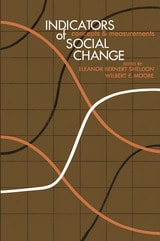
Indicators of Social Change
Concepts and MeasurementsEleanor Bernert Sheldon
Russell Sage Foundation, 1968
Includes many original contributions by an assembly of distinguished social scientists. They set forth the main features of a changing American society: how its organization for accomplishing major social change has evolved, and how its benefits and deficits are distributed among the various parts of the population. Theoretical developments in the social sciences and the vast impact of current events have contributed to a resurgence of interest in social change; in its causes, measurement, and possible prediction. These essays analyze what we know, and examine what we need to know in the study, prediction, and possible control of social change.
[more]
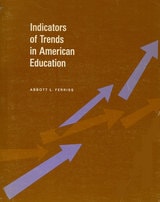
Indicators of Trends in American Education
Abbott Lamoyne Ferriss
Russell Sage Foundation, 1969
Assembles, collates, and analyzes data bearing on trends in American education. The author presents the basic data on school enrollment, retention, and attainment, indicating changes in the educational characteristics of the population and comparable time-series statistics on teachers and school finances reflecting change within the school system itself. Dr. Ferriss then relates these data to a statement of educational goals set some ten years ago, utilizing the data to provide an assessment of progress toward those goals.
[more]
Indicators of Trends in the Status of American Women
Abbott Lamoyne Ferriss
Russell Sage Foundation, 1971
Assembles, collates, and analyzes data bearing on trends in American education. The author presents the basic data on school enrollment, retention, and attainment, indicating changes in the educational characteristics of the population and comparable time-series statistics on teachers and school finances reflecting change within the school system itself. Dr. Ferriss then relates these data to a statement of educational goals set some ten years ago, utilizing the data to provide an assessment of progress toward those goals.
[more]