Results by title
2 books match the query 'Indigenous Dispossession'
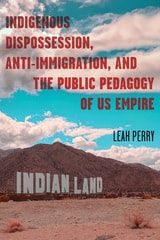
Indigenous Dispossession, Anti-Immigration, and the Public Pedagogy of US Empire
Leah Perry
The Ohio State University Press, 2024
From the founding of the United States, enduringly consequential debates over Indigeneity and immigration have occurred on the battlefield and in Congress, in courtrooms, at territorial borders, and in mainstream culture. In Indigenous Dispossession, Anti-Immigration, and the Public Pedagogy of US Empire, Leah Perry traces the ways that the US created its empire through public pedagogies—which she defines as policy and media discourses—surrounding Indigenous dispossession, gendered state violence, and racialized immigration. These pedagogies have propelled the expansion of US empire, including the redrawing of the US as a neoliberal democracy. Perry argues that by changing the discourse around gender, race, immigration, and Indigeneity, the United States has continued its imperial project through different eras, always predicated on Indigenous dispossession.
In exploring crucial components of empire, such as welfare, eugenics, disability, sexual violence, foodways, queerness, and policing, Perry interrogates violence against Indigenous peoples and against immigrants, examining these not independently—as is so often the case—but as co-constitutive. Indigenous Dispossession, Anti-Immigration, and the Public Pedagogy of US Empire thus intervenes in and fills a gap in immigration studies, Indigenous studies, race and ethnic studies, gender and sexuality studies, and US history.

Unsettling Geographies
Antiblackness, Gendered Violence, and Indigenous Dispossession in GuyanaShanya Cordis
Duke University Press, 2027