Results by title
4 books match the query 'Indigenous Identity'
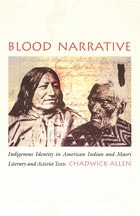
Blood Narrative
Indigenous Identity in American Indian and Maori Literary and Activist TextsChadwick Allen
Duke University Press, 2002
Allen shows how both Maori and Native Americans resisted the assimilationist tide rising out of World War II and how, in the 1960s and 1970s, they each experienced a renaissance of political and cultural activism and literary production that culminated in the formation of the first general assembly of the World Council of Indigenous Peoples. He focuses his comparison on two fronts: first, the blood/land/memory complex that refers to these groups' struggles to define indigeneity and to be freed from the definitions of authenticity imposed by dominant settler cultures. Allen's second focus is on the discourse of treaties between American Indians and the U.S. government and between Maori and Great Britain, which he contends offers strong legal and moral bases from which these indigenous minorities can argue land and resource rights as well as cultural and identity politics.
With its implicit critique of multiculturalism and of postcolonial studies that have tended to neglect the colonized status of indigenous First World minorities, Blood Narrative will appeal to students and scholars of literature, American and European history, multiculturalism, postcolonialism, and comparative cultural studies.
Circuits of Culture
Media, Politics, and Indigenous Identity in the AndesJeff D. Himpele
University of Minnesota Press, 2007
Set against the background of Bolivia’s prominent urban festival parades and the country’s recent appearance on the front lines of antiglobalization movements, Circuits of Culture is the first social analysis of Bolivian film and television, their circulation through the social and national landscape, and the emergence of the country’s indigenous video movement.
At the heart of Jeff Himpele’s examination is an ethnography of the popular television program, The Open Tribunal of the People. The indigenous and underrepresented majorities in La Paz have used the talk show to publicize their social problems and seek medical and legal assistance from the show’s hosts and the political party they launched. Himpele studies the program in order to identify the possibilities of the mass media as a site for political discourse and as a means of social action.
Charting as well the history of Bolivia’s media culture, Himpele perceptively investigates cinematic media as sites for understanding the modernization of Bolivia, its social movements, and the formation of indigenous identities, and in doing so provides a new framework for exploring the circulation of culture as a way of creating publics, political movements, and producing media.
Jeff D. Himpele is associate director for the McGraw Center for Teaching and Learning at Princeton University. He is an anthropologist and documentary filmmaker; his films include the award-winning Incidents of Travel in Chichen Itza and Taypi Kala: Six Visions of Tiwanaku.

Distorted Descent
White Claims to Indigenous IdentityDarryl Leroux
University of Manitoba Press, 2019
Illness Is a Weapon
Indigenous Identity and Enduring AfflictionsEirik Saethre
Vanderbilt University Press, 2013
Rarely is disease and suffering understood as a form of protest, and in Illness Is a Weapon, Saethre confronts the stark reality of the current contest between all parties in this struggle. As Saethre explains, "Cursing at nurses, refusing to take medication, and accepting acute illness as unremarkable is simultaneously an act of defiance and a rejection of vulnerability."