Results by title
7 books match the query 'Indigenous art'
Boundless
Native American Abundance in Art and LiteratureLisa A. Crossman and Heid E. Erdrich
Amherst College Press, 2025
Amherst College’s Collection of Native American Literature contains thousands of Indigenous-authored works spanning centuries. The Collection’s abundance of books, prints, music, ephemera, and artist-made works, all by Native people, provide rich selections for Boundless. Crosscurrents of Indigenous visual art and literature are considered in this broad and interdisciplinary project. Boundless crosses generations to explore relatedness, kinship, and collegiality.
Boundless brings artists and writers together across generations, often drawing together works by members of the same tribe or even the same family to show the history, presence, and futurity of Native American creative and intellectual production.
Indigenous Collections
Transformations in Stewardship and Conservation PracticesEllen Pearlstein
J. Paul Getty Trust, The, 0
A critical survey of the values, challenges, implications, history, and future of conserving Indigenous collections globally.
Once the exclusive realm of non-Indigenous curators and conservators, the care of Indigenous works in museums is now largely carried out either in collaboration with or by community members—a significant change from the colonial origins of museum collections and conservation practice.
This volume brings together over 100 readings—by Indigenous and non-Indigenous authors from around the world—that trace the development of the conservation of Indigenous collections. The writers provide a wide range of expertise, from archaeology and ethnography to law, and include community leaders, anthropologists, and art historians, as well as conservators and curators.
The book begins with an examination of the changes in terminology that reflect trust and respect, Indigenous care practices that predate the emergence of museums, and the impact of policy and legislation on Indigenous art and artifacts. Other readings explore the challenges associated with managing large, complex collections and the changes that resulted from addressing them: the development of specialized technical approaches, the incorporation of intangible heritage in conservation agendas, and a broadening view of what conservation means and how to practice it. Indigenous Collections concludes by looking at new approaches to museums—managed by or jointly with the people most closely connected to the holdings—and to the future, through innovations in conservation education.
Indigenous Visual Cultures in Latin America
Seeing, Being, and MeaningEdited by Tamara L. Bray and Carolyn Dean
University of Texas Press, 2026
Reframing the study of Indigenous visual cultures, this volume explores how images and objects generate affect and relation in non-Western contexts, foregrounding alternative modes of material engagement and meaning-making.
While traditional approaches to Indigenous visual cultures have often centered on iconography and representation, this volume turns toward other ways that images and objects act in the world. Indigenous Visual Cultures in Latin America explores how material productions function not merely as signs that point elsewhere but as agents that help shape relationships, environments, and affective experience.
Spanning Mesoamerica, the Andes, and Amazonia from 1500 BCE to the present, the chapters examine how meaning may reside in materials themselves; how making is a form of exchange between maker and matter; and how visual forms participate in configuring relations among humans, ancestors, deities, and place. These works are not passive containers of meaning, but charged presences—generative forces within ongoing worlds. Attuned to Indigenous ways of knowing and being, the volume invites readers to think beyond the frame, beyond the image, and beyond representation itself.
Mapping Modernisms
Art, Indigeneity, ColonialismElizabeth Harney and Ruth B. Phillips, editors
Duke University Press, 2018
Contributors. Bill Anthes, Peter Brunt, Karen Duffek, Erin Haney, Elizabeth Harney, Heather Igloliorte, Sandra Klopper, Ian McLean, Anitra Nettleton, Chika Okeke-Agulu, Ruth B. Phillips, W. Jackson Rushing III, Damian Skinner, Nicholas Thomas, Norman Vorano
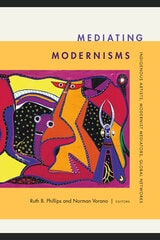
Mediating Modernisms
Indigenous Artists, Modernist Mediators, Global NetworksRuth B. Phillips and Norman Vorano, editors
Duke University Press, 2025
Contributors. Peter Brunt, Roberto Conduru, Hanna Horsberg Hansen, Elizabeth Harney, Jyotindra Jain, Sandra Klopper, Ian McLean, Anitra Nettleton, Chika Okeke-Agulu, Ruth B. Phillips, Una Rey, Megan Tamati-Quennell, Nicholas Thomas, Norman Vorano, Mark Andrew White
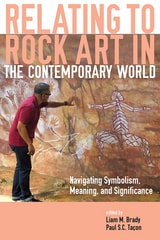
Relating to Rock Art in the Contemporary World
Navigating Symbolism, Meaning, and SignificanceLiam M. Brady
University Press of Colorado, 2016
One of the most visually striking forms of material culture embedded in landscapes, rock art is ascribed different meanings by diverse groups of people including indigenous peoples, governments, tourism offices, and the general public, all of whom relate to images and sites in unique ways. In this volume, leading scholars from around the globe shift the discourse from a primarily archaeological basis to one that examines the myriad ways that symbolism, meaning, and significance in rock art are being renegotiated in various geographical and cultural settings, from Australia to the British Isles. They also consider how people manage the complex meanings, emotions, and cultural and political practices tied to rock art sites and how these factors impact processes relating to identity construction and reaffirmation today.
Richly illustrated and geographically diverse, Relating to Rock Art in the Contemporary World connects archaeology, anthropology, and heritage studies. The book will appeal to students and scholars of archaeology, anthropology, heritage, heritage management, identity studies, art history, indigenous studies, and visual theory, as well as professionals and amateurs who have vested or avocational interests in rock art.
Contributors: Agustín Acevedo, Manuel Bea, Jutinach Bowonsachoti, Gemma Boyle, John J. Bradley, Noelene Cole, Inés Domingo, Kurt E. Dongoske, Davida Eisenberg-Degen, Dánae Fiore, Ursula K. Frederick, Kelley Hays-Gilpin, Catherine Namono, George H. Nash, John Norder, Marianna Ocampo, Joshua Schmidt, Duangpond Singhaseni, Benjamin W. Smith, Atthasit Sukkham, Noel Hidalgo Tan, Watinee Tanompolkrang, Luke Taylor, Dagmara Zawadzka

The Arts of Indigenous Health and Well-Being
Nancy Van Styvendale
University of Manitoba Press, 2021