Results by title
7 books match the query 'Indigenous peoples and mass media'
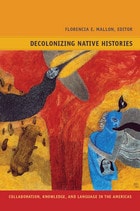
Decolonizing Native Histories
Collaboration, Knowledge, and Language in the AmericasFlorencia E. Mallon, ed.
Duke University Press, 2012
These wide-ranging case studies consider how language, the law, and the archive have historically served as instruments of colonialism and how they can be creatively transformed in constructing autonomy. The collection highlights points of commonality and solidarity across geographical, cultural, and linguistic boundaries and also reflects deep distinctions between North and South. Decolonizing Native Histories looks at Native histories and narratives in an internationally comparative context, with the hope that international collaboration and understanding of local histories will foster new possibilities for indigenous mobilization and an increasingly decolonized future.
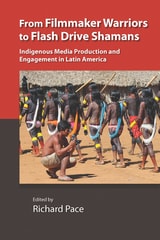
From Filmmaker Warriors to Flash Drive Shamans
Indigenous Media Production and Engagement in Latin AmericaRichard Pace
Vanderbilt University Press, 2018
The authors cover a range of topics such as the prospects of collaborative film production, the complications of archiving materials, and the contrasting meanings of and even conflict over "embedded aesthetics" in media production—i.e., how media reflects in some fashion the ownership, authorship, and/or cultural sensibilities of its community of origin. Other topics include active audiences engaging television programming in unanticipated ways, philosophical ruminations about the voices of the dead captured on digital recorders, the innovative uses of digital platforms on the internet to connect across generations and even across cultures, and the overall challenges to obtaining media sovereignty in all manner of media production.
The book opens with contributions from the founders of Indigenous Media Studies, with an overview of global Indigenous media by Faye Ginsburg and an interview with Terence Turner that took place shortly before his death.
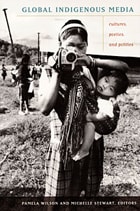
Global Indigenous Media
Cultures, Poetics, and PoliticsPamela Wilson and Michelle Stewart, eds.
Duke University Press, 2008
Global Indigenous Media addresses Indigenous self-representation across many media forms, including feature film, documentary, animation, video art, television and radio, the Internet, digital archiving, and journalism. The volume’s sixteen essays reflect the dynamism of Indigenous media-making around the world. One contributor examines animated films for children produced by Indigenous-owned companies in the United States and Canada. Another explains how Indigenous media producers in Burma (Myanmar) work with NGOs and outsiders against the country’s brutal regime. Still another considers how the Ticuna Indians of Brazil are positioning themselves in relation to the international community as they collaborate in creating a CD-ROM about Ticuna knowledge and rituals. In the volume’s closing essay, Faye Ginsburg points out some of the problematic assumptions about globalization, media, and culture underlying the term “digital age” and claims that the age has arrived. Together the essays reveal the crucial role of Indigenous media in contemporary media at every level: local, regional, national, and international.
Contributors: Lisa Brooten, Kathleen Buddle, Cache Collective, Michael Christie, Amalia Córdova,
Galina Diatchkova, Priscila Faulhaber, Louis Forline, Jennifer Gauthier, Faye Ginsburg, Alexandra Halkin, Joanna Hearne, Ruth McElroy, Mario A. Murillo, Sari Pietikäinen, Juan Francisco Salazar,
Laurel Smith, Michelle Stewart, Pamela Wilson

Indigenous Celebrity
Entanglements with FameJennifer Adese
University of Manitoba Press, 2021
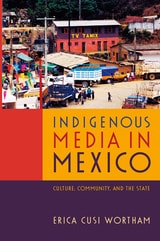
Indigenous Media in Mexico
Culture, Community, and the StateErica Cusi Wortham
Duke University Press, 2013
Drawing on her in-depth ethnographic research among indigenous mediamakers in Mexico, Wortham traces their shifting relationship with Mexican cultural agencies; situates their work within a broader, hemispheric network of indigenous media producers; and complicates the notion of a unified, homogeneous indigenous identity. Her analysis of projects from community-based media initiatives in Oaxaca to the transnational Chiapas Media Project highlights variations in cultural identity and autonomy based on specific histories of marginalization, accommodation, and resistance.
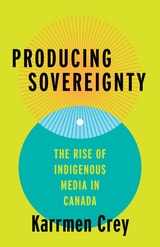
Producing Sovereignty
The Rise of Indigenous Media in CanadaKarrmen Crey
University of Minnesota Press, 2024
Exploring how Indigenous media has flourished across Canada from the 1990s to the present
In the early 1990s, Indigenous media experienced a boom across Canada, resulting in a vast landscape of film, TV, and digital media. Coinciding with a resurgence of Indigenous political activism, Indigenous media highlighted issues around sovereignty and Indigenous rights to broader audiences in Canada. In Producing Sovereignty, Karrmen Crey considers the conditions—social movements, state policy, and evolutions in technology—that enabled this proliferation.
Exploring the wide field of media culture institutions, Crey pays particular attention to those that Indigenous media makers engaged during this cultural moment, including state film agencies, arts organizations, provincial broadcasters, and more. Producing Sovereignty ranges from the formation of the Aboriginal Film and Video Art Alliance in the early 1990s and its partnership with the Banff Centre for the Arts to the Canadian Broadcasting Corporation’s 2016 production of Highway of Tears—an immersive 360-degree short film directed by Anishinaabe filmmaker Lisa Jackson—highlighting works by Indigenous creators along the way and situating Indigenous media within contexts that pay close attention to the role of media-producing institutions.
Importantly, Crey focuses on institutions with limited scholarly attention, shifting beyond the work of the National Film Board of Canada to explore lesser-known institutions such as educational broadcasters and independent production companies that create programming for the Aboriginal Peoples Television Network. Through its refusal to treat Indigenous media simply as a set of cultural aesthetics, Producing Sovereignty offers a revealing media history of this cultural moment.
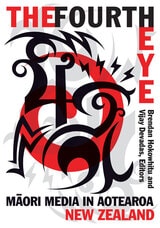
The Fourth Eye
Maori Media in Aotearoa New ZealandBrendan Hokowhitu
University of Minnesota Press, 2013
From the signing of the Treaty of Waitangi between Indigenous and settler cultures to the emergence of the first-ever state-funded Māori television network, New Zealand has been a hotbed of Indigenous concerns. Given its history of colonization, coping with biculturalism is central to New Zealand life. Much of this “bicultural drama” plays out in the media and is molded by an anxiety surrounding the ongoing struggle over citizenship rights that is seated within the politics of recognition. The Fourth Eye brings together Indigenous and non-Indigenous scholars to provide a critical and comprehensive account of the intricate and complex relationship between the media and Māori culture.
Examining the Indigenous mediascape, The Fourth Eye shows how Māori filmmakers, actors, and media producers have depicted conflicts over citizenship rights and negotiated the representation of Indigenous people. From nineteenth-century Māori-language newspapers to contemporary Māori film and television, the contributors explore a variety of media forms including magazine cover stories, print advertisements, commercial images, and current Māori-language newspapers to illustrate the construction, expression, and production of indigeneity through media.
Focusing on New Zealand as a case study, the authors address the broader question: what is Indigenous media? While engaging with distinct themes such as the misrepresentation of Māori people in the media, access of Indigenous communities to media technologies, and the use of media for activism, the essays in this much-needed new collection articulate an Indigenous media landscape that converses with issues that reach far beyond New Zealand.
Contributors: Sue Abel, U of Auckland; Joost de Bruin, Victoria U of Wellington; Suzanne Duncan, U of Otago; Kevin Fisher, U of Otago; Allen Meek, Massey U; Lachy Paterson, U of Otago; Chris Prentice, U of Otago; Jay Scherer, U of Alberta; Jo Smith, Victoria U of Wellington; April Strickland; Stephen Turner, U of Auckland.