Results by title
4 books match the query 'Indigenous peoples in motion pictures'
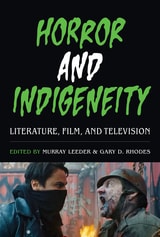
Horror and Indigeneity
Literature, Film, and TelevisionEdited by Murray Leeder and Gary D. Rhodes
University of Texas Press, 2026
A collection of essays about Indigeneity and horror in cinema, literature, and beyond.
How did Indigeneity come to be horrifying? Think of the “Indian burial ground” trope, a staple of 1970s horror cinema, not to mention decades of Western films and fictions that made “savage Indians” the face of fear in popular culture. Can horror do something else in the hands of Indigenous people? Creators such as Eden Robinson and Jeff Barnaby have self-consciously turned to horror to tell new kinds of stories, stories that question who is a monster and what constitutes the monstrous.
Horror and Indigeneity explores representations of Indigenous people in settler horror texts and in the growing corpus of horror by Indigenous writers and filmmakers. Widely spanning time periods and media, the contributors to this edited volume address themes such as cannibalism, eco-horror, historical trauma, and contemporary antiracism as they relate to classical horror cinema and recent works such as The Dead Can’t Dance, Lovecraft Country, and Stephen Graham Jones’s The Only Good Indians. Also featuring interviews with Jones and director T. J. Cuthand, Horror and Indigeneity rethinks the terror of the Other in potent and provocactive terms.
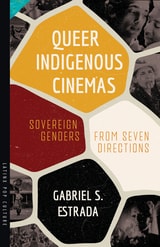
Queer Indigenous Cinemas
Sovereign Genders from Seven DirectionsGabriel S. Estrada
University of Arizona Press, 2026
The seven Indigenous directions—east, south, west, north, down, up, and center—provide a map of understanding gender in media history.
In Queer Indigenous Cinemas, scholar Gabriel S. Estrada offers an analysis of queer Indigenous media from the Americas, the Pacific, and the Caribbean. This groundbreaking work uses Indigenous directional space and sovereign mapping methods to uncover the emotional, spiritual, and cultural dimensions of queer Indigenous lives. The book’s seven chapters—each one of the directions—look closely at media such as cinema and streaming videos that draw on Indigenous concepts from diverse nations such as Diné, Caxcan, Kanaka Maoli, and Nehiyawak. Estrada discusses how the cinema brings into focus the ways that many Indigenous genders do not conform with the male/female binary, genders and sexualities that may or may not overlap with contemporary constructions of gay, lesbian, bisexual, transgender, intersex, and two-spirit (LGBTQI2+) identities.
Highlighting the struggles and resistances of two-spirit peoples, Estrada’s analysis engages with films that represent the diverse and sovereign identities of queer Indigenous peoples. Estrada provides a framework for understanding how queer Indigenous media producers confront colonial trauma and reclaims space for the spiritual and bodily sovereignty of LGBTQI2+ peoples.
The Third Eye
Race, Cinema, and Ethnographic SpectacleFatimah Tobing Rony
Duke University Press, 1996
In films as seemingly dissimilar as Nanook of the North, King Kong, and research footage of West Africans from an 1895 Paris ethnographic exposition, Rony exposes a shared fascination with—and anxiety over—race. She shows how photographic “realism” contributed to popular and scientific notions of evolution, race, and civilization, and how, in turn, anthropology understood and critiqued its own use of photographic technology. Looking beyond negative Western images of the Other, Rony considers performance strategies that disrupt these images—for example, the use of open resistance, recontextualization, and parody in the films of Katherine Dunham and Zora Neale Hurston, or the performances of Josephine Baker. She also draws on the work of contemporary artists such as Lorna Simpson and Victor Masayesva Jr., and writers such as Frantz Fanon and James Baldwin, who unveil the language of racialization in ethnographic cinema.
Elegantly written and richly illustrated, innovative in theory and original in method, The Third Eye is a remarkable interdisciplinary contribution to critical thought in film studies, anthropology, cultural studies, art history, postcolonial studies, and women’s studies.
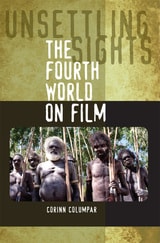
Unsettling Sights
The Fourth World on FilmCorinn Columpar
Southern Illinois University Press, 2010
Unsettling Sights: The Fourth World on Film examines the politics of representing Aboriginality, in the process bringing frequently marginalized voices and visions, issues and debates into the limelight. Corinn Columpar uses film theory, postcolonial theory, and Indigenous theory to frame her discussion of the cinematic construction and transnational circulation of Aboriginality. The result is a broad interdisciplinary analysis of how Indigeneity is represented in cinema, supported by more than twenty rigorous and theoretically informed case studies of contemporary feature films by both First- and Fourth-World filmmakers in the United States, Canada, New Zealand, and Australia. Columpar relies heavily on textual analysis of the films but also explores contextual issues in filmmaking such as funding, personnel, modes of production, and means of distribution.
Part one of Unsettling Sights focuses on contact narratives in which the Aboriginal subject is constructed in reactive response to a colonizing or invading presence. Films such as The Piano and The Proposition, wherein a white man “goes native,” and The New World and Map of the Human Heart, which approach contact from the perspective of an Aboriginal character, serve as occasions to examine the ways in which Aboriginal identities are negotiated within dominant cinema. Part two shifts the focus from contact narratives to films that seek to define Aboriginality on its own terms, with reference to a (lost) homeland and/or Indigenous practices of (hi)story-telling: while texts such as Once Were Warriors and Smoke Signals foster an engagement with issues of deterritorialization, relocation, and urbanization, discussion of beDevil, Atanarjuat, and The Business of Fancydancing, among others,bring questions of voice, translation, and the relationship between cinema and oral tradition to the forefront.
Unsettling Sights is the first significant, scholarly examination of Aboriginality and cinema in an international context and will be invaluable to scholars and students in many fields including cinema studies, anthropology, critical race studies, cultural studies, and postcolonial studies.