Results by title
21 books match the query 'Indigenous women'
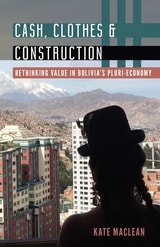
Cash, Clothes, and Construction
Rethinking Value in Bolivia's Pluri-economyKate Maclean
University of Minnesota Press, 2023
A groundbreaking feminist perspective on Movimiento al Socialismo (MAS) rule in Bolivia and the country’s radical transformation under Evo Morales
The presidency of Evo Morales in Bolivia (2006–2019) has produced considerable academic scholarship, much of it focused on indigenous social movements or extractivism, and often triumphalist about the successes of Morales’s Movimiento al Socialismo (MAS). Turning a new lens on the movement, Cash, Clothes, and Construction presents the first gender-based analysis of “pluri-economy,” a central pillar of Bolivia’s program under Morales, evaluating the potential of this vision of “an economy where all economies fit” to embrace feminist critiques of capitalism and economic diversity.
Based on more than twelve years of empirical research exploring the remarkable transformations in Bolivia since 2006, this book focuses on three sectors—finance, clothing, and construction—in which indigenous women have defied gendered expectations. Kate Maclean presents detailed case studies of women selling secondhand high street clothes from the United States in the vast, peri-urban markets of Bolivian cities; Aymaran designers of new pollera (traditional Andean dress) fashions, one of whom exhibited her collection in New York City; and the powerful and rich chola paceña, whose real estate investments have transformed the cultural maps of La Paz and El Alto.
Cash, Clothes, and Construction offers a gendered analysis of the mission of MAS to dismantle neoliberalism and decolonize politics and economy from the perspective of the Indigenous women who have radically transformed Bolivia’s economy from the ground up.
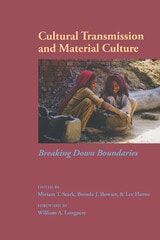
Cultural Transmission and Material Culture
Breaking Down BoundariesEdited by Miriam T. Stark, Brenda J. Bowser, and Lee Horne
University of Arizona Press, 2008
Working in several subdisciplines, contributors report on research in the areas of cultural boundaries, cultural transmission, and the socially organized nature of learning. Boundaries are found not only within and between the societies in these studies but also within and between the communities of scholars who study them. To break down these boundaries, this volume includes scholars who use multiple theoretical perspectives, including practice theory and evolutionary traditions, which are sometimes complementary and occasionally clashing. Geographic coverage ranges from the indigenous Americas to Africa, the Near East, and South Asia, and the time frame extends from the prehistoric or precontact to colonial periods and up to the ethnographic present. Contributors include leading scholars from the United States, Canada, the United Kingdom, and Europe. Together, they employ archaeological, ethnographic, ethnoarchaeological,experimental, and simulation data to link micro-scale processes of cultural transmission to macro-scale processes of social group boundary formation, continuity, and change.
Dilemmas of Difference
Indigenous Women and the Limits of Postcolonial Development PolicySarah A. Radcliffe
Duke University Press, 2015
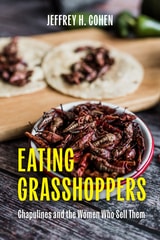
Eating Grasshoppers
Chapulines and the Women Who Sell ThemJeffrey H. Cohen
University of Texas Press, 2025
An approachable ethnography of how grasshoppers are harvested, sold, and consumed in Oaxaca.
Chapulines (toasted grasshoppers) are not a delicacy in Oaxaca. They are just food—good food—and a protein-rich seasonal snack that is the product of a long-standing industry based overwhelmingly on the labor of women. Jeffrey Cohen has interviewed dozens of these chapulineras, who harvest insects from corn and alfalfa fields, prepare them, and sell them in urban and rural marketplaces. An accessible ethnography, Eating Grasshoppers tells their story alongside the broader history of chapulines.
For tourists, chapulines are an experience—a gateway to the “real” Oaxaca. For locals, they are ordinary fare, but also a reminder of Indigenous stability and rural survival. In a sense, eating chapulines is a declaration of independence from a government that has condemned eating insects as backward. Yet, while chapulines are a generations-old favorite, eating them is not an act of preservation. Cohen shows that the business of this traditional food is thoroughly modern and ever evolving, with entrepreneurial chapulineras responding nimbly to complex and dynamic markets. From alfalfa fields to online markets, Eating Grasshoppers takes readers inside one of the world’s most fascinating food cultures.

Food Storage in Michigan's Late Woodland
The Work of Indigenous WomenKathryn M. Frederick
University of Alabama Press, 2026
Incorporates experimental archaeology to understand the food-caching strategies led by Indigenous women in Late Woodland Michigan.
This experimental archaeology book centers on the decision of Indigenous women in Michigan’s Late Woodland to store food in cache pits for later use, to ensure a stable food supply. These food storage techniques were efforts to increase communal chances of survival in direct responses to sociopolitical changes. Kathryn M. Frederick highlights the importance of food storage in these communities and the decision-making and behaviors behind it.
To discover why food storage became a popular practice at that period, Frederick considered the efficacy of subterranean food storage and constructed experiments to understand the timing and use of cache pits and to test their reliability and efficiency. She also compiled ethnographic data on location, environmental conditions, movement strategies, and types of foodstuffs stored for dozens of hunter-gatherer groups. Two distinct patterns of food storage emerged: “reliant” and “redundant.” Frederick argues that the Indigenous women utilized a system of reliant storage during times of abundance but could switch to a redundant system as the socioeconomic climate shifted. This book will interest a wide swath of archaeologists and others interested in Indigenous foodways and women’s key roles.

Honouring the Strength of Indian Women
Plays, Stories, PoetryVera Manuel
University of Manitoba Press, 2019
Implicating the System
Judicial Discourses in Sentencing of Indigenous WomenElspeth Kaiser-Derrick
University of Manitoba Press, 2019
In Good Relation
History, Gender, and Kinship in Indigenous FeminismsSarah Nickel
University of Manitoba Press, 2020
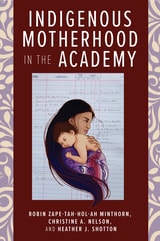
Indigenous Motherhood in the Academy
Robin Zape-tah-hol-ah Minthorn
Rutgers University Press, 2022
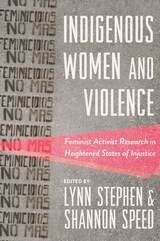
Indigenous Women and Violence
Feminist Activist Research in Heightened States of InjusticeEdited by Lynn Stephen and Shannon Speed
University of Arizona Press, 2021
Indigenous Women and Violence is built on engaging case studies that highlight the individual and collective struggles that Indigenous women face from the racial and gendered oppression that structures their lives. Gendered violence has always been a part of the genocidal and assimilationist projects of settler colonialism, and it remains so today. These structures—and the forms of violence inherent to them—are driving criminalization and victimization of Indigenous men and women, leading to escalating levels of assassination, incarceration, or transnational displacement of Indigenous people, and especially Indigenous women.
This volume brings together the potent ethnographic research of eight scholars who have dedicated their careers to illuminating the ways in which Indigenous women have challenged communities, states, legal systems, and social movements to promote gender justice. The chapters in this book are engaged, feminist, collaborative, and activism focused, conveying powerful messages about the resilience and resistance of Indigenous women in the face of violence and systemic oppression.
Contributors: R. Aída Hernández-Castillo, Morna Macleod, Mariana Mora, María Teresa Sierra, Shannon Speed, Lynn Stephen, Margo Tamez, Irma Alicia Velásquez Nimatuj
Indigenous Women and Work
From Labor to ActivismEdited by Carol Williams
University of Illinois Press, 2012
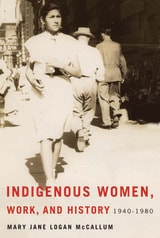
Indigenous Women, Work, and History
Mary Jane Logan McCallum
University of Manitoba Press, 2014
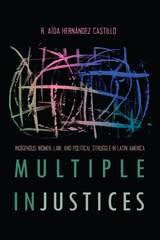
Multiple InJustices
Indigenous Women, Law, and Political Struggle in Latin AmericaR. Aída Hernández Castillo
University of Arizona Press, 2016
Multiple InJustices synthesizes R. Aída Hernández Castillo’s twenty-four years of activism and research among indigenous women’s organizations in Latin America. As both feminist and critical anthropologist, Hernández Castillo analyzes the context of legal pluralism wherein the indigenous women of Mexico, Guatemala, and Colombia struggle for justice. Through ethnographical research in community, state, and international justice, she reflects on the possibilities and limitations of customary, national, and international law for indigenous women.
Colonialism, racism, and patriarchal violence have been fundamental elements for the reproduction of capitalism, Hernández Castillo asserts. Only a social policy that offers economic alternatives based on distribution of wealth and a real recognition of cultural and political rights of indigenous peoples can counter the damage of outside forces such as drug cartels on indigenous lands.
She concludes that the theories of indigenous women on culture, tradition, and gender equity—as expressed in political documents, event reports, public discourse, and their intellectual writings—are key factors in the decolonization of Latin American feminisms and social justice for all.
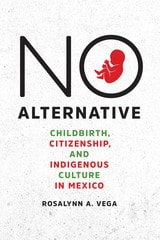
No Alternative
Childbirth, Citizenship, and Indigenous Culture in MexicoBy Rosalynn A. Vega
University of Texas Press, 2018
Recent anthropological scholarship on “new midwifery” centers on how professional midwives in various countries are helping women reconnect with “nature,” teaching them to trust in their bodies, respecting women’s “choices,” and fighting for women’s right to birth as naturally as possible. In No Alternative, Rosalynn A. Vega uses ethnographic accounts of natural birth practices in Mexico to complicate these narratives about new midwifery and illuminate larger questions of female empowerment, citizenship, and the commodification of indigenous culture, by showing how alternative birth actually reinscribes traditional racial and gender hierarchies.
Vega contrasts the vastly different birthing experiences of upper-class and indigenous Mexican women. Upper-class women often travel to birthing centers to be delivered by professional midwives whose methods are adopted from and represented as indigenous culture, while indigenous women from those same cultures are often forced by lack of resources to use government hospitals regardless of their preferred birthing method. Vega demonstrates that women’s empowerment, having a “choice,” is a privilege of those capable of paying for private medical services—albeit a dubious privilege, as it puts the burden of correctly producing future members of society on women’s shoulders. Vega’s research thus also reveals the limits of citizenship in a neoliberal world, as indigeneity becomes an object of consumption within a transnational racialized economy.
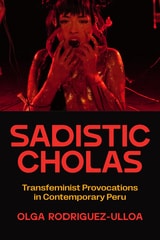
Sadistic Cholas
Transfeminist Provocations in Contemporary PeruOlga Rodriguez-Ulloa
University of Texas Press, 2026
Analyzing how Peruvian feminist art and activism subverts and reclaims the chola stereotype to confront colonial and patriarchal institutions.
Indigenous Andean women have long been derided in Peru, spurned by colonial and then national elites as depraved cholas. Olga Rodriguez-Ulloa shows how contemporary artists and activists not only reclaim this term of abuse but also mobilize the stereotype of the angry and perverted chola to confront the cruelties of patriarchy, capitalism, and white supremacy.
Sadistic Cholas examines music, visual arts, literature, and grassroots organizing by self-identified cholas—in particular, Black women and trans and queer feminists. Under colonial domination, cholas were destined for sexual coercion, labor extraction, and reproductive exploitation. While exhuming historical traces of chola resistance, Rodriguez-Ulloa argues that this condition of oppression persisted through the internal war of the 1980s, when Marxist women at the forefront of the armed campaign were condemned as hypersexual deviants. Inspired by their leftist forebears, today’s artists experiment with an aesthetic of sadistic vengeance, configured as rightful self-defense. Yet, in spite of their violent imagery, activist cholas pursue nonviolent goals, promoting a commons of care incorporating people, animals, and the environment.
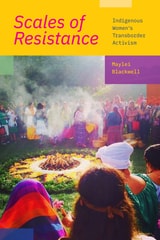
Scales of Resistance
Indigenous Women’s Transborder ActivismMaylei Blackwell
Duke University Press, 2022
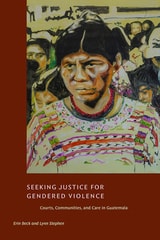
Seeking Justice for Gendered Violence
Courts, Communities, and Care in GuatemalaErin Beck and Lynn Stephen
Duke University Press, 2026

Talkin' Up to the White Woman
Indigenous Women and FeminismAileen Moreton-Robinson
University of Minnesota Press, 2021
A twentieth-anniversary edition of this tour de force in feminism and Indigenous studies, now with a new preface
The twentieth anniversary of the original publication of this influential and prescient work is commemorated with a new edition of Talkin’ Up to the White Woman by Aileen Moreton-Robinson. In this bold book, of its time and ahead of its time, whiteness is made visible in power relations, presenting a dialogic of how white feminists represent Indigenous women in discourse and how Indigenous women self-present.
Moreton-Robinson argues that white feminists benefit from colonization: they are overwhelmingly represented and disproportionately predominant, play the key roles, and constitute the norm, the ordinary, and the standard of womanhood. They do not self-present as white but rather represent themselves as variously classed, sexualized, aged, and abled. The disjuncture between representation and self-presentation of Indigenous women and white feminists illuminates different epistemologies and an incommensurability in the social construction of gender.
Not so much a study of white womanhood, Talkin’ Up to the White Woman instead reveals an invisible racialized subject position represented and deployed in power relations with Indigenous women. The subject position occupied by middle-class white women is embedded in material and discursive conditions that shape the nature of power relations between white feminists and Indigenous women—and the unjust structural relationship between white society and Indigenous society.
Vernacular Sovereignties
Indigenous Women Challenging World PoliticsManuela Lavinas Picq
University of Arizona Press, 2018
In Vernacular Sovereignties, Manuela Lavinas Picq shows that Indigenous women have long been dynamic political actors who have partaken in international politics and have shaped state practices carrying different forms of resistance. Her research on Ecuador shows that although Kichwa women face overlapping oppressions from socioeconomic exclusions to sexual violence, they are achieving rights unparalleled in the world. They successfully advocated for women’s participation in the administration of Indigenous justice during the 2008 constitutional reform, creating the first constitution in Latin America to explicitly guarantee the rights of Indigenous women and the first constitution worldwide to require gender parity in the administration of justice.
Picq argues that Indigenous women are among the important forces reshaping states in Latin America. She offers empirical research that shows the significance of Indigenous women in international politics and the sophistication of their activism. Indigenous women strategically use international norms to shape legal authority locally, defying Western practices of authority as they build what the author calls vernacular sovereignties. Weaving feminist perspectives with Indigenous studies, this interdisciplinary work expands conceptual debates on state sovereignty.
Picq persuasively suggests that the invisibility of Indigenous women in high politics is more a consequence of our failure to recognize their agency than a result of their de facto absence. It is an invitation not merely to recognize their achievements but also to understand why they matter to world politics.
Violence and Indigenous Communities
Confronting the Past and Engaging the PresentEdited by Susan Sleeper-Smith, Jeffrey Ostler, and Joshua L. Reid
Northwestern University Press, 2021
In contrast to past studies that focus narrowly on war and massacre, treat Native peoples as victims, and consign violence safely to the past, this interdisciplinary collection of essays opens up important new perspectives. While recognizing the long history of genocidal violence against Indigenous peoples, the contributors emphasize the agency of individuals and communities in genocide’s aftermath and provide historical and contemporary examples of activism, resistance, identity formation, historical memory, resilience, and healing. The collection also expands the scope of violence by examining the eyewitness testimony of women and children who survived violence, the role of Indigenous self-determination and governance in inciting violence against women, and settler colonialism’s promotion of cultural erasure and environmental destruction.
By including contributions on Indigenous peoples in the United States, Canada, the Pacific, Greenland, Sápmi, and Latin America, the volume breaks down nation-state and European imperial boundaries to show the value of global Indigenous frameworks. Connecting the past to the present, this book confronts violence as an ongoing problem and identifies projects that mitigate and push back against it.
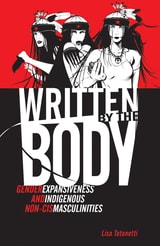
Written by the Body
Gender Expansiveness and Indigenous Non-Cis MasculinitiesLisa Tatonetti
University of Minnesota Press, 2021
Examining the expansive nature of Indigenous gender representations in history, literature, and film
Within Native American and Indigenous studies, the rise of Indigenous masculinities has engendered both productive conversations and critiques. Lisa Tatonetti intervenes in this conversation with Written by the Body by centering how female, queer, and/or Two-Spirit Indigenous people take up or refute masculinity, and, in the process, offer more expansive understandings of gender.
Written by the Body moves from the eighteenth- and nineteenth-century archive to turn-of-the-century and late-twentieth-century fiction to documentaries, HIV/AIDS activism, and, finally, recent experimental film and literature. Across it all, Tatonetti shows how Indigenous gender expansiveness, and particularly queer and non-cis gender articulations, moves between and among Native peoples to forge kinship, offer protection, and make change. She charts how the body functions as a somatic archive of Indigenous knowledge in Native histories, literatures, and activisms—exploring representations of Idle No More in the documentary Trick or Treaty, the all-female wildland firefighting crew depicted in Apache 8, Chief Theresa Spence, activist Carole laFavor, S. Alice Callahan, Thirza Cuthand, Joshua Whitehead, Carrie House, and more.
In response to criticisms of Indigenous masculinity studies, Written by the Body de-sutures masculinity from the cis-gendered body and investigates the ways in which female, trans, and otherwise nonconforming masculinities carry the traces of Two-Spirit histories and exceed the limitations of settler colonial imaginings of gender.