Results by title

16 books match the query 'Individual'

cover of Anthropology of the Self: The Individual in Cultural Perspective

Anthropology of the Self

The Individual in Cultural Perspective

Brian Morris

Pluto Press, 1994

[more]
cover of Digital Dilemmas: The State, the Individual, and Digital Media in Cuba

Digital Dilemmas

The State, the Individual, and Digital Media in Cuba

Venegas, Cristina

Rutgers University Press, 2010

The contentious debate in Cuba over Internet use and digital media primarily focuses on three issuesùmaximizing the potential for economic and cultural development, establishing stronger ties to the outside world, and changing the hierarchy of control. A growing number of users decry censorship and insist on personal freedom in accessing the web, while the centrally managed system benefits the government in circumventing U.S. sanctions against the country and in controlling what limited capacity exists.

Digital Dilemmas views Cuba from the Soviet Union's demise to the present, to assess how conflicts over media access play out in their both liberating and repressive potential. Drawing on extensive scholarship and interviews, Cristina Venegas questions myths of how Internet use necessarily fosters global democracy and reveals the impact of new technologies on the country's governance and culture. She includes film in the context of broader media history, as well as artistic practices such as digital art and networks of diasporic communities connected by the Web. This book is a model for understanding the geopolitic location of power relations in the age of digital information sharing.

[more]
cover of Individual and Community: Variations on a Theme in American Fiction

Individual and Community

Variations on a Theme in American Fiction

Kenneth H. Baldwin and David Kirby, eds.

Duke University Press, 1975

The contributors to Individual and Community attempt to illuminate aspects of the individual-community relationship. Though different in focus and approach, the essays themselves express a "community" of concern, a concern which includes not just the situations of characters in fictional worlds, but one which touches the relationship of both novelists and reader to a world of words.
The essays are intended to point to the continuity of an important theme in American fiction and to offer insight into the variety of philosophical and literary strategies utilized in significant works of significant authors in dealing with the question of the individual and the community.
[more]
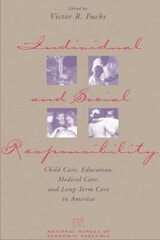
cover of Individual and Social Responsibility: Child Care, Education, Medical Care, and Long-Term Care in America

Individual and Social Responsibility

Child Care, Education, Medical Care, and Long-Term Care in America

Edited by Victor R. Fuchs

University of Chicago Press, 1995

Does government spend too little or too much on child care? How can education dollars be spent more efficiently? Should government's role in medical care increase or decrease? In this volume, social scientists, lawyers, and a physician explore the political, social, and economic forces that shape policies affecting human services.

Four in-depth studies of human-service sectors—child care, education, medical care, and long-term care for the elderly—are followed by six cross-sector studies that stimulate new ways of thinking about human services through the application of economic theory, institutional analysis, and the history of social policy.

The contributors include Kenneth J. Arrow, Martin Feldstein, Victor Fuchs, Alan M. Garber, Eric A. Hanushek, Christopher Jencks, Seymour Martin Lipset, Glenn Loury, Roger G. Noll, Paul M. Romer, Amartya Sen, and Theda Skocpol.

This timely study sheds important light on the tension between individual and social responsibility, and will appeal to economists and other social scientists and policymakers concerned with social policy issues.
[more]
cover of John Dewey's Liberalism: Individual, Community, and Self-Development

John Dewey's Liberalism

Individual, Community, and Self-Development

Daniel Savage

Southern Illinois University Press, 2001

John Dewey's classical pragmatism, Daniel M. Savage asserts, can be used to provide a self-development-based justification of liberal democracy that shows the current debate between liberal individualism and republican communitarianism to be based largely on a set of pseudoproblems.

From Dewey's classical pragmatism, Savage derives a conception of individual autonomy that, while meeting all of the criteria for a conception of autonomy, does not, as the dominant Kantian variant does, require transcendence from any particular language community. The Deweyan conception of autonomy that Savage derived from classical pragmatism, in fact, requires that the individual be situated within a context of cultural beliefs. Savage argues that this particular conception of autonomy is necessary if one wants to conceive of life, as communitarians do, as a quest for the good life within a social context.

Thus, Savage constructs a conception of autonomy that consists of a set of intellectual virtues, each of which can be understood, like Aristotle's moral virtues, as a mean between two extremes (or vices). The virtue of critical reflection is the mean between the vices of dogmatism on the one hand and philosophical skepticism on the other. The virtue of creative individuality is the mean between the opposing vices of conformity and eccentricity. Finally, the virtue of sociability is the mean between the extremes of docility and rebelliousness.

The three virtues together provide a natural method of adapting to change. The method is natural because it is in accord with a continuous cycle of activity—tension/movement/harmony—that is generic to all living things, Dewey's method of adapting to change requires, in both the individual and in the community, the synthesis of integrating and differentiating forces.
[more]
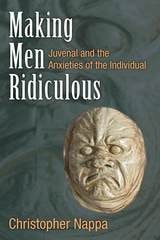
cover of Making Men Ridiculous: Juvenal and the Anxieties of the Individual

Making Men Ridiculous

Juvenal and the Anxieties of the Individual

Christopher Nappa

University of Michigan Press, 2018

Writing during the reign of emperors Trajan and Hadrian, Juvenal drew on Roman legend and the history of preceding imperial dynasties as a means of scrutinizing cultural upheavals in the Rome of his day. Tacky foreigners, the nouveaux riches, women who don’t know their place, bloodthirsty—even crazy—emperors and their (often worse) wives confront the reader at every turn, along with bad poets, corrupt aristocrats, gladiators, whores, false philosophers, sad-sack men in the street, and slaves. Juvenal’s poetry set the tone, and often the topics, for satirists throughout the centuries of European literature.

In his sixteen verse satires, Juvenal presents speakers who decry the breakdown in traditional Roman values and the status of Roman men as they are confronted by upstart foreigners, devious and deviant women, class traitors, the power of the imperial household, and even the body itself. The satirist castigates vice and immorality even as he revels in describing them. This book locates Juvenal’s targets among the matrices of birth, wealth, class, gender, and ethnicity and walks carefully through a number of his most arresting vignettes in order to show not only what, but how, he satirizes. Moreover, the analysis shows that Juvenal’s portraits sometimes escape his grasp, and, as often as not, he ends up undermining the voice with which he speaks and the values he claims to hold dear. Individual chapters look at the satirist himself, rebellious bodies, disgraced aristocrats, uppity (even murderous) wives, and the necessary but corrupting power of money. The conclusion considers the endurance of both the targets and the rhetoric behind them in the modern world.

Making Men Ridiculous will interest scholars and advanced students of ancient satire, later European satire, imperial Roman culture and literature, and class, gender, and sexuality in the ancient world.
[more]
cover of Pornography, Feminism and the Individual

Pornography, Feminism and the Individual

Alison Assiter

Pluto Press, 1989

[more]
cover of Realism after the Individual: Women, Desire, and the Modern American Novel

Realism after the Individual

Women, Desire, and the Modern American Novel

Rafael Walker

University of Chicago Press, 2026

A study of the transformation of the realist novel in the hands of early-twentieth-century American writers, who adapted this quintessentially nineteenth-century genre to the conditions of their age. 
 
Realism after the Individual offers a new theoretical paradigm for understanding realist novels published in the United States between 1900 and 1920, a period that has been described wrongheadedly as a “gulf” or a “valley” in American literary history. In this generation of writers, only three have remained in favor among critics: Kate Chopin, Edith Wharton, and Theodore Dreiser. Others have disappeared from view altogether—writers such as Robert Grant, Robert Herrick, and Booth Tarkington, all of whom were critically acclaimed bestsellers in their day.

As Rafael Walker shows, this generation of writers deserves new attention for the way they revised many core facets of the nineteenth-century novel in response to the historical shifts around it. This generation of novelists not only rejected liberal individualism but also formulated alternative paradigms for conceptualizing selfhood. The result was a slew of woman-centered realist novels that broke with literary precedent: The novels punish characters not for desiring too much but for failing to desire enough, they depict subjectivity not as private and interior but as outward-facing, and they view closure not as the novel’s aim but as a convention to flout. Realism after the Individual both revises prevailing views of American realism and lays the foundation for an alternative account of the development of literary modernism, one that illuminates the continuity between realism and the modernism that followed it.
[more]
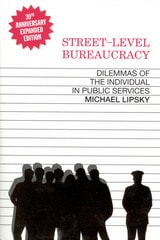
cover of Street-Level Bureaucracy, 30th Anniversary Edition: Dilemmas of the Individual in Public Service

Street-Level Bureaucracy, 30th Anniversary Edition

Dilemmas of the Individual in Public Service

Michael Lipsky

Russell Sage Foundation, 2010
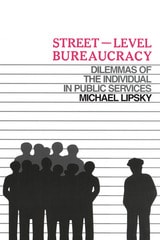
First published in 1980, Street-Level Bureaucracy received critical acclaim for its insightful study of how public service workers, in effect, function as policy decision makers, as they wield their considerable discretion in the day-to-day implementation of public programs. Three decades later, the need to bolster the availability and effectiveness of healthcare, social services, education, and law enforcement is as urgent as ever. In this thirtieth anniversary expanded edition, Michael Lipsky revisits the territory he mapped out in the first edition to reflect on significant policy developments over the last several decades. Despite the difficulties of managing these front-line workers, he shows how street-level bureaucracies can be and regularly are brought into line with public purposes. Street-level bureaucrats—from teachers and police officers to social workers and legal-aid lawyers—interact directly with the public and so represent the frontlines of government policy. In Street-Level Bureaucracy, Lipsky argues that these relatively low-level public service employees labor under huge caseloads, ambiguous agency goals, and inadequate resources. When combined with substantial discretionary authority and the requirement to interpret policy on a case-by-case basis, the difference between government policy in theory and policy in practice can be substantial and troubling. The core dilemma of street-level bureaucrats is that they are supposed to help people or make decisions about them on the basis of individual cases, yet the structure of their jobs makes this impossible. Instead, they are forced to adopt practices such as rationing resources, screening applicants for qualities their organizations favor, "rubberstamping" applications, and routinizing client interactions by imposing the uniformities of mass processing on situations requiring human responsiveness. Occasionally, such strategies work out in favor of the client. But the cumulative effect of street-level decisions made on the basis of routines and simplifications about clients can reroute the intended direction of policy, undermining citizens' expectations of evenhanded treatment. This seminal, award-winning study tells a cautionary tale of how decisions made by overburdened workers translate into ad-hoc policy adaptations that impact peoples' lives and life opportunities. Lipsky maintains, however, that these problems are not insurmountable. Over the years, public managers have developed ways to bring street-level performance more in line with agency goals. This expanded edition of Street-Level Bureaucracy underscores that, despite its challenging nature, street-level work can be made to conform to higher expectations of public service.
[more]
cover of Street-Level Bureaucracy: Dilemmas of the Individual in Public Service

Street-Level Bureaucracy

Dilemmas of the Individual in Public Service

Michael Lipsky

Russell Sage Foundation, 1983

Street-Level Bureaucracy is an insightful study of how public service workers, in effect, function as policy decision makers, as they wield their considerable discretion in the day-to-day implementation of public programs.
[more]
cover of The Individual and the Cosmos in Renaissance Philosophy

The Individual and the Cosmos in Renaissance Philosophy

Ernst Cassirer

University of Chicago Press, 2010

This provocative volume, one of the most important interpretive works on the philosophical thought of the Renaissance, has long been regarded as a classic in its field.  Ernst Cassirer here examines the changes brewing in the early stages of the Renaissance, tracing the interdependence of philosophy, language, art, and science; the newfound recognition of individual consciousness; and the great thinkers of the period—from da Vinci and Galileo to Pico della Mirandola and Giordano Bruno. The Individual and the Cosmos in Renaissance Philosophy discusses the importance of fifteenth-century philosopher Nicholas Cusanus, the concepts of freedom and necessity, and the subject-object problem in Renaissance thought.

“This fluent translation of a scholarly and penetrating original leaves little impression of an attempt to show that a ‘spirit of the age’ or ‘spiritual essence of the time’ unifies and expresses itself in all aspects of society or culture.”—Philosophy
[more]
cover of The Individual in History: Essays in Honor of Jehuda Reinharz

The Individual in History

Essays in Honor of Jehuda Reinharz

Edited by ChaeRan Y. Freeze, Sylvia Fuks Fried, and Eugene R. Sheppard

Brandeis University Press, 2015

Jehuda Reinharz, born in Haifa in 1944, spent his childhood in Israel and his adolescence in Germany, and moved with his family to the United States when he was seventeen. These three diverse geographies and the experiences they engendered shaped his formative years and the future of a prolific scholar who devoted his life to the study of the central role of leadership as Jews faced the challenges of emancipation and integration in Germany, the rise of modern antisemitism, the formation of Zionist youth culture and politics, and the transformation of Jewish politics in Palestine and the State of Israel. In this volume, eminent scholars in their respective fields extend the lines of Reinharz’s research interests and personal activism by focusing on the ideological, political, and scholarly contributions of a diverse range of individuals in Jewish history. Essays are clustered around five central themes: ideology and politics; statecraft; intellectual, social and cultural spheres; witnessing history; and in the academy. This volume offers a panoramic view of modern Jewish history through engaging essays that celebrate Reinharz’s rich contribution as a path-breaking and prolific scholar, teacher, and leader in the academy and beyond.
[more]
cover of The Individual, Society, and Education: A HISTORY OF AMERICAN EDUCATIONAL IDEAS

The Individual, Society, and Education

A HISTORY OF AMERICAN EDUCATIONAL IDEAS

Clarence J. Karier

University of Illinois Press, 1986

  This is an updated version of Karier's highly regarded Man, Society,
        and Education, which focuses on the concepts of human nature and community
        throughout American educational history. For the new edition, Karier has
        added chapters on the major movements in American education from World
        War II to the present and on the major Supreme Court cases involving educational
        policy during the same period.
      "This classic volume remains a remarkable study in the history of
        ideas into which the implications for American schooling have been deftly
        woven. It is balanced, thorough, and intelligently challenging."
        --- Ann M. Keppel, College of Education, University of Hawaii at
        Manoa
      "This new edition should have great use as a primary text at the
        graduate and advanced undergraduate levels."
        --- Peter A. Sola, School of Education, Howard University
 
[more]
cover of The Rise of the Individual in 1950s Israel: A Challenge to Collectivism

The Rise of the Individual in 1950s Israel

A Challenge to Collectivism

Orit Rozin

Brandeis University Press, 2011
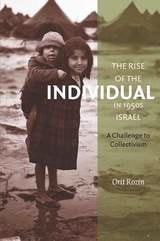
In this sharply argued volume, Orit Rozin reveals the flaws in the conventional account of Israeli society in the 1950s, which portrayed the Israeli public as committed to a collectivist ideology. In fact, major sectors of Israeli society espoused individualism and rejected the state-imposed collectivist ideology. Rozin draws on archival, legal, and media sources to analyze the attitudes of black-market profiteers, politicians and judges, middle-class homemakers, and immigrants living in transit camps and rural settlements. Part of a refreshing trend in recent Israeli historiography to study the voices, emotions, and ideas of ordinary people, Rozin’s book provides an important corrective to much extant scholarly literature on Israel’s early years.
[more]
cover of Writing AIDS: (Re)Conceptualizing the Individual and Social Body in Spanish American Literature

Writing AIDS

(Re)Conceptualizing the Individual and Social Body in Spanish American Literature

Jodie Parys

The Ohio State University Press, 2012

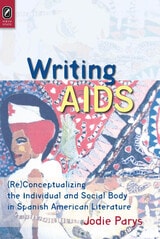
Writing AIDS: (Re)Conceptualizing the Individual and Social Body in Spanish American Literature by Jodie Parys examines the ways in which AIDS has pervaded the personal and social imaginings of the body by highlighting textual representations found in Spanish American literature where AIDS has a significant role. This book addresses the current void in literary theory about HIV/AIDS in Spanish America by drawing together diverse literary texts to illuminate how these Spanish American writers have chosen to depict this disease and how their texts will be archived for future generations. All of the works are united under the broad topic of the body, conceived of as the individual comprising a physical, emotional, and spiritual entity both in isolation and in communion with others. Because HIV and AIDS are physical viruses that attack real bodies, it is the initial portal of entry into the exploration of the notion of identity and how it is impacted and altered by the arrival of AIDS. However, each individual is also a part of a larger community, and the virus itself impacts society as well as individuals. These separate but related concepts—the individual and social bodies—are the uniting themes that are woven throughout the entire study.
[more]
cover of iChina: The Rise of the Individual in Modern Chinese Society

iChina

The Rise of the Individual in Modern Chinese Society

Edited by Mette Halskov Hansen and Rune Svarverud

National University of Singapore Press, 2010

In spite of the intense preoccupation with individual and self in modern Western thought, the social sciences have tended to focus on groups and collectives and downplay the individual. This implicit view has also coloured the study of social life in China where both Confucian ethics and Communist policies have shaped collective structures with little room for individual agency and choice. What is actually happening, however, is a growing individualization of China – not only changing perceptions of the individual but also rising expectations for individual freedom, choice and individuality. The individual has also become a basic social category in China, and a development has begun that permeates all areas of social, economic and political life. How this process evolves in a state and society lacking two of the defining characteristics of European individualization – a culturally embedded democracy and a welfare system – is one of the questions that the volume explores. A strength of this volume is that its authors succeed in depicting the individualization process in conceptually acute and empirically sensitive terms, and as something with its own distinctively Chinese profile. That makes this book a ‘must read’ for all those wanting to understand present-day Chinese society, with all of its ambivalences, contingencies and contradictions.
[more]