Results by title
4 books match the query 'Indo-European languages'
A Dictionary of Selected Synonyms in the Principal Indo-European Languages
Carl Darling Buck
University of Chicago Press, 1988
An Introduction to the Indo-European Languages
Philip Baldi
Southern Illinois University Press, 1983
This comprehensive linguistic survey of the Indo-European groups synthesizes the vast amount of information contained in the specialized handbooks of the individual stocks.
The text begins with an introduction to the concept of the Indo-European language family, the history of its discovery, and the techniques of analysis. The introduction also gives a structural sketch of Proto-Indo-European, the parent language from which the others are descended. Baldi then devotes a chapter to each of the 11 major branches of Indo-European (Italic, Celtic, Indo-Iranian, Greek, Armenian, Albanian, Baltic, Slavic, Germanic, Tocharian, and Anatolian).
Each chapter provides an outline of the external history of the branch, its people, dialects, and other relevant history. This outline is followed by a structural sketch of the most important language or languages of the branch (e.g., Old Irish for Celtic, Sanskrit and Avestan for Indo-Iranian, Latin and Osco-Umbrian for Italic). The sketch also contains the phonology, morphology, and syntax of each language. There is lastly a sample text of each language containing both interlinear and free translation. In those branches where there are special issues (e.g., the relation of Italic to Celtic and Baltic to Slavic, or the problem of archaism in Hittite), additional discussions of these issues are provided. Baldi’s final chapter gives a brief outline of the “minor” Indo-European languages such as Illyrian, Thracian, Raetic, and Phrygian. Adding further to the usefulness of the book are extensive bibliographies, an up-to-date map showing the geographical distribution of the Indo-European languages throughout the world, and a detailed family tree diagram of the members of each subgroup within the Indo-European language family and their interrelationships.
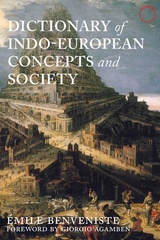
Dictionary of Indo-European Concepts and Society
Émile Benveniste
HAU, 2016
This book has famously inspired a wealth of thinkers, including Roland Barthes, Claude Lévi-Strauss, Pierre Bourdieu, Jacques Derrida, Umberto Eco, Giorgio Agamben, François Jullien, and many others. In this new volume, Benveniste’s masterpiece on the study of language and society finds new life for a new generation of scholars. As political fictions continue to separate and reify differences between European, Middle Eastern, and South Asian societies, Benveniste reminds us just how historically deep their interconnections are and that understanding the way our institutions are evoked through the words that describe them is more necessary than ever.
The Indo-European Dialects
Antoine Meillet
University of Alabama Press, 1967
The Indo‑European Dialects is a foundational work of historical linguistics that investigates how the Indo‑European language family diversified into its major regional branches. Originally delivered as lectures and first published in the early twentieth century, the book remains essential reading for understanding how phonological, morphological, and lexical evidence reveals ancient patterns of language contact, migration, and cultural development. Including Indo‑European, Indo‑Iranian, Greek, Italic (including Latin), Celtic, Germanic, Baltic, Slavic, Armenian, Albanian, Anatolian, and Tocharian, Meillet’s comparative approach situates dialect differences within a broader historical framework, making this volume a lasting contribution to Indo‑European studies and to the methods of linguistic reconstruction more generally.
The author, Antoine Meillet, was one of the most influential linguists of the twentieth century and a central figure in the development of Indo‑European comparative grammar. This edition is expertly translated by Samuel N. Rosenberg, whose careful scholarship preserves Meillet’s analytical precision while making the work accessible to modern English‑language readers. The volume is further enhanced by scholarly notes, bibliographical references, and indexes that increase its usefulness for research and teaching.
This book will be of interest to linguists, philologists, classicists, and historians of language, as well as graduate and advanced undergraduate students studying historical linguistics. It will also appeal to readers interested in how language evidence informs the study of prehistoric societies and cultural connections across Europe and Asia.