Results by title
4 books match the query 'Industrial organization (Economic theory)'
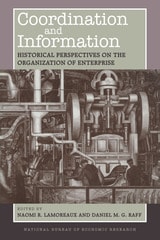
Coordination and Information
Historical Perspectives on the Organization of EnterpriseEdited by Naomi R. Lamoreaux and Daniel M. G. Raff
University of Chicago Press, 1995
In an ideal world, the market would be the optimal provider of coordination, but in the real world of incomplete information, some activities are better coordinated in other ways. Divided into three parts, this book addresses coordination within firms, at the borders of firms, and outside firms, providing a picture of the overall incidence and logic of economic coordination. The case studies—drawn from the late nineteenth and early twentieth century, when the modern business enterprise was evolving, address such issues as the relationship between coordination mechanisms and production techniques, the logic of coordination in industrial districts, and the consequences of regulation for coordination.
Continuing the work on information and organization presented in the influential Inside the Business Enterprise, this book provides material for business historians and economists who want to study the development of the dissemination of information and the coordination of economic activity within and between firms.
Law & Capitalism
What Corporate Crises Reveal about Legal Systems and Economic Development around the WorldCurtis J. Milhaupt and Katharina Pistor
University of Chicago Press, 2008
Using comparative case studies that address the United States, China, Germany, Japan, Korea, and Russia, Curtis J. Milhaupt and Katharina Pistor argue that a disparate blend of legal and nonlegal mechanisms have supported economic growth around the world. Their groundbreaking findings show that law and markets evolve together in a “rolling relationship,” and legal systems, including those of the most successful economies, therefore differ significantly in their organizational characteristics. Innovative and insightful, Law and Capitalism will change the way lawyers, economists, policy makers, and business leaders think about legal regulation in an increasingly global market for capital and corporate governance.
The Firm, the Market, and the Law
R. H. Coase
University of Chicago Press, 1987
A Nobel Prize winner's most important, groundbreaking work, collected in one volume
The Firm, the Market, and the Law gathers the most important and lasting works by Nobel Prize-winning economist Ronald Coase. Awarded the Nobel Prize in 1991 for his groundbreaking work on the significance of transaction costs and property rights, Coase continually urged his fellow economists to examine the real-world foundations on which their theories rest. This volume collects some of his classic articles probing those very foundations. "The Nature of the Firm" (1937) introduced the then-revolutionary concept of transaction costs into economic theory. "The Problem of Social Cost" (1960) further developed this concept, emphasizing the effect of the law on the working of the economic system. The remaining papers and new introductory essay clarify and extend Coarse's arguments and address his critics.
The Organization of Industry
George J. Stigler
University of Chicago Press, 1983
In part one, Stigler examines the nature of competition and monopoly. In part two he discusses the forces that determine the size structure of industry, including barriers to entry, economics of scale, and mergers. Part three contains articles on a wide range of topics, such as profitability, delivered price systems, block booking, the economics of information, and the kinky oligopoly demand curve and rigid price. Part four offers a discussion of antitrust policy and includes Stigler's recommendations for future policy as well as an examination of the effects of past policies.
"Stigler's writings might well be subtitled 'The Joys of Doing Economics.' He, more than any other contemporary American economist, dispels the gloom surrounding economic theory. It is impossible to confront the subject treated with such humor and verve and come away still believing that economics is the dismal science."—Shirley B. Johnson, American Scholar