Results by title
4 books match the query 'Inequalities'
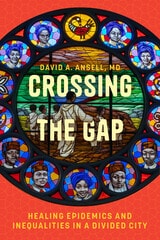
Crossing the Gap
Healing Epidemics and Inequalities in a Divided CityDavid A. Ansell, MD
University of Chicago Press, 2026
A doctor, a disinvested neighborhood, and a radical experiment to close America’s death gap.
Two girls are born in the same Chicago hospital. Their neighborhoods—just seven train stops apart—will shape their futures and help determine how long they live. One will celebrate her eighty-fifth birthday. The other will die before sixty-five.
This is the death gap: lives lost too soon. Crossing the Gap asks how a city with world-class hospitals can tolerate an epidemic of premature death—and tells the story of the people fighting to end it.
In his landmark book The Death Gap, physician and health equity leader David A. Ansell exposed how structural racism and poverty shorten lives. He moves beyond diagnosis in Crossing the Gap to explore what happens when a major medical center joins forces with pastors, community organizers, residents, and young leaders on Chicago’s West Side to redefine what a hospital owes its neighbors. Part medical memoir and part urban chronicle, Crossing the Gap follows groundbreaking initiatives such as West Side United and the Sankofa Wellness Village as they confront decades of disinvestment and work to build healthier communities.
Through stories of collaboration, courage, conflict, and community leadership, Ansell shows how neighborhood voices, rigorous data, and moral imagination can transform health systems from bystanders into partners for change—not just in one city but throughout the nation.

Inequalities of Love
College-Educated Black Women and the Barriers to Romance and FamilyAveril Y. Clarke
Duke University Press, 2011

Inequalities of Platform Publishing
The Promise and Peril of Self-Publishing in the Digital Book EraClaire Parnell
University of Massachusetts Press, 2025
Uncovering race, gender, and sexual biases in popular self-publishing platforms
The average reader need not go far in a bookstore before, knowingly or not, they encounter authors who started their careers by self-publishing prior to achieving commercial success. Examples include Margaret Atwood, Andy Weir, Colleen Hoover, Anna Todd, E. L. James, Scarlett St. Clair, and many more. Such stories of self-made writers are compelling and seem more attainable to others with the accessibility of modern publishing platforms such as Amazon, Apple, Google, Kobo, Wattpad, Webtoon, Radish, Inkitt, Qidian, Tapas, and Swoon Reads. However, as Claire Parnell uncovers in her examination of the two most popular—Amazon and Wattpad—these services in fact perpetuate systemic racial, gender, and sexual bias against authors of color and queer authors through their technological, economic, social, and cultural structures.
At a time when there is a real reckoning with the discrimination that has resulted in publishing opportunities for only relatively few privileged authors—who are often White, upper class, and male—self-publishing presents itself as an equalizer of sorts. Exploring that idea, Parnell shows that these platforms are not just intermediaries for information; they structure content and users in multiple, often inequitable, ways through their ability to set market conditions and apply algorithmic sorting. Combining original interviews, walkthrough method, metadata analysis, and more, Parnell finds that self-publishing platforms reproduce challenges for authors from marginalized communities. Far from equalizing the market, the new platforms instead frequently perpetuate the stubborn barriers to mainstream success for BIPOC and queer authors.

Vetting for Passion
Race, Gender, and Inequalities in the Veterinary ProfessionAdilia E. E. James
Temple University Press, 2027
Despite calls from industry associations for a diverse workforce to meet a changing client base, racial and gendered occupational segregation persists in the veterinary profession. As of 2018, nearly 90% of veterinarians identify as White and more than 70% are women. Adilia James explains the causes and effects of this growing and alarming trend in Vetting for Passion.
James interviews aspiring and employed veterinarians about why marginalized groups are, ironically, not making equitable progress in an elite labor market that encourages diversity and inclusion policies. She shows how cultural and structural barriers exclude people of color from the profession and how relationships with animals are used as racialization tools. People of color are also hindered by factors such as social and lived experiences, the debt-to-income ratio, and an uncomfortable working environment.
Additionally, James finds that hiring managers, veterinary schools, and mentors rely on “constrained choice narratives” to justify their assumption that only White women are likely to appreciate the unique benefits of a career in veterinary medicine, leading these gatekeepers to excuse their opportunity hoarding as benevolent.
Vetting for Passion offers a critical case study of a profession whose associations, colleges, and workplaces justify and perpetuate a culture of racial exclusion.