Results by title
38 books match the query 'Information'

Access with Attitude
An Advocate’s Guide to Freedom of Information in OhioDavid Marburger
Ohio University Press, 2011
For those who find themselves in a battle for public records, Access with Attitude: An Advocate’s Guide to Freedom of Information in Ohio is an indispensable weapon. First Amendment lawyer David Marburger and investigative journalist Karl Idsvoog have written a simply worded, practical guide on how to take full advantage of Ohio’s so-called Sunshine Laws.
Journalists, law firms, labor unions, private investigators, genealogists, realty companies, banks, insurers—anyone who regularly needs access to publicly held information—will find this comprehensive and contentious guide to be invaluable. Marburger, who drafted many of the provisions that Ohio adopted in its open records law, and coauthor Idsvoog have been fighting for broader access to public records their entire careers. They offer field-tested tips on how to avoid “no,” and advise readers on legal strategies if their requests for information go unmet. Step by step, they show how to avoid delays and make the law work.
Whether you’re a citizen, a nonprofit organization, a journalist, or an attorney going after public records, Access with Attitude is an essential resource.
Architects of Memory
Information and Rhetoric in a Networked Archival AgeNathan R. Johnson
University of Alabama Press, 2020
Understanding the systems that shape what societies remember, archive, and forget.
We are now living in the richest age of public memory. From museums and memorials to the vast digital infrastructure of the internet, access to the past is only a click away. Even so, the methods and technologies created by scientists, espionage agencies, and information management coders and programmers have drastically delimited the ways that communities across the globe remember and forget our wealth of retrievable knowledge.
In Architects of Memory: Information and Rhetoric in a Networked Archival Age, Nathan R. Johnson charts turning points where concepts of memory became durable in new computational technologies and modern memory infrastructures took hold. He works through both familiar and esoteric memory technologies—from the card catalog to the book cart to Zatocoding and keyword indexing—as he delineates histories of librarianship and information science and provides a working vocabulary for understanding rhetoric’s role in contemporary memory practices.
This volume draws upon the twin concepts of memory infrastructure and mnemonic technê to illuminate the seemingly opaque wall of mundane algorithmic techniques that determine what is worth remembering and what should be forgotten. Each chapter highlights a conflict in the development of twentieth-century librarianship and its rapidly evolving competitor, the discipline of information science. As these two disciplines progressed, they contributed practical techniques and technologies for making sense of explosive scientific advancement in the wake of World War II. Taming postwar science became part and parcel of practices and information technologies that undergird uncountable modern communication systems, including search engines, algorithms, and databases for nearly every national clearinghouse of the twenty-first century.
Bodies of Information
Intersectional Feminism and the Digital HumanitiesElizabeth Losh
University of Minnesota Press, 2018
A wide-ranging, interconnected anthology presents a diversity of feminist contributions to digital humanities
In recent years, the digital humanities has been shaken by important debates about inclusivity and scope—but what change will these conversations ultimately bring about? Can the digital humanities complicate the basic assumptions of tech culture, or will this body of scholarship and practices simply reinforce preexisting biases? Bodies of Information addresses this crucial question by assembling a varied group of leading voices, showcasing feminist contributions to a panoply of topics, including ubiquitous computing, game studies, new materialisms, and cultural phenomena like hashtag activism, hacktivism, and campaigns against online misogyny.
Taking intersectional feminism as the starting point for doing digital humanities, Bodies of Information is diverse in discipline, identity, location, and method. Helpfully organized around keywords of materiality, values, embodiment, affect, labor, and situatedness, this comprehensive volume is ideal for classrooms. And with its multiplicity of viewpoints and arguments, it’s also an important addition to the evolving conversations around one of the fastest growing fields in the academy.
Contributors: Babalola Titilola Aiyegbusi, U of Lethbridge; Moya Bailey, Northeastern U; Bridget Blodgett, U of Baltimore; Barbara Bordalejo, KU Leuven; Jason Boyd, Ryerson U; Christina Boyles, Trinity College; Susan Brown, U of Guelph; Lisa Brundage, CUNY; micha cárdenas, U of Washington Bothell; Marcia Chatelain, Georgetown U; Danielle Cole; Beth Coleman, U of Waterloo; T. L. Cowan, U of Toronto; Constance Crompton, U of Ottawa; Amy E. Earhart, Texas A&M; Nickoal Eichmann-Kalwara, U of Colorado Boulder; Julia Flanders, Northeastern U Library; Sandra Gabriele, Concordia U; Brian Getnick; Karen Gregory, U of Edinburgh; Alison Hedley, Ryerson U; Kathryn Holland, MacEwan U; James Howe, Rutgers U; Jeana Jorgensen, Indiana U; Alexandra Juhasz, Brooklyn College, CUNY; Dorothy Kim, Vassar College; Kimberly Knight, U of Texas, Dallas; Lorraine Janzen Kooistra, Ryerson U; Sharon M. Leon, Michigan State; Izetta Autumn Mobley, U of Maryland; Padmini Ray Murray, Srishti Institute of Art, Design, and Technology; Veronica Paredes, U of Illinois; Roopika Risam, Salem State; Bonnie Ruberg, U of California, Irvine; Laila Shereen Sakr (VJ Um Amel), U of California, Santa Barbara; Anastasia Salter, U of Central Florida; Michelle Schwartz, Ryerson U; Emily Sherwood, U of Rochester; Deb Verhoeven, U of Technology, Sydney; Scott B. Weingart, Carnegie Mellon U.

Compendium of Information on Seed Storage Behaviour, Volume 2 (I–Z)
T. D. Hong, S. Linington, and R. H. Ellis
Royal Botanic Gardens, Kew, 1998
Coordination and Information
Historical Perspectives on the Organization of EnterpriseEdited by Naomi R. Lamoreaux and Daniel M. G. Raff
University of Chicago Press, 1995
In an ideal world, the market would be the optimal provider of coordination, but in the real world of incomplete information, some activities are better coordinated in other ways. Divided into three parts, this book addresses coordination within firms, at the borders of firms, and outside firms, providing a picture of the overall incidence and logic of economic coordination. The case studies—drawn from the late nineteenth and early twentieth century, when the modern business enterprise was evolving, address such issues as the relationship between coordination mechanisms and production techniques, the logic of coordination in industrial districts, and the consequences of regulation for coordination.
Continuing the work on information and organization presented in the influential Inside the Business Enterprise, this book provides material for business historians and economists who want to study the development of the dissemination of information and the coordination of economic activity within and between firms.

Driver Adaptation to Information and Assistance Systems
Alan Stevens
The Institution of Engineering and Technology, 2013

Eight Months in Illinois
With Information to ImmigrantsWilliam Oliver. Foreword by James E. Davis
Southern Illinois University Press, 2002
The Illinois frontier offered abundant opportunity, noted English traveler William Oliver after his journey to America in 1841–42, but life there was hard. Accordingly, Oliver advised the wealthy and comfortable to remain in England and counseled the unprosperous to seek their fortunes in America. Written for the poor who would migrate and published in 1843, his Eight Months in Illinois: With Information to Immigrants sought only to provide pertinent, valid, and practical information about what people might encounter in the frontier state. What Oliver actually accomplished, however, was much more: he imparted invaluable insights into and analyses of American life during an era of sweeping social, economic, and political change.
In his new foreword to this edition, James E. Davis stresses Oliver’s sincere desire to help British immigrants succeed in America. Oliver, Davis notes, “devoted dozens of pages of advice on numerous matters: various routes to Illinois and their advantages and disadvantages, processes of settling, qualities of western houses, costs of obtaining a new farm.” Oliver discussed other practical matters, such as the importance of having sons. He also assured his intended readership that “in the West, distinction of classes is little known and seldom recognized.”
As a document covering the middle west in the 1840s, Eight Months in Illinois: With Information to Immigrants has few equals. Its portrayal of farming and trade in relatively primitive times is historically accurate. It paints a plain picture, laying out the essential facts and presenting the typical incidents that enable us to trace the course of a settler’s simple, diligent, laborious day-to-day life. According to Davis, Oliver depicted “accurate and balanced slices of life in Illinois and America, including nasty insects, crude conditions, and the necessity of work.” And he did so without a trace of anti-American bias.
Eight Months in Illinois with Information to Immigrants was reprinted with emendations in 1924 by Walter Hill.

Formalizing the Dynamics of Information
Edited by Martina Faller, Stefan Kaufmann, and Marc Pauly
CSLI, 2000
Games, Information, and Politics
Applying Game Theoretic Models to Political ScienceScott Gates and Brian D. Humes
University of Michigan Press, 1997

Information and Communication Technologies for Humanitarian Services
Muhammad Nazrul Islam
The Institution of Engineering and Technology, 2020

Information and Democratic Processes
Edited by John A. Ferejohn and James H. Kuklinski
University of Illinois Press, 1990
The golden democratic tradition of an informed and involved electorate freely and rationally choosing its public officials seems to be at odds with American political reality. Thus the questions: On what basis do people vote and form opinions? How does the lack of information at the individual level affect system performance?
In this collection twenty-six distinguished political scientists discuss, debate, and define the relationship between information and the democracy it supposedly serves. The contributors address both the empirical and normative aspects of governing in the United States, employing psychological, sociological, and economic perspectives.

Information and Elections
R. Michael Alvarez
University of Michigan Press, 1998

Information and Experimental Knowledge
James Mattingly
University of Chicago Press, 2021
What is experimental knowledge, and how do we get it? While there is general agreement that experiment is a crucial source of scientific knowledge, how experiment generates that knowledge is far more contentious. In this book, philosopher of science James Mattingly explains how experiments function. Specifically, he discusses what it is about experimental practice that transforms observations of what may be very localized, particular, isolated systems into what may be global, general, integrated empirical knowledge. Mattingly argues that the purpose of experimentation is the same as the purpose of any other knowledge-generating enterprise—to change the state of information of the knower. This trivial-seeming point has a non-trivial consequence: to understand a knowledge-generating enterprise, we should follow the flow of information. Therefore, the account of experimental knowledge Mattingly provides is based on understanding how information flows in experiments: what facilitates that flow, what hinders it, and what characteristics allow it to flow from system to system, into the heads of researchers, and finally into our store of scientific knowledge.
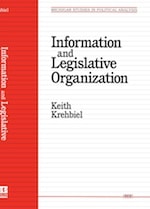
Information and Legislative Organization
Keith Krehbiel
University of Michigan Press, 1992
In this controversial book, Keith Krehbiel investigates and casts doubt upon a view of Congress held by many academics, journalists, and members of the lay public: that Congress is organized primarily to facilitate logrolling or "gains from trade" between legislators. The author puts forward an alternative "informational" theory that, unlike previous formal theories, highlights institutional needs and individual incentives for acquiring policy expertise. Using games with incomplete information, Krehbiel derives a set of unique and testable predictions about the organization of legislatures -- including the composition of committees and the procedures under which legislation is considered.
Krehbiel's creative illustrations and nonmathematical presentation of formal theories make this book accessible to a diverse set of readers. The political relevance and testability of games with incomplete information will be appreciated by game theorists and economists, while the book's findings make it essential reading for political scientists who study American politics, political institutions, or democratic legislatures.
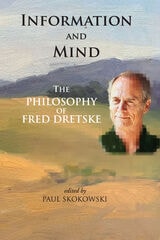
Information and Mind
The Philosophy of Fred DretskeEdited by Paul G. Skokowski
CSLI, 2020
Information, Incentives, and Economics Mechanisms
Essays in Honor of Leonid HurwiczTheodore Groves
University of Minnesota Press, 1987
Information, Participation, and Choice
An Economic Theory of Democracy in PerspectiveBernard Grofman, Editor
University of Michigan Press, 1993
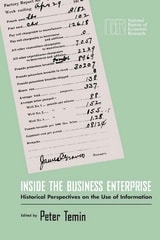
Inside the Business Enterprise
Historical Perspectives on the Use of InformationEdited by Peter Temin
University of Chicago Press, 1991
Because business enterprises are complex institutions, these questions can prove difficult to address. All too often, firms are treated as the atoms of economics, the irreducible unit of analysis. This accessible volume, suitable for course use, looks more closely at the American firm—into its internal workings and its genesis in the Gilded Age. Focusing on the crucial role of imperfect and asymmetric information in the operation of enterprises, Inside the Business Enterprise forges an innovative link between modern economic theory and recent business history.

Knowledge and the Flow of Information
Fred I. Dretske
CSLI, 1999
Legislating in the Dark
Information and Power in the House of RepresentativesJames M. Curry
University of Chicago Press, 2015
The answer? They aren’t. With Legislating in the Dark, James M. Curry reveals that the availability of information about legislation is a key tool through which Congressional leadership exercises power. Through a deft mix of legislative analysis, interviews, and participant observation, Curry shows how congresspersons—lacking the time and resources to study bills deeply themselves—are forced to rely on information and cues from their leadership. By controlling their rank-and-file’s access to information, Congressional leaders are able to emphasize or bury particular items, exploiting their information advantage to push the legislative agenda in directions that they and their party prefer.
Offering an unexpected new way of thinking about party power and influence, Legislating in the Dark will spark substantial debate in political science.

Logic, Information and Agency
Johan van Benthem
CSLI, 2025
Everything we do is driven by information, but the dynamic process of acquiring information and adjusting our views based on it has seldom been put at the center place in logic, and there are few textbooks introducing readers to this line of work. The present book introduces the reader to major logical techniques for studying information dynamics and interaction between agents, based on a variety of intuitive scenarios as well as recent research. Readers will learn styles of modeling, as well as the basic features of the new logical systems emanating from this line of work. All the separate strands in the book are brought together in a comprehensive study of information flow and action in games, forming a logic-based complement to standard perspectives in game theory.

Making Marie Curie
Intellectual Property and Celebrity Culture in an Age of InformationEva Hemmungs Wirtén
University of Chicago Press, 2015
Making Marie Curie explores what went into the creation of this icon of science. It is not a traditional biography, or one that attempts to uncover the “real” Marie Curie. Rather, Eva Hemmungs Wirtén, by tracing a career that spans two centuries and a world war, provides an innovative and historically grounded account of how modern science emerges in tandem with celebrity culture under the influence of intellectual property in a dawning age of information. She explores the emergence of the Curie persona, the information culture of the period that shaped its development, and the strategies Curie used to manage and exploit her intellectual property. How did one create and maintain for oneself the persona of scientist at the beginning of the twentieth century? What special conditions bore upon scientific women, and on married women in particular? How was French identity claimed, established, and subverted? How, and with what consequences, was a scientific reputation secured?
In its exploration of these questions and many more, Making Marie Curie provides a composite picture not only of the making of Marie Curie, but the making of modern science itself.

Metabolizing Capital
Writing, Information, and the Biophysical EnvironmentChristian J. Pulver
Utah State University Press, 2020
The rise of the global cloud and the internet-of-things have ushered in a new stage of the internet that marks a transition from the celebrated user-generated content of Web 2.0 to the data-driven networks of Web 3.0. As social media networks have expanded, so has the amount of writing and communication we do online. This has created several valuable sub-layers of data and metadata about consumer-citizens that corporations and governments now routinely collect, store, and monetize. This frenzy to collect more data is contributing to several problematic social and environmental concerns as flows of information and capital dangerously accelerate how energy and matter move through ecosystems at every scale.
This book explores the planetary consequences of Web 3.0 and the vital role that writing and data production play in accelerating capital circulation, from concerns raised by the growing energy demands of the information industries, to growing streams of electronic waste, to the growing socioeconomic tensions arising as a result of information monopolies.
A posthuman, Marxist analysis of digital culture and writing, Metabolizing Capital contributes to and challenges current understandings of rhetorical agency and actor networks. Combining scholarship from writing studies, rhetoric, and composition with research in metabolic ecology, information theory, media studies, cognitive psychology, history, and new materialism, this book should be of interest to scholars in writing studies as well as others who study digital culture, ecological literacies, the history of writing and information, big data, and environmental concerns related to electronics and the information industries.
Numbers and Nerves
Information, Emotion, and Meaning in a World of DataScott Slovic
Oregon State University Press, 2015
The essays and interviews in Numbers and Nerves explore the quandary of our cognitive responses to quantitative information, while also offering compelling strategies for overcoming insensitivity to the meaning of such information. With contributions by journalists, literary critics, psychologists, naturalists, activists, and others, this book represents a unique convergence of psychological research, discourse analysis, and visual and narrative communication.
At a time of unprecedented access to information, our society is frequently stymied in its efforts to react to the world’s massive problems. Many of these problems are systemic, deeply rooted in seemingly intransigent cultural patterns and lifestyles. In order to sense the significance of these issues and begin to confront them, we must first understand the psychological tendencies that enable and restrict our processing of numerical information.
Numbers and Nerves explores a wide range of psychological phenomena and communication strategies—fast and slow thinking, psychic numbing, pseudoinefficacy, the prominence effect, the asymmetry of trust, contextualized anecdotes, multifaceted mosaics of prose, and experimental digital compositions, among others—and places these in real-world contexts. In the past two decades, cognitive science has increasingly come to understand that we, as a species, think best when we allow numbers and nerves, abstract information and experiential discourse, to work together. This book provides a roadmap to guide that collaboration. It will be invaluable to scholars, educators, professional communicators, and anyone who struggles to grasp the meaning behind the numbers.

Optimizing Structure in Context
Scrambling and Information StructureHye-Won Choi
CSLI, 1999

Privacy and Freedom of Information in 21st-Century Libraries
Jason Griffey
American Library Association, 2010
Promiscuous Knowledge
Information, Image, and Other Truth Games in HistoryKenneth Cmiel and John Durham Peters
University of Chicago Press, 2020

Studies in Language and Information
John Perry
CSLI, 2019
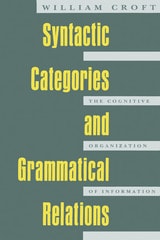
Syntactic Categories and Grammatical Relations
The Cognitive Organization of InformationWilliam Croft
University of Chicago Press, 1991

The Economics of Information and Uncertainty
Edited by John J. McCall
University of Chicago Press, 1982
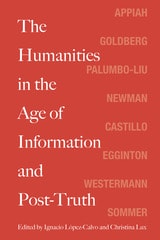
The Humanities in the Age of Information and Post-Truth
Edited by Ignacio López-Calvo and Christina Lux
Northwestern University Press, 2019
While the reader may suspect that these types of lucubration are a desperate reaction to decreased public funding for the humanities worldwide, a decreased enrollment of students, or anxiety over the future of our profession, there is in this volume a coherent argument for the continued need, perhaps more now than ever, to invest in humanities education if we are to have informed and socially conscious citizens rather than just willing consumers and obedient workers. Furthermore, the essays prove that the humanities and the arts are, after all, not a luxury but an integral part of a complete scholarly education.
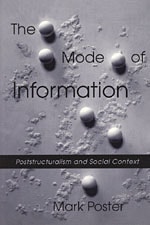
The Mode of Information
Poststructuralism and Social ContextMark Poster
University of Chicago Press, 1990
The difference, Mark Poster argues, is the profound effect electronic mediation exerts on the very way we perceive ourselves and reality. To help decode the linguistic dimensions of our multiple forms of social interaction, he plays upon Marx's theory of the mode of production—the shift to late capitalism has a parallel in the shift from the mode of production to that of information.
Enlisting poststructuralist theory, he links four modes of communication with four poststructuralists: TV ads with Baudrillard, data bases with Foucault, electronic writing with Derrida, and computer science with Lyotard. Mode of Information points the way to a poststructuralist strategy for writing history, a framework well suited to unearthing structures of domination and the means to their disruption.
"An informed, insightful, provocative account of phenomena that have transformed virtually every area of public and private life on our time."—Robert Anchor, American Historical Review
"The importance of Poster's book is unmistakable for he skillfully negotiates between and juxtaposes two wide theoretical domains—electronically mediated communications and poststructuralist theory—about which much has been written, but hardly with the acumen that he brings to bear in a long-awaited critical rapprochement."—Charles J. Stivale, Criticism
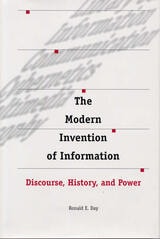
The Modern Invention of Information
Discourse, History, and PowerRonald E. Day
Southern Illinois University Press, 2008
In The Modern Invention of Information: Discourse, History, and Power, Ronald E. Day provides a historically informed critical analysis of the concept and politics of information. Analyzing texts in Europe and the United States, his critical reading method goes beyond traditional historiographical readings of communication and information by engaging specific historical texts in terms of their attempts to construct and reshape history.
After laying the groundwork and justifying his method of close reading for this study, Day examines the texts of two pre–World War II documentalists, Paul Otlet and Suzanne Briet. Through the work of Otlet and Briet, Day shows how documentation and information were associated with concepts of cultural progress. Day also discusses the social expansion of the conduit metaphor in the works of Warren Weaver and Norbert Wiener. He then shows how the work of contemporary French multimedia theorist Pierre Lévy refracts the earlier philosophical writings of Gilles Deleuze and Félix Guattari through the prism of the capitalist understanding of the “virtual society.”
Turning back to the pre–World War II period, Day examines two critics of the information society: Martin Heidegger and Walter Benjamin. He explains Heidegger’s philosophical critique of the information culture’s model of language and truth as well as Benjamin’s aesthetic and historical critique of mass information and communication. Day concludes by contemplating the relation of critical theory and information, particularly in regard to the information culture’s transformation of history, historiography, and historicity into positive categories of assumed and represented knowledge.

The Ontogeny of Information
Developmental Systems and EvolutionSusan Oyama
Duke University Press, 2000
Information, says Oyama, is thought to reside in molecules, cells, tissues, and the environment. When something wondrous occurs in the world, we tend to question whether the information guiding the transformation was pre-encoded in the organism or installed through experience or instruction. Oyama looks beyond this either-or question to focus on the history of such developments. She shows that what developmental “information” does depends on what is already in place and what alternatives are available. She terms this process “constructive interactionism,” whereby each combination of genes and environmental influences simultaneously interacts to produce a unique result. Ontogeny, then, is the result of dynamic and complex interactions in multileveled developmental systems.
The Ontogeny of Information challenges specialists in the fields of developmental biology, philosophy of biology, psychology, and sociology, and even nonspecialists, to reexamine the existing nature-nurture dichotomy as it relates to the history and formation of organisms.
The Political Economy of Expertise
Information and Efficiency in American National PoliticsKevin M. Esterling
University of Michigan Press, 2004
More than mere touts for the interests of Washington insiders, these groups encourage Congress to enact policies that are likely to succeed while avoiding those that have too great of a risk of failure. The surprising result is greater legislative efficiency. The Political Economy of Expertise illustrates that this system actually favors effective and informed decision making, thereby increasing the likelihood that new policies will benefit the American public.
The Politics of Information
Problem Definition and the Course of Public Policy in AmericaFrank R. Baumgartner and Bryan D. Jones
University of Chicago Press, 2014
With The Politics of Attention, leading policy scholars Frank R. Baumgartner and Bryan D. Jones demonstrated the central role attention plays in how governments prioritize problems. Now, with The Politics of Information, they turn the focus to the problem-detection process itself, showing how the growth or contraction of government is closely related to how it searches for information and how, as an organization, it analyzes its findings. Better search processes that incorporate more diverse viewpoints lead to more intensive policymaking activity. Similarly, limiting search processes leads to declines in policy making. At the same time, the authors find little evidence that the factors usually thought to be responsible for government expansion—partisan control, changes in presidential leadership, and shifts in public opinion—can be systematically related to the patterns they observe.
Drawing on data tracing the course of American public policy since World War II, Baumgartner and Jones once again deepen our understanding of the dynamics of American policy making.
The Science of Reading
Information, Media, and Mind in Modern AmericaAdrian Johns
University of Chicago Press, 2023
Reading is perhaps the essential practice of modern civilization. For centuries, it has been seen as key to both personal fulfillment and social progress, and millions today depend on it to participate fully in our society. Yet, at its heart, reading is a surprisingly elusive practice. This book tells for the first time the story of how American scientists and others have sought to understand reading, and, by understanding it, to improve how people do it.
Starting around 1900, researchers—convinced of the urgent need to comprehend a practice central to industrial democracy—began to devise instruments and experiments to investigate what happened to people when they read. They traced how a good reader’s eyes moved across a page of printed characters, and they asked how their mind apprehended meanings as they did so. In schools across the country, millions of Americans learned to read through the application of this science of reading. At the same time, workers fanned out across the land to extend the science of reading into the social realm, mapping the very geography of information for the first time. Their pioneering efforts revealed that the nation’s most pressing problems were rooted in drastic informational inequities, between North and South, city and country, and white and Black—and they suggested ways to tackle those problems.
Today, much of how we experience our information society reflects the influence of these enterprises. This book explains both how the science of reading shaped our age and why, with so-called reading wars still plaguing schools across the nation, it remains bitterly contested.
The Science of Reading
Information, Media, and Mind in Modern AmericaAdrian Johns
University of Chicago Press, 2023
For the first time, the story of how and why we have plumbed the mysteries of reading, and why it matters today.
Reading is perhaps the essential practice of modern civilization. For centuries, it has been seen as key to both personal fulfillment and social progress, and millions today depend on it to participate fully in our society. Yet, at its heart, reading is a surprisingly elusive practice. This book tells for the first time the story of how American scientists and others have sought to understand reading, and, by understanding it, to improve how people do it.
Starting around 1900, researchers—convinced of the urgent need to comprehend a practice central to industrial democracy—began to devise instruments and experiments to investigate what happened to people when they read. They traced how a good reader’s eyes moved across a page of printed characters, and they asked how their mind apprehended meanings as they did so. In schools across the country, millions of Americans learned to read through the application of this science of reading. At the same time, workers fanned out across the land to extend the science of reading into the social realm, mapping the very geography of information for the first time. Their pioneering efforts revealed that the nation’s most pressing problems were rooted in drastic informational inequities, between North and South, city and country, and white and Black—and they suggested ways to tackle those problems.
Today, much of how we experience our information society reflects the influence of these enterprises. This book explains both how the science of reading shaped our age and why, with so-called reading wars still plaguing schools across the nation, it remains bitterly contested.