Results by title
13 books match the query 'Information Age'

A Matter of Facts
The Value of Evidence in an Information AgeLaura A. Millar
American Library Association, 2019
The safeguarding of authentic facts is essential, especially in this disruptive Orwellian age, where digital technologies have opened the door to a post-truth world in which “alternative facts” can be so easily accepted as valid. And because facts matter, evidence matters. In this urgent manifesto, archives luminary Millar makes the case that authentic and accurate records, archives, data, and other sources of documentary proof are crucial in supporting and fostering a society that is respectful, democratic, and self-aware. An eye-opening treatise for the general public, an invaluable resource for archives students, and a provocative call-to-arms for information and records professionals, Millar’s book
- explains the concept of evidence and discusses the ways in which records, archives, and data are not just useful tools for our daily existence but also essential sources of evidence both today and in the future;
- includes plentiful examples that illustrate the critical role evidence plays in upholding rights, enforcing responsibilities, tracing family or community stories, and capturing and sharing memories; and
- examines the impact of digital technologies on how records and information are created and used.
With documentary examples ranging from Mesopotamian clay tablets to World War II photographs to today’s Twitter messages and Facebook posts, Millar’s stirring book will encourage readers to understand more fully the importance of their own records and archives, for themselves and for future generations.
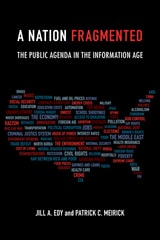
A Nation Fragmented
The Public Agenda in the Information AgeJill Edy
Temple University Press, 2019
The transformation from an undifferentiated public to a surfeit of interest groups has become yet another distinguishing feature of the increasing polarization of American politics. Jill Edy and Patrick Meirick contend that the media has played a key role in this splintering. A Nation Fragmented reveals how the content and character of the public agenda has transformed as the media environment evolved from network television and daily newspapers in the late 1960s to today’s saturated social media world with 200 cable channels.
The authors seek to understand what happened as the public’s sense of shared priorities deteriorated. They consider to what extent our public agenda has “fallen apart” as attention to news has declined, and to what extent we have been “driven apart” by changes in the issue agendas of news. Edy and Meirick also show how public attention is limited and spread too thin except in cases where a highly consistent news agenda can provoke a more focused public agenda.
A Nation Fragmented explores the media’s influence and political power and, ultimately, how contemporary democracy works.
Archives & Archivists in the Information Age
Richard J. Cox
American Library Association, 2005
Demanding Medical Excellence
Doctors and Accountability in the Information AgeMichael L. Millenson
University of Chicago Press, 2000
"If you read only one book this year, read Demanding Medical Excellence. It's that good, and the revolution it describes is that important."—Health Affairs
"Millenson has done yeoman's work in amassing and understanding that avalanche of data that lies beneath most of the managed-care headlines. . . . What he finds is both important and well-explained: inconsistency, overlap, and inattention to quality measures in medical treatment cost more and are more dangerous than most cost-cutting measures. . . . [This book] elevates the healthcare debate to a new level and deserves a wide readership."—Library Journal
"An involving, human narrative explaining how we got to where we are today and what lies ahead."—Mark Taylor, Philadelphia Inquirer
"Read this book. It will entertain you, challenge, and strengthen you in your quest for better accountability in health care."—Alex R. Rodriguez, M.D., American Journal of Medical Quality
"Finally, a health-care book that doesn't wring its hands over the decline of medicine at the hands of money-grubbing corporations. . . . This is a readable account of what Millenson calls a 'quiet revolution' in health care, and his optimism makes for a refreshing change."—Publishers Weekly
"With meticulous detail, historical accuracy, and an uncommon understanding of the clinical field, Millenson documents our struggle to reach accountability."—Saty Satya-Murti, M.D., Journal of the American Medical Association
Disconnected
Haves and Have-Nots in the Information AgeWresch, William
Rutgers University Press, 1996
In the Information Age, information is power. Who produces all that information, how does it move around, who uses it, to what ends, and under what constraints? Who gets that power? And what happens to the people who have no access to it?
Disconnected begins with a striking vignette of two men: One is the thriving manager of a company selling personal computers and computer services. The other is just one among thousands of starving laborers. He has no way to find the information that might help him find a job, he cannot afford newspapers, rarely sees television, cannot understand the dialect of local radio broadcasts, will probably never touch a computer. These two men happen to live in Windhoek, Namibia, but this is not a story about Africa––it is a story that could be repeated almost anywhere in the world, even next door.
With vivid anecdotes and data, William Wresch contrasts the opportunities of the information-rich with the limited prospects of the information-poor. Surveying the range of information––personal, public, organizational, commercial––that has become the currency of exchange in today’s world, he shows how each represents a form of power. He analyzes the barriers that keep people information-poor: geography, tyranny, illiteracy, psychological blinders, “noise,” crime. Technology alone, he demonstrates, is not the answer. Even the technology-rich do not always get access to important information––or recognize its value.
Wresch spells out the grim consequences of information inequity for individuals and society. Yet he ends with reasons for optimism and stories of people who are working to pull down the impediments to the flow of information.
More Speech, Not Less
Communications Law in the Information AgeMark Sableman. Foreword by Paul Simon
Southern Illinois University Press, 1997
On a daily basis we are confronted with "more speech, not less"—more news reports, more television channels, more publications, more electronic communications. Communications laws have expanded in response to the proliferation of communications, and these laws affect everyone.
Communications lawyer Mark Sableman uses recent case studies, practical examples, and plain language to describe and analyze the broad spectrum of modern communications laws and policies. In these essays, Sableman helps communications professionals as well as informed citizens understand the law.
The constitutional foundation for the information age is settled: radical solutions on either side have been rejected. Neither First Amendment absolutism nor untrammeled content-based censorship will rule in America. But within the remaining middle area, many key policy choices are being made by courts and policy makers. Intricate webs of legal do’s and don’ts, practical pitfalls, and effective safe harbors are being developed across the broad spectrum of communications law.
In this guide to existing law, developing trends, and critical policy determinations, Sableman discusses privacy, Internet communications and policy, censorship, libel and slander, copyright and intellectual property, advertising, broadcasting, and journalistic confidentiality. Through actual cases and practical examples, he examines and explains both the existing rules for communications professionals and the developing policies that deserve the attention and scrutiny of informed citizens. Sableman approaches these subjects as a practicing lawyer experienced in both business and media communications.
The phrase "more speech, not less" describes not only the growing cacophony of the information age, but also one approach to legal policy—Justice Louis D. Brandeis’s preference for "more speech, not enforced silence" in all but the most extreme situations. Drawing from his strong advocacy of free speech, Sableman hopes to stimulate informed debate among all who are concerned about the power of information and the magic of words and images.

Network Culture
Politics for the Information AgeTiziana Terranova
Pluto Press, 2004
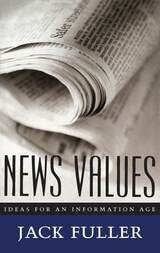
News Values
Ideas for an Information AgeJack Fuller
University of Chicago Press, 1996
"Every talk show host should read this book. So should every newsroom cynic. . . . 'Pursuit of truth is not a license to be a jerk.' In all too many newsrooms, that statement would resound like a three-bell bulletin."—Martin F. Nolan, New York Times Book Review
"[News Values] ought to be required reading not just for those who work for newspapers, but for all those who read and care about them. . . . [This book] seems destined to become one of those slim but important volumes people read for a long time to come."—Richard J. Tofel, Wall Street Journal
"Fuller stays above the fray [of the many books on the media]: His is a deeply intellectual approach, one that provides serious context to the highly complicated issue of how the news 'works.'"—Duncan McDonald, Chicago Tribune Books
"News Values has the touch and feel of knowledgeable, authentic caring about the kind of journalism than can help make society more cohesive, even human." —"Monitor's Pick," Christian Science Monitor
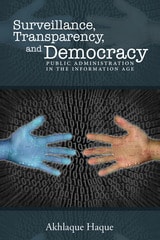
Surveillance, Transparency, and Democracy
Public Administration in the Information AgeAkhlaque Haque
University of Alabama Press, 2015
Exploring the delicate balance between technological innovation, government transparency, and democratic freedom.
In this well-informed yet anxious age, public administrators have constructed vast cisterns that collect and interpret a meteoric shower of facts. Akhlaque Haque demonstrates that this pervasive use and increasing dependence on information technology (IT) enables sophisticated and well-intentioned public services that nevertheless risk deforming public policy decision-making and sees a contradiction inherent in a public that seeks services that require a level of data collection that in turn triggers fears of a tyrannical police state.
The author posits that IT’s potential as a tool for human development depends on how civil servants and citizens actively engage in identifying desired outcomes, map IT solutions to those outcomes, and routinize the applications of those solutions. This leads to his call for the development of entrepreneurs who generate innovative solutions to critical human needs and problems. In his powerful summary, he recaps possible answers to the question: What is the best way a public institution can apply technology to improving the human condition?
Engrossing, challenging, and timely, Surveillance, Transparency, and Democracy is essential reading for both policy makers as well as the great majority of readers and citizens engaged in contemporary arguments about the role of government, public health and security, individual privacy, data collection, and surveillance.
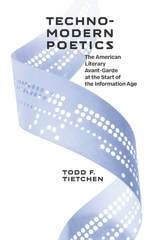
Technomodern Poetics
The American Literary Avant-Garde at the Start of the Information AgeTodd F. Tietchen
University of Iowa Press, 2018
After the second World War, the term “technology” came to signify both the anxieties of possible annihilation in a rapidly changing world and the exhilaration of accelerating cultural change. Technomodern Poetics examines how some of the most well-known writers of the era described the tensions between technical, literary, and media cultures at the dawn of the Digital Age. Poets and writers such as Allen Ginsberg, Charles Olson, Jack Kerouac, and Frank O’Hara, among others, anthologized in Donald Allen’s iconic The New American Poetry, 1945–1960, provided a canon of work that has proven increasingly relevant to our technological present. Elaborating on the theories of contemporaneous technologists such as Norbert Wiener, Claude Shannon, J. C. R. Licklider, and a host of noteworthy others, these artists express the anxieties and avant-garde impulses they wrestled with as they came to terms with a complex array of issues raised by the dawning of the nuclear age, computer-based automation, and the expansive reach of electronic media. As author Todd Tietchen reveals, even as these writers were generating novel forms and concerns, they often continued to question whether such technological changes were inherently progressive or destructive.
With an undeniable timeliness, Tietchen’s book is sure to appeal to courses in modern English literature and American studies, as well as among fans of Beat writers and early Cold War culture.
The Intensification of Surveillance
Crime, Terrorism and Warfare in the Information AgeEdited by Kirstie Ball and Frank Webster
Pluto Press, 2003
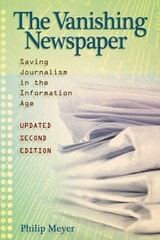
The Vanishing Newspaper [2nd Ed]
Saving Journalism in the Information AgePhilip Meyer
University of Missouri Press, 2009
Tyranny of the Moment
Fast and Slow Time in the Information AgeThomas Hylland Eriksen
Pluto Press, 2001