Results by title
16 books match the query 'Information science'

ALA Glossary of Library and Information Science
Michael Levine-Clark
American Library Association, 2013
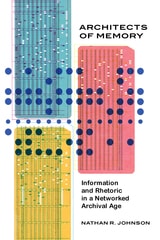
Architects of Memory
Information and Rhetoric in a Networked Archival AgeNathan R. Johnson
University of Alabama Press, 2020
Understanding the systems that shape what societies remember, archive, and forget.
We are now living in the richest age of public memory. From museums and memorials to the vast digital infrastructure of the internet, access to the past is only a click away. Even so, the methods and technologies created by scientists, espionage agencies, and information management coders and programmers have drastically delimited the ways that communities across the globe remember and forget our wealth of retrievable knowledge.
In Architects of Memory: Information and Rhetoric in a Networked Archival Age, Nathan R. Johnson charts turning points where concepts of memory became durable in new computational technologies and modern memory infrastructures took hold. He works through both familiar and esoteric memory technologies—from the card catalog to the book cart to Zatocoding and keyword indexing—as he delineates histories of librarianship and information science and provides a working vocabulary for understanding rhetoric’s role in contemporary memory practices.
This volume draws upon the twin concepts of memory infrastructure and mnemonic technê to illuminate the seemingly opaque wall of mundane algorithmic techniques that determine what is worth remembering and what should be forgotten. Each chapter highlights a conflict in the development of twentieth-century librarianship and its rapidly evolving competitor, the discipline of information science. As these two disciplines progressed, they contributed practical techniques and technologies for making sense of explosive scientific advancement in the wake of World War II. Taming postwar science became part and parcel of practices and information technologies that undergird uncountable modern communication systems, including search engines, algorithms, and databases for nearly every national clearinghouse of the twenty-first century.
Foundations of Information Ethics
John T. F. Burgess
American Library Association, 2019
As discussions about the roles played by information in economic, political, and social arenas continue to evolve, the need for an intellectual primer on information ethics that also functions as a solid working casebook for LIS students and professionals has never been more urgent. This text, written by a stellar group of ethics scholars and contributors from around the globe, expertly fills that need. Organized into twelve chapters, making it ideal for use by instructors, this volume from editors Burgess and Knox
- thoroughly covers principles and concepts in information ethics, as well as the history of ethics in the information professions;
- examines human rights, information access, privacy, discourse, intellectual property, censorship, data and cybersecurity ethics, intercultural information ethics, and global digital citizenship and responsibility;
- synthesizes the philosophical underpinnings of these key subjects with abundant primary source material to provide historical context along with timely and relevant case studies;
- features contributions from John M. Budd, Paul T. Jaeger, Rachel Fischer, Margaret Zimmerman, Kathrine A. Henderson, Peter Darch, Michael Zimmer, and Masooda Bashir, among others; and
- offers a special concluding chapter by Amelia Gibson that explores emerging issues in information ethics, including discussions ranging from the ethics of social media and social movements to AI decision making.
This important survey will be a key text for LIS students and an essential reference work for practitioners
Foundations of Library and Information Science
Richard E. Rubin
American Library Association, 2020
Richard E. Rubin’s book has served as the authoritative introductory text for generations of library and information science practitioners, with each new edition taking in its stride the myriad societal, technological, political, and economic changes affecting our users and institutions and transforming our discipline. Rubin teams up with his daughter, Rachel G. Rubin, a rising star in the library field in her own right, for the fifth edition. Spanning all types of libraries, from public to academic, school, and special, it illuminates the major facets of LIS for students as well as current professionals. Continuing its tradition of excellence, this text addresses
- the history and mission of libraries from past to present, including the history of service to African Americans;
- critical contemporary social issues such as services to marginalized communities, tribal libraries, and immigrants;
- the rise of e-government and the crucial role of political advocacy;
- digital devices, social networking, digital publishing, e-books, virtual reality, and other technology;
- forces shaping the future of libraries, including Future Ready libraries, and sustainability as a core value of librarianship;
- the values and ethics of the profession, with new coverage of civic engagement, combatting fake news, the importance of social justice, and the role of critical librarianship;
- knowledge infrastructure and organization, including Resource Description and Access (RDA), linked data, and the Library Research Model;
- the significance of the digital divide and policy issues related to broadband access and net neutrality;
- intellectual freedom, legal issues, and copyright-related topics;
- contemporary issues in LIS education such as the ongoing tensions between information science and library science; and
- the changing character of collections and services including the role of digital libraries, preservation, and the digital humanities.
In its newest edition, Foundations of Library and Information Science remains the field’s essential resource.
Foundations of Library and Information Science
Richard E. Rubin
American Library Association, 2016

Handbook Of Academic Writing For Librarians
Assoc of College & Research Libraries, 2013
Handbook of Academic Writing for Librarians
Christopher Hollister
Assoc of College & Research Libraries, 2014
This primary reference tool for the library and information science (LIS) community supports those who either desire or are required to publish in the professional literature. LIS students at the masters and doctoral levels can also benefit from this comprehensive volume.
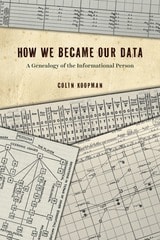
How We Became Our Data
A Genealogy of the Informational PersonColin Koopman
University of Chicago Press, 2019
In How We Became Our Data, Colin Koopman excavates early moments of our rapidly accelerating data-tracking technologies and their consequences for how we think of and express our selfhood today. Koopman explores the emergence of mass-scale record keeping systems like birth certificates and social security numbers, as well as new data techniques for categorizing personality traits, measuring intelligence, and even racializing subjects. This all culminates in what Koopman calls the “informational person” and the “informational power” we are now subject to. The recent explosion of digital technologies that are turning us into a series of algorithmic data points is shown to have a deeper and more turbulent past than we commonly think. Blending philosophy, history, political theory, and media theory in conversation with thinkers like Michel Foucault, Jürgen Habermas, and Friedrich Kittler, Koopman presents an illuminating perspective on how we have come to think of our personhood—and how we can resist its erosion.
Library and Information Science
A Guide to Key Literature and SourcesMichael Bemis
American Library Association, 2014
Practical Research Methods for Librarians and Information Professionals
Susan E. Beck
American Library Association, 2008
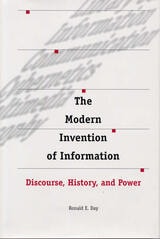
The Modern Invention of Information
Discourse, History, and PowerRonald E. Day
Southern Illinois University Press, 2008
In The Modern Invention of Information: Discourse, History, and Power, Ronald E. Day provides a historically informed critical analysis of the concept and politics of information. Analyzing texts in Europe and the United States, his critical reading method goes beyond traditional historiographical readings of communication and information by engaging specific historical texts in terms of their attempts to construct and reshape history.
After laying the groundwork and justifying his method of close reading for this study, Day examines the texts of two pre–World War II documentalists, Paul Otlet and Suzanne Briet. Through the work of Otlet and Briet, Day shows how documentation and information were associated with concepts of cultural progress. Day also discusses the social expansion of the conduit metaphor in the works of Warren Weaver and Norbert Wiener. He then shows how the work of contemporary French multimedia theorist Pierre Lévy refracts the earlier philosophical writings of Gilles Deleuze and Félix Guattari through the prism of the capitalist understanding of the “virtual society.”
Turning back to the pre–World War II period, Day examines two critics of the information society: Martin Heidegger and Walter Benjamin. He explains Heidegger’s philosophical critique of the information culture’s model of language and truth as well as Benjamin’s aesthetic and historical critique of mass information and communication. Day concludes by contemplating the relation of critical theory and information, particularly in regard to the information culture’s transformation of history, historiography, and historicity into positive categories of assumed and represented knowledge.
The New Information Professional
Your Guide to Careers in the Digital AgeKelly Kowatch
American Library Association, 2010
The Self As Subject
Autoethnographic Research IntoAnneMarie Deitering
Assoc of College & Research Libraries, 2017
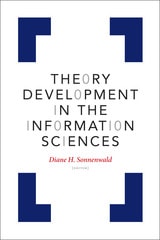
Theory Development in the Information Sciences
Edited by Diane H. Sonnenwald
University of Texas Press, 2016
Emerging as a discipline in the first half of the twentieth century, the information sciences study how people, groups, organizations, and governments create, share, disseminate, manage, search, access, evaluate, and protect information, as well as how different technologies and policies can facilitate and constrain these activities. Given the broad span of the information sciences, it is perhaps not surprising that there is no consensus regarding its underlying theory—the purposes of it, the types of it, or how one goes about developing new theories to talk about new research questions.
Diane H. Sonnenwald and the contributors to this volume seek to shed light on these issues by sharing reflections on the theory-development process. These reflections are not meant to revolve around data collection and analysis; rather, they focus on the struggles, challenges, successes, and excitement of developing theories. The particular theories that the contributors explore in their essays range widely, from theories of literacy and reading to theories of design and digital search. Several chapters engage with theories of the behavior of individuals and groups; some deal with processes of evaluation; others reflect on questions of design; and the rest treat cultural and scientific heritage. The ultimate goal, Sonnenwald writes in her introduction, is to “encourage, inspire, and assist individuals striving to develop and/or teach theory development.”
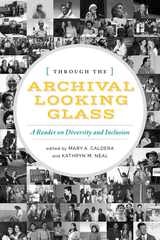
Through the Archival Looking Glass
A Reader on Diversity and InclusionMary A. Caldera
Society of American Archivists, 2014
Working in the Virtual Stacks
Laura Townsend Kane
American Library Association, 2011