Results by title
7 books match the query 'Infrastructures'
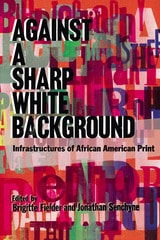
Against a Sharp White Background
Infrastructures of African American PrintEdited by Brigitte Fielder and Jonathan Senchyne
University of Wisconsin Press, 2019

Flows of Violence
Water, Infrastructures, and the State in Buenaventura, ColombiaFelipe Fernández
University of Arizona Press, 2025
Flows of Violence offers a profound ethnographic exploration of the intricate relationship between violence and water infrastructure in one of Colombia’s most marginalized cities. This groundbreaking work engages with the concept of “infrastructural violence,” revealing how the Colombian state’s neglect and inadequate provision of water services perpetuate inequality and suffering among Buenaventura’s residents. Through extensive fieldwork, Fernández provides rich empirical data and firsthand accounts that bring to light the daily struggles and resilience of the city’s inhabitants.
The book critically examines how everyday crime and state neglect intersect, altering the improvised practices of water storage and access among the population. It also highlights the innovative mechanisms employed by social movements and ordinary citizens to cope with and resist these challenges.
Flows of Violence is an essential read for scholars in anthropology, geography, and Latin American studies, offering valuable insights into the sociopolitical impacts of infrastructure. This timely contribution underscores the urgent need for equitable infrastructure development and social justice, making it a pivotal text for understanding urban poverty and state dynamics in Latin America and beyond.
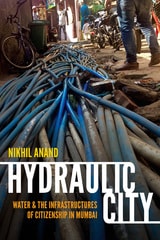
Hydraulic City
Water and the Infrastructures of Citizenship in MumbaiNikhil Anand
Duke University Press, 2017

Infrastructures of Apocalypse
American Literature and the Nuclear ComplexJessica Hurley
University of Minnesota Press, 2020
A new approach to the vast nuclear infrastructure and the apocalypses it produces, focusing on Black, queer, Indigenous, and Asian American literatures
Since 1945, America has spent more resources on nuclear technology than any other national project. Although it requires a massive infrastructure that touches society on myriad levels, nuclear technology has typically been discussed in a limited, top-down fashion that clusters around powerful men. In Infrastructures of Apocalypse, Jessica Hurley turns this conventional wisdom on its head, offering a new approach that focuses on neglected authors and Black, queer, Indigenous, and Asian American perspectives.
Exchanging the usual white, male “nuclear canon” for authors that include James Baldwin, Leslie Marmon Silko, and Ruth Ozeki, Infrastructures of Apocalypse delivers a fresh literary history of post-1945 America that focuses on apocalypse from below. Here Hurley critiques the racialized urban spaces of civil defense and reads nuclear waste as a colonial weapon. Uniting these diverse lines of inquiry is Hurley’s belief that apocalyptic thinking is not the opposite of engagement but rather a productive way of imagining radically new forms of engagement.
Infrastructures of Apocalypse offers futurelessness as a place from which we can construct a livable world. It fills a blind spot in scholarship on American literature of the nuclear age, while also offering provocative, surprising new readings of such well-known works as Atlas Shrugged, Infinite Jest, and Angels in America. Infrastructures of Apocalypse is a revelation for readers interested in nuclear issues, decolonial literature, speculative fiction, and American studies.
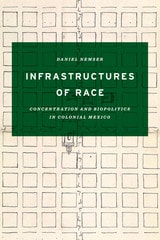
Infrastructures of Race
Concentration and Biopolitics in Colonial MexicoBy Daniel Nemser
University of Texas Press, 2017
Winner, Humanities Book Prize, Mexico Section of the Latin American Studies Association, 2018
Many scholars believe that the modern concentration camp was born during the Cuban war for independence when Spanish authorities ordered civilians living in rural areas to report to the nearest city with a garrison of Spanish troops. But the practice of spatial concentration—gathering people and things in specific ways, at specific places, and for specific purposes—has a history in Latin America that reaches back to the conquest. In this paradigm-setting book, Daniel Nemser argues that concentration projects, often tied to urbanization, laid an enduring, material groundwork, or infrastructure, for the emergence and consolidation of new forms of racial identity and theories of race.
Infrastructures of Race traces the use of concentration as a technique for colonial governance by examining four case studies from Mexico under Spanish rule: centralized towns, disciplinary institutions, segregated neighborhoods, and general collections. Nemser shows how the colonial state used concentration in its attempts to build a new spatial and social order, and he explains why the technique flourished in the colonies. Although the designs for concentration were sometimes contested and short-lived, Nemser demonstrates that they provided a material foundation for ongoing processes of racialization. This finding, which challenges conventional histories of race and mestizaje (racial mixing), promises to deepen our understanding of the way race emerges from spatial politics and techniques of population management.
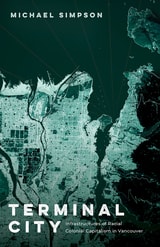
Terminal City
Infrastructures of Racial Colonial Capitalism in VancouverMichael Simpson
University of Minnesota Press, 2026
The entanglement of Vancouver’s infrastructure in settler colonialism and racialized exploitation
Vancouver, Canada, has long been held up as an environmentally conscious coastal refuge and model of progressive urban planning. Unpacking the troubling complexities that lie beneath the city’s otherwise tidy self-image, Terminal City reveals the long, recurring patterns of racialized violence and Indigenous dispossession crucial to its formation.
Examining the histories of Vancouver’s infrastructures, including railways, ports, the freeway system, fossil-fuel pipelines, and property, Michael Simpson details the various spatial manifestations of settler colonialism and racial capitalism that constitute the city’s urban environment—using it as a case study to reveal such tendencies around the world. Simpson exposes how the seizure of Indigenous lands and the destruction of Black communities has been foundational to the development of the city, and he highlights its structural dependency on these violent legacies, as well as the ongoing struggles to dismantle them.
Bringing together theoretical insights from the fields of urban geography, political ecology, and Indigenous studies, Simpson provides a distinctive intervention into contemporary debates around the material basis of logistics and circulation. At a time when massive upheavals to urban infrastructure are taking place in the hopes of establishing greater sustainability, Terminal City raises important questions about how this moment of transition might be harnessed to bring about decolonial abolitionist futures that redefine what a city can become.
Retail e-book files for this title are screen-reader friendly with images accompanied by short alt text and/or extended descriptions.
The Infrastructures of Security
Technologies of Risk Management in JohannesburgMartin J. Murray
University of Michigan Press, 2022
In The Infrastructures of Security, author Martin J. Murray concentrates on not only the turn toward technological solutions to managing the risk of crime through digital (and software-based) surveillance and automated information systems, but also the introduction of somewhat bizarre and fly-by-night experimental “answers” to perceived risk and danger. Digitalized surveillance is significant for two reasons: first, it enables monitoring to take place across wide "geographical distances with little time delay"; and second, it allows for the active sorting, identification, and "tracking of bodies, behaviors, and characteristics of subject populations on a continuous, real-time basis." These new software-based surveillance technologies represent monitoring, tracking, and information gathering without walls, towers, or guards.