Results by title
12 books match the query 'Inheritance'
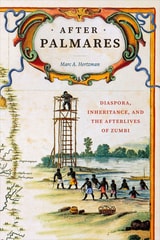
After Palmares
Diaspora, Inheritance, and the Afterlives of ZumbiMarc A. Hertzman
Duke University Press, 2024
In After Palmares, Marc A. Hertzman tells the rise, fall, and afterlives of Palmares, one of history’s largest and longest-lasting maroon societies. Forged during the seventeenth century by formerly enslaved Africans in what would become northeast Brazil, Palmares stood for a century, withstanding sustained attacks from two European powers. In 1695, colonial forces assassinated its most famous leader, Zumbi. Hertzman examines the remarkable ways that Palmares and its inhabitants lived on after Zumbi’s death, creating vivid portraits of those whose lives and voices scholars have often assumed are inaccessible. With an innovative approach to African languages, and paying close attention to place as well as African and diasporic spiritual beliefs, Hertzman reshapes our understanding of Palmares and Zumbi and advances a new framework for studying fugitive slave communities and marronage in the African diaspora.
[more]
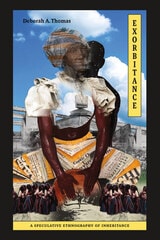
Exorbitance
A Speculative Ethnography of InheritanceDeborah A. Thomas
Duke University Press, 2025
In Exorbitance, Deborah A. Thomas calls for new approaches to political sovereignty grounded in the embodied forms of autonomy and relation created in daily life. Rather than rooting sovereignty in the violence of the state and its institutions, Thomas conceives of sovereignty as the embodied refusal of law and dominion. Drawing on the insights of Caribbeanist thought and studies of Jamaican social, political, and spiritual life, Thomas proposes an exorbitant sovereignty enacted through a phenomenological notion of inheritance. Such a sovereignty emerges from alternative genealogies of governance, community, and ceremony that exceed Enlightenment expectations of political life. Thomas contends that the articulations of exorbitant sovereignty are emergent, ephemeral, and ultimately, relational. By outlining the perils and promises of our inheritance of colonial logics and the tools to refuse them, Thomas models a collaborative and collective anthropology oriented toward improvisational experimentation rather than ethnographic extraction.
[more]
Games of Inheritance
Kabbalah, Tradition, and Authorship in Jorge Luis BorgesYitzhak Lewis
Rutgers University Press, 2025
Games of Inheritance explores the thought of Argentine author and public intellectual Jorge Luis Borges (1899–1986) on questions of authorship and literary tradition. The book focuses on Borges’s engagement with Jewish literary and intellectual traditions, highlighting the role of this engagement in developing and expressing his views on these questions. The book argues that the primary relevance of Borges’s persistent reference to “the Judaic” is not for understanding his attitude toward Jews and Judaism but for understanding his position in contemporary Argentinian debates about nationalism and literature, empire and postcolonialism, and populism and aesthetics. By broadening the frame of Borges and the Judaic, this book shifts the scholarly focus to the poetic utility of Borges’s engagement with Jewish literary and intellectual traditions. This allows a better understanding of the nuance of his views on the issues that most animate his oeuvre: authorship and writing, literature and tradition.
[more]
Inheritance of Loss
China, Japan, and the Political Economy of Redemption after EmpireYukiko Koga
University of Chicago Press, 2016
How do contemporary generations come to terms with losses inflicted by imperialism, colonialism, and war that took place decades ago? How do descendants of perpetrators and victims establish new relations in today’s globalized economy? With Inheritance of Loss, Yukiko Koga approaches these questions through the unique lens of inheritance, focusing on Northeast China, the former site of the Japanese puppet state Manchukuo, where municipal governments now court Japanese as investors and tourists. As China transitions to a market-oriented society, this region is restoring long-neglected colonial-era structures to boost tourism and inviting former colonial industries to create special economic zones, all while inadvertently unearthing chemical weapons abandoned by the Imperial Japanese Army at the end of World War II.
Inheritance of Loss chronicles these sites of colonial inheritance––tourist destinations, corporate zones, and mustard gas exposure sites––to illustrate attempts by ordinary Chinese and Japanese to reckon with their shared yet contested pasts. In her explorations of everyday life, Koga directs us to see how the violence and injustice that occurred after the demise of the Japanese Empire compound the losses that later generations must account for, and inevitably inherit.
Inheritance of Loss chronicles these sites of colonial inheritance––tourist destinations, corporate zones, and mustard gas exposure sites––to illustrate attempts by ordinary Chinese and Japanese to reckon with their shared yet contested pasts. In her explorations of everyday life, Koga directs us to see how the violence and injustice that occurred after the demise of the Japanese Empire compound the losses that later generations must account for, and inevitably inherit.
[more]
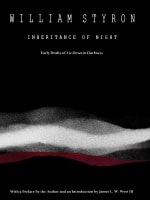
Inheritance of Night
Early Drafts of Lie Down in DarknessWilliam Styron
Duke University Press, 1993
From 1947 to 1949, William Styron twice attempted to write a novel under the working title Inheritance of Night. On the third attempt he produced the award-winning Lie Down in Darkness, which when published in September 1951 established him as one of the most promising writers of his generation. Duke University Press is proud to publish, in facsimile form, the long-lost drafts of Styron's earliest versions of Lie Down in Darkness.
Although Styron began the narrative twice, he realized both times that his writing was derivative and his characters not yet fully conceived. These drafts show young Stryon feeling his way into the story with various narrative voices and strategies, and attempting to work out his plot. Influence from William Faulkner, F. Scott Fitzgerald, and Robert Penn Warren is apparent in the text, and there is a character present named Marcus Bonner who is an early rendition of Stingo in Sophie's Choice.
The typescript drafts of Inheritance of Night for many years were thought to have been lost, but in 1980 were discovered in the files of one of Styron's former literary agents. These drafts, eventually made their way to the archive of Styron's papers assembled at Duke University Library. This facsimile is published here in two different limited editions for collectors: a lettered, signed, and boxed edition (26 copies) and a numbered, signed edition (250). A general interest trade volume is also available.
With a preface by Styron and an introduction by James L. W. West III, these drafts afford much insight into the creation of Lie Down in Darkness and the writing of a major twentieth-century American writer.
[more]

Inheritance
Love, Loss, and the Legacy of the HolocaustCharlie Scheidt
Rutgers University Press, 2026
2026 International Book Award (IBA) for Nonfiction: Narrative.
2026 Independent Publisher Book Awards (IPPY) Silver Medal in the Autobiography/Memoir II (Coming of Age/Family Legacy) category.
After his mother’s death, Charlie Scheidt discovered a trove of historic documents that set him on a decade-long journey to uncover his family’s hidden past during the Holocaust. Joined by Kat Rohrer, the granddaughter of a Nazi officer, Scheidt embarked on a quest to trace his family’s harrowing efforts to escape from Nazi-occupied Europe. As they investigated, they uncovered stories of survival and loss. Their journey takes them across generations and continents, revealing a legacy of love, loss, and resilience. Grappling with questions about the long-lasting effects of inherited trauma, the book asks whether it is possible to break free of a familial cycle. This memoir, rooted in his family’s escape and the lasting trauma that followed, is a powerful reflection on history’s enduring scars, the importance of remembrance, and healing across generations.
[more]
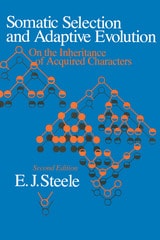
Somatic Selection and Adaptive Evolution
On the Inheritance of Acquired CharactersE. J. Steele
University of Chicago Press, 1981
If the thesis advanced in this book can be corroborated by experiments currently being carried out in a number of laboratories around the world, it will signify an intellectual revolution and a landmark in the history of science. E. J. Steele here suggests that on the basis of his own immunological research, the theory originally put forward by Lamarck 170 years ago and subsequently rejected—the notion that organisms may transmit characters acquired in their lifetimes to their offspring—may in fact be right. In the new postscript to the second edition, Steele presents his latest findings and replies to the enormous body of criticism his research has engendered.
[more]
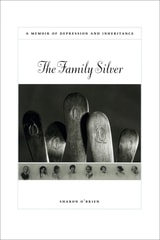
The Family Silver
A Memoir of Depression and InheritanceSharon O'Brien
University of Chicago Press, 2004
Finding herself struggling with depression ("like a rude houseguest, coming and going of its own accord"), Sharon O'Brien set out to understand its origins beyond the biochemical explanations and emotional narratives prevailing in contemporary American culture. Her quest for her inheritance took her straight into the pressures and possibilities of American culture, and then to the heart of her family—the generations who shaped and were shaped by one another and their moment in history. In The Family Silver, as O'Brien travels into her family's past, she goes beyond depression to discover courage, poetry, and grace.
A compassionate and engaging writer, O'Brien uses the biographer's methods to understand her family history, weaving the scattered pieces of the past—her mother's memo books, her father's reading journal, family photographs, tombstones, dance cards, hospital records, the family silver—into a compelling narrative. In the lives of her Irish-American relatives she finds that the American values of upward mobility, progress, and the pressure to achieve sparked both desire and depression, following her family through generations, across the sea, from the Irish famine of the 1840s to Harvard Yard in the late 1960s.
"Many people who write stories of depression or other chronic illnesses tell tales of recovery in the upward-mobility sense, the 'once I was ill, but now I am well' formula that we may find appealing, but doesn't match the messiness of our lives," she writes. "Mine is not such a tale. But it is a recovery tale in another sense—a story of salvage, of rescuing stories from silence." Told with humor and honesty, O'Brien's story will captivate all readers who want to know how they, and their families, have been shaped by the past.
[more]
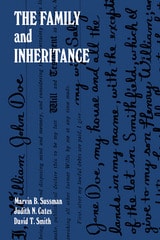
The Family and Inheritance
Marvin Sussman
Russell Sage Foundation, 1970
Two sociologists and a lawyer examine here the attitudes of both survivors and attorney on various problems surrounding inheritance—from will-making through estate settlement. Within a legal frame of reference, this book is a study of what happens within a family at death—and why. The authors use the "inheritance unit" as the basis for looking at the functions of inheritance in intergenerational family continuity and the general patterns of family relationship.
[more]
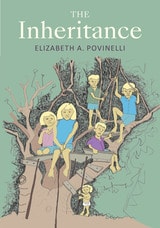
The Inheritance
Elizabeth A. Povinelli
Duke University Press, 2021
Elizabeth A. Povinelli’s inheritance was passed down not through blood or soil but through a framed map of Trentino, Alto Adige—the region where family's ancestral alpine village is found. Far more than a map hanging above the family television, the image featured colors and lines that held in place the memories and values fueling the Povinelli family's fraught relationships with the village and with each other. In her graphic memoir The Inheritance, Povinelli explores the events, traumas, and powers that divide and define our individual and collective pasts and futures. Weaving together stories of her grandparents' flight from their village in the early twentieth century to the fortunes of their knife-grinding business in Buffalo, New York, and her own Catholic childhood in a shrinking Louisiana woodlands of the 1960s and 1970s, Povinelli describes the serial patterns of violence, dislocation, racism and structural inequality that have shaped not only her life but the American story. Plumbing the messy relationships among nationality, ethnicity, kinship, religion, and belonging, The Inheritance takes us into the gulf between the facts of history and the stories we tell ourselves to survive and justify them.
[more]
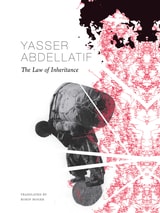
The Law of Inheritance
Yasser Abdellatif
Seagull Books, 2018
This lyrical novel tells the story of a young man living in Egypt in the 1990s, a time of great turmoil. We see student riots at Cairo University, radical politics, and the first steps towards the making of a writer. But his story is not told in isolation: through his experiences and memories Yasser Abdellatif also unfolds the experiences of his Nubian family through the epochal changes the country underwent in the twentieth-century.
The symphonic four-part text presents us with narratives of Egyptian identity, a constant knitting and unravelling that moves us back and forth through time, as the reader slides and leaps across the shifting tectonic plates of Abdellatif’s vignettes, his immaculately limpid prose poetry bringing forth the same questions. Nobody quite belongs in Cairo, it seems, but at the same time none of them belongs anywhere else: a relative emigrates from his Nubian village to the Cairo of the 1930s, where Italian fascists chase him through the streets and into a Maltese exile, only for him to return and make his way back South to the homeland he left. Another relative falls into religious esotericism and later madness, spinning away from Cairo and back to the wasteland of a village relocated after it had been flooded by the Aswan Dam. Meanwhile, in the 1990s, students fight security forces and binge on pills amid the dysfunctional remnants of a centralized state whose gravitational pull uprooted their parents and offered the possibility of assimilation into a national identity.
Through the clear sky of Abdellatif’s novel his characters, the spaces they call home, their way-stations, and even the nation that contains them all are a murmuration of starlings, held together and apart forever.
[more]
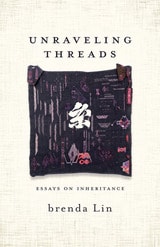
Unraveling Threads
Essays on Inheritancebrenda Lin
The Ohio State University Press, 2026
A memoir-in-essays that, in its exploration of language, family ties, and Taiwanese history, distills how the handmade holds memory, inheritance, and the work of caretaking.
“Tactile memory feels like it is the easiest to lose,” brenda Lin writes in Unraveling Threads. But in these exquisite essays, she demonstrates just how the tactile bolsters personal, familial, and cultural memory. From the remnant of a baby’s umbilical cord to the antique hand-embroidered baby carriers her mother collects, Lin shows us how the tactile and handmade connect parents and children, homeland and diaspora, and give texture to caregiving’s many forms. As Lin writes, the radical for thread forms the basis of Chinese characters for women’s work, for practice through repetition, for inheritance. Threads form the mesh in the stent that keeps her father’s heart working. And yuan, the red thread of fate, is the first word she translated for her future husband. When Lin returns to Taiwan after decades away, this time with her young family, the threads of creativity and caretaking become the warp and weft of the continual process of homecoming. These essays on motherhood, language, art, and diaspora will resonate with anyone who has experienced the process of returning to, or building, a home.
“Tactile memory feels like it is the easiest to lose,” brenda Lin writes in Unraveling Threads. But in these exquisite essays, she demonstrates just how the tactile bolsters personal, familial, and cultural memory. From the remnant of a baby’s umbilical cord to the antique hand-embroidered baby carriers her mother collects, Lin shows us how the tactile and handmade connect parents and children, homeland and diaspora, and give texture to caregiving’s many forms. As Lin writes, the radical for thread forms the basis of Chinese characters for women’s work, for practice through repetition, for inheritance. Threads form the mesh in the stent that keeps her father’s heart working. And yuan, the red thread of fate, is the first word she translated for her future husband. When Lin returns to Taiwan after decades away, this time with her young family, the threads of creativity and caretaking become the warp and weft of the continual process of homecoming. These essays on motherhood, language, art, and diaspora will resonate with anyone who has experienced the process of returning to, or building, a home.
[more]