Results by title
4 books match the query 'Inheriting'
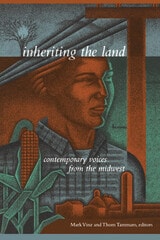
Inheriting The Land
Contemporary Voices from the MidwestMark Vinz
University of Minnesota Press, 1993
[more]
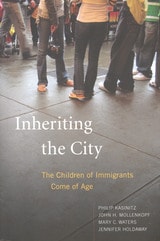
Inheriting the City
The Children of Immigrants Come of AgePhilip Kasinitz
Russell Sage Foundation, 2008
The United States is an immigrant nation—nowhere is the truth of this statement more evident than in its major cities. Immigrants and their children comprise nearly three-fifths of New York City's population and even more of Miami and Los Angeles. But the United States is also a nation with entrenched racial divisions that are being complicated by the arrival of newcomers. While immigrant parents may often fear that their children will "disappear" into American mainstream society, leaving behind their ethnic ties, many experts fear that they won't—evolving instead into a permanent unassimilated and underemployed underclass. Inheriting the City confronts these fears with evidence, reporting the results of a major study examining the social, cultural, political, and economic lives of today's second generation in metropolitan New York, and showing how they fare relative to their first-generation parents and native-stock counterparts. Focused on New York but providing lessons for metropolitan areas across the country, Inheriting the City is a comprehensive analysis of how mass immigration is transforming life in America's largest metropolitan area. The authors studied the young adult offspring of West Indian, Chinese, Dominican, South American, and Russian Jewish immigrants and compared them to blacks, whites, and Puerto Ricans with native-born parents. They find that today's second generation is generally faring better than their parents, with Chinese and Russian Jewish young adults achieving the greatest education and economic advancement, beyond their first-generation parents and even beyond their native-white peers. Every second-generation group is doing at least marginally—and, in many cases, significantly—better than natives of the same racial group across several domains of life. Economically, each second-generation group earns as much or more than its native-born comparison group, especially African Americans and Puerto Ricans, who experience the most persistent disadvantage. Inheriting the City shows the children of immigrants can often take advantage of policies and programs that were designed for native-born minorities in the wake of the civil rights era. Indeed, the ability to choose elements from both immigrant and native-born cultures has produced, the authors argue, a second-generation advantage that catalyzes both upward mobility and an evolution of mainstream American culture. Inheriting the City leads the chorus of recent research indicating that we need not fear an immigrant underclass. Although racial discrimination and economic exclusion persist to varying degrees across all the groups studied, this absorbing book shows that the new generation is also beginning to ease the intransigence of U.S. racial categories. Adapting elements from their parents' cultures as well as from their native-born peers, the children of immigrants are not only transforming the American city but also what it means to be American.
[more]
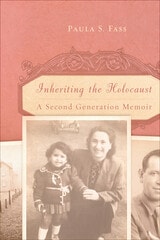
Inheriting the Holocaust
A Second-Generation MemoirPaula S. Fass
Rutgers University Press, 2011
In Inheriting the Holocaust, Paula S. Fass explores her own past as the daughter of Holocaust survivors to reflect on the nature of history and memory. Through her parents' experiences and the stories they recounted, Fass defined her engagement as a historian and used these skills to better understand her parents' lives.
Fass begins her journey through time and relationships when she travels to Poland and locates birth certificates of the murdered siblings she never knew. That journey to recover her family's story provides her with ever more evidence for the perplexing reliability of memory and its winding path toward historical reconstruction. In the end, Fass recovers parts of her family's history only to discover that Poland is rapidly re-imagining the role Jews played in the nation's past.
[more]
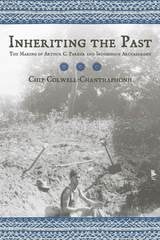
Inheriting the Past
The Making of Arthur C. Parker and Indigenous ArchaeologyChip Colwell-Chanthaphonh
University of Arizona Press, 2009
In recent years, archaeologists and Native American communities have struggled to find common ground even though more than a century ago a man of Seneca descent raised on New York’s Cattaraugus Reservation, Arthur C. Parker, joined the ranks of professional archaeology. Until now, Parker’s life and legacy as the first Native American archaeologist have been neither closely studied nor widely recognized. At a time when heated debates about the control of Native American heritage have come to dominate archaeology, Parker’s experiences form a singular lens to view the field’s tangled history and current predicaments with Indigenous peoples.
In Inheriting the Past, Chip Colwell-Chanthaphonh examines Parker’s winding career path and asks why it has taken generations for Native peoples to follow in his footsteps. Closely tracing Parker’s life through extensive archival research, Colwell-Chanthaphonh explores how Parker crafted a professional identity and negotiated dilemmas arising from questions of privilege, ownership, authorship, and public participation. How Parker, as well as the discipline more broadly, chose to address the conflict between Native American rights and the pursuit of scientific discovery ultimately helped form archaeology’s moral community.
Parker’s rise in archaeology just as the field was taking shape demonstrates that Native Americans could have found a place in the scholarly pursuit of the past years ago and altered its trajectory. Instead, it has taken more than a century to articulate the promise of an Indigenous archaeology—an archaeological practice carried out by, for, and with Native peoples. As the current generation of researchers explores new possibilities of inclusiveness, Parker’s struggles and successes serve as a singular reference point to reflect on archaeology’s history and its future.
[more]