Results by title
4 books match the query 'Injury'
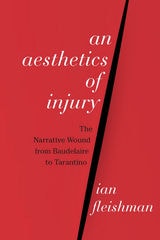
An Aesthetics of Injury
The Narrative Wound from Baudelaire to TarantinoIan Fleishman
Northwestern University Press, 2018
An Aesthetics of Injury exposes wounding as a foundational principle of modernism in literature and film. Theorizing the genre of the narrative wound—texts that aim not only to depict but also to inflict injury—Ian Fleishman reveals harm as an essential aesthetic strategy in ten exemplary authors and filmmakers: Charles Baudelaire, Franz Kafka, Georges Bataille, Jean Genet, Hélène Cixous, Ingeborg Bachmann, Elfriede Jelinek, Werner Schroeter, Michael Haneke, and Quentin Tarantino.
Violence in the modernist mode, an ostensible intrusion of raw bodily harm into the artwork, aspires to transcend its own textuality, and yet, as An Aesthetics of Injury establishes, the wound paradoxically remains the essence of inscription. Fleishman thus shows how the wound, once the modernist emblem par excellence of an immediate aesthetic experience, comes to be implicated in a postmodern understanding of reality reduced to ceaseless mediation. In so doing, he demonstrates how what we think of as the most real object, the human body, becomes indistinguishable from its “nonreal” function as text. At stake in this tautological textual model is the heritage of narrative thought: both the narratological workings of these texts (how they tell stories) and the underlying epistemology exposed (whether these narrativists still believe in narrative at all).
With fresh and revealing readings of canonical authors and filmmakers seldom treated alongside one another, An Aesthetics of Injury is important reading for scholars working on literary or cinematic modernism and the postmodern, philosophy, narratology, body culture studies, queer and gender studies, trauma studies, and cultural theory.
[more]
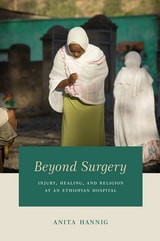
Beyond Surgery
Injury, Healing, and Religion at an Ethiopian HospitalAnita Hannig
University of Chicago Press, 2017
Over the past few decades, maternal childbirth injuries have become a potent symbol of Western biomedical intervention in Africa, affecting over one million women across the global south. Western-funded hospitals have sprung up, offering surgical sutures that ostensibly allow women who suffer from obstetric fistula to return to their communities in full health. Journalists, NGO staff, celebrities, and some physicians have crafted a stock narrative around this injury, depicting afflicted women as victims of a backward culture who have their fortunes dramatically reversed by Western aid. With Beyond Surgery, medical anthropologist Anita Hannig unsettles this picture for the first time and reveals the complicated truth behind the idea of biomedical intervention as quick-fix salvation.
Through her in-depth ethnography of two repair and rehabilitation centers operating in Ethiopia, Hannig takes the reader deep into a world inside hospital walls, where women recount stories of loss and belonging, shame and delight. As she chronicles the lived experiences of fistula patients in clinical treatment, Hannig explores the danger of labeling “culture” the culprit, showing how this common argument ignores the larger problem of insufficient medical access in rural Africa. Beyond Surgery portrays the complex social outcomes of surgery in an effort to deepen our understanding of medical missions in Africa, expose cultural biases, and clear the path toward more effective ways of delivering care to those who need it most.
Through her in-depth ethnography of two repair and rehabilitation centers operating in Ethiopia, Hannig takes the reader deep into a world inside hospital walls, where women recount stories of loss and belonging, shame and delight. As she chronicles the lived experiences of fistula patients in clinical treatment, Hannig explores the danger of labeling “culture” the culprit, showing how this common argument ignores the larger problem of insufficient medical access in rural Africa. Beyond Surgery portrays the complex social outcomes of surgery in an effort to deepen our understanding of medical missions in Africa, expose cultural biases, and clear the path toward more effective ways of delivering care to those who need it most.
[more]
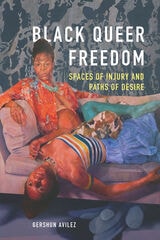
Black Queer Freedom
Spaces of Injury and Paths of DesireGerShun Avilez
University of Illinois Press, 2020
Whether engaged in same-sex desire or gender nonconformity, black queer individuals live with being perceived as a threat while simultaneously being subjected to the threat of physical, psychological, and socioeconomical injury. Attending to and challenging threats has become a defining element in queer black artists’ work throughout the black diaspora. GerShun Avilez analyzes the work of diasporic artists who, denied government protections, have used art to create spaces for justice. He first focuses on how the state seeks to inhibit the movement of black queer bodies through public spaces, whether on the street or across borders. From there, he pivots to institutional spaces—specifically prisons and hospitals—and the ways such places seek to expose queer bodies in order to control them. Throughout, he reveals how desire and art open routes to black queer freedom when policy, the law, racism, and homophobia threaten physical safety, civil rights, and social mobility.
[more]

Insult to Injury
Libel, Slander, and Invasions of PrivacyChrista Jones
University Press of Colorado, 2003
William K. Jones reviews the seminal US Supreme Court decisions that restrict the First Amendment in order to protect persons against defamatory falsehoods, invasions of privacy, and related psychic harm. Covering cases ranging from a restaurant owner dri
[more]