Results by title
2 books match the query 'Inner Worlds'

From Inner Worlds to Outer Space
The Multimedia Performances of Dan KwongDan Kwong
University of Michigan Press, 2004
"Somehow, Kwong has held onto his sense of childlike wonder about the cosmos, and that awe informs his free-wheeling and uproarious performance."
-Asian Week
"He weaves striking, multi-focus stage pictures around simple monologues about his Chinese and Japanese grandfathers, ironic accounts of his own childhood, and litanies of the trials facing Asian American males."
-L.A. Times
"Saturated with high-spirited enthusiasm . . . a refreshingly forthright approach to his often dark material."
-Chicago Tribune
"Kwong's humor is warm and loving . . . it stems from a delightfully twisted taste for the absurdity of human behavior. . . . Be prepared to laugh, to be moved, and to fall in love with a performer."
-L.A. Reader
Dan Kwong's performances delve into the complexities of growing up as a working-class Chinese-Japanese-American male in L.A., land of Hollywood and Disney. Kwong's remarkable performances, a potent array of multimedia effects and athletic physicalization, investigate questions of identity and the intersecting effects of race, culture, class, gender, and sexuality. From Inner Worlds to Outer Space brings together Kwong's scripts with illuminating commentary by critic Robert Vorlicky. The book includes interviews that reveal Kwong's personal and artistic influences, his evolution as an artist, and his philosophical and technical approach to art-making.
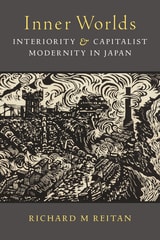
Inner Worlds
Interiority and Capitalist Modernity in JapanRichard M Reitan
University of Michigan Press, 2026
Inner Worlds examines the emergence and operation of representations of interiority—consciousness, “folk mind,” “spirit”—in Japan from its industrial revolution to the rise of fascism during the interwar period. These representations functioned to reproduce the capitalist system by containing its excesses. Thus, poverty in the 1880s was ostensibly the result of defects in one’s innate mental character. A degenerate “crowd mind” explained the strikes and riots of the early twentieth century. State subversion during the 1930s supposedly reflected an attenuated “folk spirit.” By locating the roots of capitalism’s excesses not within the socioeconomic order itself but within a defective interiority, ideologies of interiority operated to contain disruptions to Japan’s socioeconomic order, conceal its defects, and sustain the capitalist system. Inner Worlds reveals how interiority was constituted in ways consistent with both the demands of the emerging capitalist order of the late nineteenth century and the conditions that coalesced to form a fascist conjecture in the 1930s.