Results by title
4 books match the query 'Inomata, Takeshi'
Archaeology Of Settlement Abandonment of Middle America
Takeshi Inomata
University of Utah Press, 2003
Mesoamerican archaeologists have long been interested in the collapse of political systems or civilizations but have been slow to undertake detailed abandonment analyses of specific settlements. The Archaeology of Settlement Abandonment in Middle America explores some of the old questions in Middle American archaeology in light of the newer theoretical approach provided by abandonment studies. Unlike much of the abandonment work previously done in the American Southwest, a number of contributions to this volume examine relatively large population centers.
Among the original contributions in this collection is the discovery that deposits resulting from termination rituals are more common than previously thought. Several chapters point out that structures and places can continue to serve ritual functions even after abandonment. Another finding is that the causes of abandonment—warfare, economic marginalization, or natural cataclysm—are likely to have varied effects on different social groups, which in turn sheds light on occupational histories in specific sites preceding major abandonments.
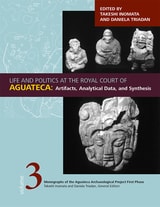
Life and Politics at the Royal Court of Aguateca
Artifacts, Analytical Data, and SynthesisTakeshi Inomata
University of Utah Press, 2014
Because of the surprise nature of the attack, most artifacts were left in their original locations, providing unprecedented views of the daily life of the Classic Maya. Detailed analyses of these objects and their distribution has shown that Mayan elites stored some of their food in their residences and that they also conducted various administrative duties there. The presence of numerous precious ornaments indicates that many of the Maya elite were also skilled craft producers.
Life and Politics at the Royal Court of Aguateca is the third and final volume of the monograph series on Aguateca. It presents the analyses of items not covered in the first two volumes, including figurines, ceramic laminates and masks, spindle whorls, ground stone, and bone artifacts, as well as hieroglyphic texts and plant and animal remains. It discusses the broad implications of this remarkable data set and provides a summation of the project.
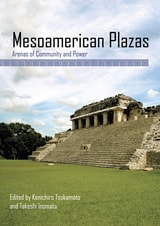
Mesoamerican Plazas
Arenas of Community and PowerEdited by Kenichiro Tsukamoto and Takeshi Inomata
University of Arizona Press, 2014
The primary question that has motivated the contributors is how Mesoamerican plazas became arenas for the creation and negotiation of social relations and values in a community. The thirteen contributions stress the significance of interplay between power relations and embodied practices set in specific historical and material settings, as outlined by practice theory and performance theory. This approach allows the contributors to explore broader anthropological issues, such as the negotiation of power relations, community making, and the constitution of political authorities.
Overall, the contributions establish that physical interactions among people in communal events were not the outcomes of political machinations held behind the scenes, but were the actual political processes through which people created, negotiated, and subverted social realities. If so, spacious plazas that were arguably designed for interactions among a large number of individuals must have also provided critical arenas for the constitution and transformation of society.
Warfare and the Fall of a Fortified Center
Archaeological Investigations at AguatecaTakeshi Inomata
Vanderbilt University Press, 2006
VIMA Series #3