Results by title
5 books match the query 'Inscriptions, Greek'
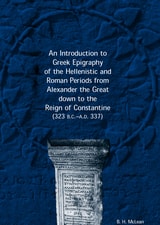
An Introduction to Greek Epigraphy of the Hellenistic and Roman Periods from Alexander the Great down to the Reign of Constantine
B. H. McLean
University of Michigan Press, 2011
“In short, this is a reference work of the best kind. For the beginner, it is indispensable. And for those who already know something about its subject matter, the book is in many ways useful, informative, and interesting. We all owe a debt to [the author] for undertaking this significant project, and for completing it so well.”
—Michael Peachin, Classical World
“. . . provides invaluable road maps for non-epigraphers faced with passages of inscribed Greek.”
—Graham Shipley, Bryn Mawr Classical Review
Greek inscriptions form a valuable resource for the study of all aspects of the Greco-Roman world. They are primary witnesses to society's laws and institutions, religious habits, and language. This volume provides students with the tools to take advantage of the historical value of these treasures. It examines letter forms, ancient names, and ancient calendars, knowledge of which is essential in reading inscriptions of all kinds.
B. H. McLean discusses the classification of inscriptions into their various categories and analyzes particular types of inscriptions, including decrees, honorary inscriptions, dedications, funerary inscriptions, and manumissions. Finally, McLean includes special topics that bear upon the interpretation of specific features of inscriptions, such as Greek and Roman administrative titles and functions.
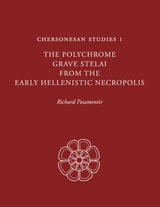
Chersonesan Studies 1
The Polychrome Grave Stelai from the Early Hellenistic NecropolisBy Richard Posamentir
University of Texas Press, 2010
Chersonesan Studies 1 presents the painted grave stelai of the Early Hellenistic necropolis of Chersonesos Taurike, a Greek city on the northern shore of the Black Sea. This unique collection of over one hundred objects is of major interest to students of ancient art and Greek culture. Their polychrome decoration has been extraordinarily well preserved, a rarity in the ancient world. They compose a remarkable, even unique, body of evidence of Greek funerary memorial sculpture: their shapes are gender-specific, their depicted objects are gender- and age-specific, and they can be ascribed to a handful of specific workshops. Their surprising uniformity requires an explanation, since comparable assemblages from other parts of the Greek world show substantial diversity in all these aspects.
This book provides the first complete catalog and description of the stelai, together with full-color illustrations of all the significant stelai and many details. Through his painstaking recovery and reassembling of fragments, as well as the use of advanced photographic techniques, Richard Posamentir has been able to add a whole new dimension to the study of these artifacts. The volume covers the history of the stelai, analysis of the workshops, and reconstruction of the necropolis that the stelai originally graced. A comparison chapter discusses how the stelai fit into the context of Greek funerary art and provides insights into the culture and society of a city on the Black Sea.
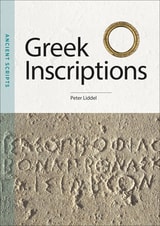
Greek Inscriptions
Ancient ScriptsPeter Liddel
J. Paul Getty Trust, The, 2025
Ancient Greek inscriptions are crucially important in understanding the cultures of Greece and the Mediterranean in antiquity. They provide glimpses of the behavior of the people of the time, including clues about their mindsets and aspirations. These public records combine word and image in a multitude of ways and are rich in the insights they offer.
The inscriptions examined in this volume come from a range of objects on metal or stone that include laws, decrees, accounts and inventories, honorific texts, dedications to deities, and funerary epitaphs. They give a broad view of interstate relations, historical narratives, and the political administration of various city-states while also providing new perspectives on concepts such as democracy, citizenship, gender, ethnicity, religion, and the supernatural. Peter Liddel emphasizes the physical form of the texts alongside their importance in understanding ancient Greek culture. Accessible and insightful, Greek Inscriptions both highlights the significance and history of these artifacts and examines their reception in the modern world.
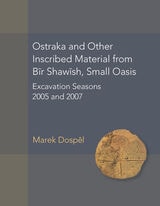
Ostraka and Other Inscribed Material from Bir Shawish, Small Oasis
Excavation Seasons 2005 and 2007Marek Dospel
University of Michigan Press, 2020
Informal documents and remains of material culture, when analyzed properly, offer a unique window into the daily lives and workings of ancient civilizations. Published here in their archaeological context and with any relevant artifacts, the documents and inscriptions excavated recently in Egypt’s Western Desert represent a valuable addition to our meager documentation of the Bahriya Oasis in the first centuries CE.
This is the first comprehensive treatment of an archaeological dataset from the archaeological exploration of Bīr Shawīsh. Dating to around 400 CE, these primary historical sources include documentary texts written on ostraka, informal inscriptions on various ceramic objects, plus a group of incised lids. The core of the volume consists of an annotated edition and analytical indices. This is prefaced by the historical and archaeological context and is followed by a synthesis of selected issues inherent to the published material. The book includes appendices and pictures of all published objects. Doubling the number of texts and inscriptions published to date from the Small Oasis, this new corpus furthers our understanding of the economic, administrative, and social history of Late Antique Egypt.
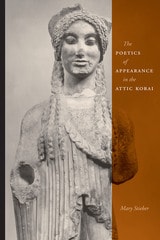
The Poetics of Appearance in the Attic Korai
By Mary Stieber
University of Texas Press, 2004
Some of the loveliest works of Archaic art were the Athenian korai—sculptures of beautiful young women presenting offerings to the goddess Athena that stood on the Acropolis. Sculpted in the sixth and early fifth centuries B.C., they served as votives until Persians sacked the citadel in 480/79 B.C. Subsequently, they were buried as a group and forgotten for nearly twenty-four centuries, until archaeologists excavated them in the 1880s. Today, they are among the treasures of the Acropolis Museum.
Mary Stieber takes a fresh look at the Attic korai in this book. Challenging the longstanding view that the sculptures are generic female images, she persuasively argues that they are instead highly individualized, mimetically realistic representations of Archaic young women, perhaps even portraits of real people. Marshalling a wide array of visual and literary evidence to support her claims, she shows that while the korai lack the naturalism that characterizes later Classical art, they display a wealth and realism of detail that makes it impossible to view them as generic, idealized images. This iconoclastic interpretation of the Attic korai adds a new dimension to our understanding of Archaic art and to the distinction between realism and naturalism in the art of all periods.