Results by title
5 books match the query 'Inscriptions, Latin'

History and Silence
Purge and Rehabilitation of Memory in Late AntiquityBy Charles W. Hedrick Jr.
University of Texas Press, 2000
The ruling elite in ancient Rome sought to eradicate even the memory of their deceased opponents through a process now known as damnatio memoriae. These formal and traditional practices included removing the person's name and image from public monuments and inscriptions, making it illegal to speak of him, and forbidding funeral observances and mourning. Paradoxically, however, while these practices dishonored the person's memory, they did not destroy it. Indeed, a later turn of events could restore the offender not only to public favor but also to re-inclusion in the public record.
This book examines the process of purge and rehabilitation of memory in the person of Virius Nicomachus Flavianus(?-394). Charles Hedrick describes how Flavian was condemned for participating in the rebellion against the Christian emperor Theodosius the Great—and then restored to the public record a generation later as members of the newly Christianized senatorial class sought to reconcile their pagan past and Christian present. By selectively remembering and forgetting the actions of Flavian, Hedrick asserts, the Roman elite honored their ancestors while participating in profound social, cultural, and religious change.
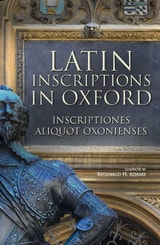
Latin Inscriptions in Oxford
Compiled with Translations by Reginald H. Adams
Bodleian Library Publishing, 2015
For Latin Inscriptions in Oxford, Reginald H. Adams, a former scholar at St. John’s College, University of Oxford, has translated a selection of Latin inscriptions. Among them, he finds a great many tributes and memorials—to Queen Anne, Cardinal Wolsey, and T. E. Lawrence, but also to Irene Frude, a “most kindly landlady” on Little Clarendon who “provided each day for almost thirty-five years enormous breakfasts.” Some of the inscriptions offer concise commentary—“Without experiment, it is not possible to know anything adequately.” While others are instructive like the Rhodes House’s warning, “Let no one who is smoke-bearing enter here.”
Evocative mementoes of the past, the inscriptions collected by Adams bring insight to the vivid history of Oxford, the city and the university.
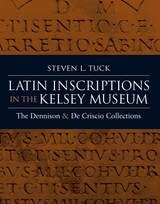
Latin Inscriptions in the Kelsey Museum
The Dennison and De Criscio CollectionsSteven L. Tuck
University of Michigan Press, 2006
The 400 entries in this volume include all of the Latin inscriptions on stone or metal in the Kelsey Museum of Archaeology at the University of Michigan; they represent the largest, and arguably the most important, collection of Latin inscriptions in the Western Hemisphere. The collection is notable not just for its size but for the fact that almost all the inscriptions were acquired by purchase for their scholarly and educational value to the members of the university community. Because of this, the collection is also an important testimony to a seminal phase in the development of the study of Classics at the University of Michigan. For the first time ever, this project makes the Latin inscriptions of the Kelsey available in one volume and has provided an opportunity to reexamine some texts that have not been edited in over a century. The commentaries for this edition have benefited from a wealth of recent scholarship resulting in some amended readings and reidentification of texts.
Steven L. Tuck is Assistant Professor of Classics at Miami University of Ohio.
The Kelsey Museum Studies series, edited by University of Michigan professors Elaine Gazda, Margaret Cool Root, and John Pedley, is designed to publish unusual material in the Museum's collections, together with reports of current and past archaeological expeditions sponsored by the University of Michigan.

Organizing for Foreign Policy Crises
Presidents, Advisers, and the Management of Decision MakingPatrick J. Haney
University of Michigan Press, 2002
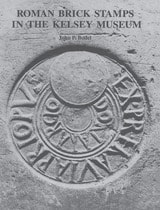
Roman Brick Stamps in the Kelsey Museum
John P. Bodel
University of Michigan Press, 1983